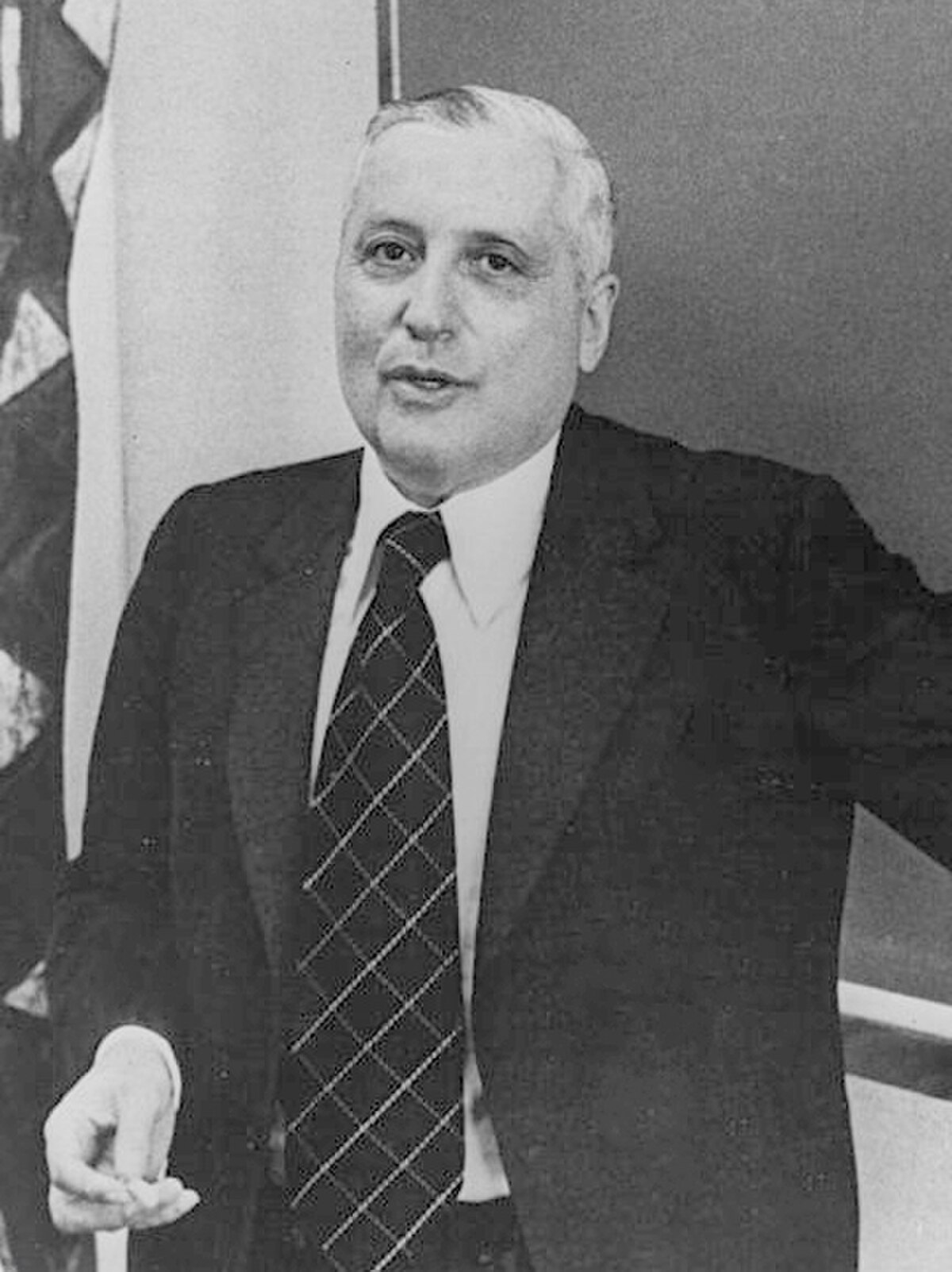
Ilya Prigogine
Dates: 1917–2003 Domain: Chemistry, Thermodynamics, Philosophy of Science
Biography
Ilya Prigogine was born in Moscow in 1917, weeks before the Bolshevik Revolution. His family emigrated shortly after, eventually settling in Belgium, where Prigogine would spend most of his career at the Université Libre de Bruxelles. He received the Nobel Prize in Chemistry in 1977 for his contributions to the thermodynamics of non-equilibrium systems — specifically for the theory of dissipative structures. He died in Brussels in 2003.
His scientific contribution is both technically specific and philosophically sweeping. Classical thermodynamics — the thermodynamics of Boltzmann and Clausius — described a universe in which entropy (disorder, randomness) inevitably increases: the universe runs down, complex structures break down into simpler ones, and time is the arrow pointing from order to disorder. This is the thermodynamic basis for the modern world's sense of inevitable decline: the universe is dying, and the appearance of complexity and life is a temporary eddy against the general flow toward maximum disorder.
Prigogine's work on far-from-equilibrium systems showed that this picture was incomplete. Under certain conditions — when a system is kept far from thermodynamic equilibrium by a constant input and throughput of energy — spontaneous self-organization can occur. Complex, ordered structures (dissipative structures) can arise and maintain themselves precisely through the dissipation of energy: they are ordered patterns that exist only because they are constantly processing energy. Living organisms are the most obvious examples: they maintain their highly ordered biological structures precisely by continuously consuming energy (eating, metabolizing, breathing). But the same phenomenon occurs in purely chemical and physical systems: the Bénard cells (regular convection patterns in a heated fluid), the Belousov-Zhabotinsky reaction (oscillating chemical waves), and many other systems exhibit spontaneous order arising from disorder under far-from-equilibrium conditions.
The philosophical implications, which Prigogine developed extensively in his popular writings (particularly Order Out of Chaos, written with the philosopher Isabelle Stengers), are significant. The universe is not simply a machine running down toward heat death; it is a system capable of spontaneous creative evolution toward more complex forms of order. Time's arrow is not merely the direction of entropy increase but also, and under certain conditions, the direction of increasing complexity and organization. This rehabilitates the concept of genuine novelty in nature — something that is genuinely new, not merely a rearrangement of pre-existing parts — and it suggests that the emergence of life, consciousness, and cultural complexity is not an inexplicable anomaly in a universe otherwise governed by decay but a natural possibility of certain material configurations.
The connection to the alchemical and initiatory traditions is structural rather than causal. The alchemical formula solve et coagula (dissolve and congeal) describes exactly the process Prigogine discovered at the chemical level: the dissolution of an existing form as the necessary condition for the emergence of a more complex form. The initiatory death-and-rebirth pattern is, at the level of consciousness, the same structural process: the dissolution of the existing organization of the self as the necessary condition for the emergence of a more integrated, more complex form of consciousness. Prigogine's science does not prove that initiatory traditions are tracking a real process; but it provides a scientific vocabulary in which the claim that genuine transformation requires genuine dissolution — not just psychological metaphorically but as a structural necessity — is a feature of the natural order at every level.
From Being to Becoming (1980) is Prigogine's most philosophically ambitious scientific work: an argument that the classical physics paradigm of Being (time-reversible equations, deterministic laws, no genuine novelty) must be replaced by a paradigm of Becoming (time's irreversibility, genuine novelty, probabilistic rather than deterministic laws). This is a significant philosophical claim, and its connection to the process-philosophical traditions (Whitehead, Bergson) that the project also engages is not accidental.
Key Works (in library)
| Work | Year | Relevance |
|---|---|---|
| Order Out of Chaos (with Isabelle Stengers) | 1984 | The accessible synthesis: dissipative structures and the new dialogue between science and nature |
| From Being to Becoming | 1980 | The philosophical argument for time's irreversibility and genuine novelty in nature |
| The End of Certainty | 1997 | The late synthesis; determinism, chaos, and the probabilistic nature of complex systems |
Role in the Project
Prigogine is the project's scientific alibi — not in the sense of providing false cover for mystical claims, but in the precise sense of providing a natural-scientific framework within which the initiatory tradition's claims about genuine transformation through dissolution are not anomalous but consistent with the known behavior of complex systems at every level of organization. The project does not argue that the Mysteries are validated by Prigogine's science; it argues that Prigogine's science and the Mysteries' practice are both tracking the same structural feature of reality — the possibility of genuine novelty through genuine dissolution — each at its own level of analysis and with its own instruments.
Key Ideas
- Dissipative Structures: Complex, self-organizing patterns that arise and maintain themselves far from thermodynamic equilibrium through the continuous processing (dissipation) of energy; the scientific model for emergence and genuine novelty.
- Far-from-Equilibrium: The condition in which spontaneous order can arise; not the stable, comfortable condition of equilibrium but the dynamic, stressed condition that requires constant energy input.
- Time's Arrow: The irreversibility of time in complex systems — genuine novelty cannot be undone; the direction of evolution is not merely toward entropy but, under certain conditions, toward increasing complexity.
- Order Out of Chaos: The paradox that maximum openness to disorder, not the rigid maintenance of existing order, is the condition for the emergence of higher-order organization.
- Solve et Coagula as Natural Process: The alchemical formula describes, at the level of consciousness and culture, the same structural process that Prigogine described at the chemical and physical level.
Connections
- Influenced by: Classical thermodynamics (Boltzmann, Clausius, Carnot), Henri Bergson (philosophical influence acknowledged), Ludwig von Bertalanffy (systems theory)
- Influenced: Complexity theory (Stuart Kauffman, Santa Fe Institute), philosophy of science (Stengers), process philosophy connections, the popular science of complexity and emergence
- In tension with: Classical deterministic physics (Newtonian mechanics and its philosophical implications), the second law of thermodynamics as usually interpreted
Agent Research Notes
[AGENT: perplexity | DATE: 2026-03-22] Prigogine's dates are confirmed 1917–2003. The Nobel Prize in Chemistry was awarded in 1977 "for his contributions to the thermodynamics of irreversible processes, particularly the theory of dissipative structures." Order Out of Chaos was originally published in French as La Nouvelle Alliance (1979); the English translation by Ian and John Stengers appeared from Heinemann (1984). Prigogine explicitly acknowledged a debt to Bergson's philosophy of time in several interviews. The Solvay International Institutes in Brussels, which Prigogine directed, remain an active center for complexity research.