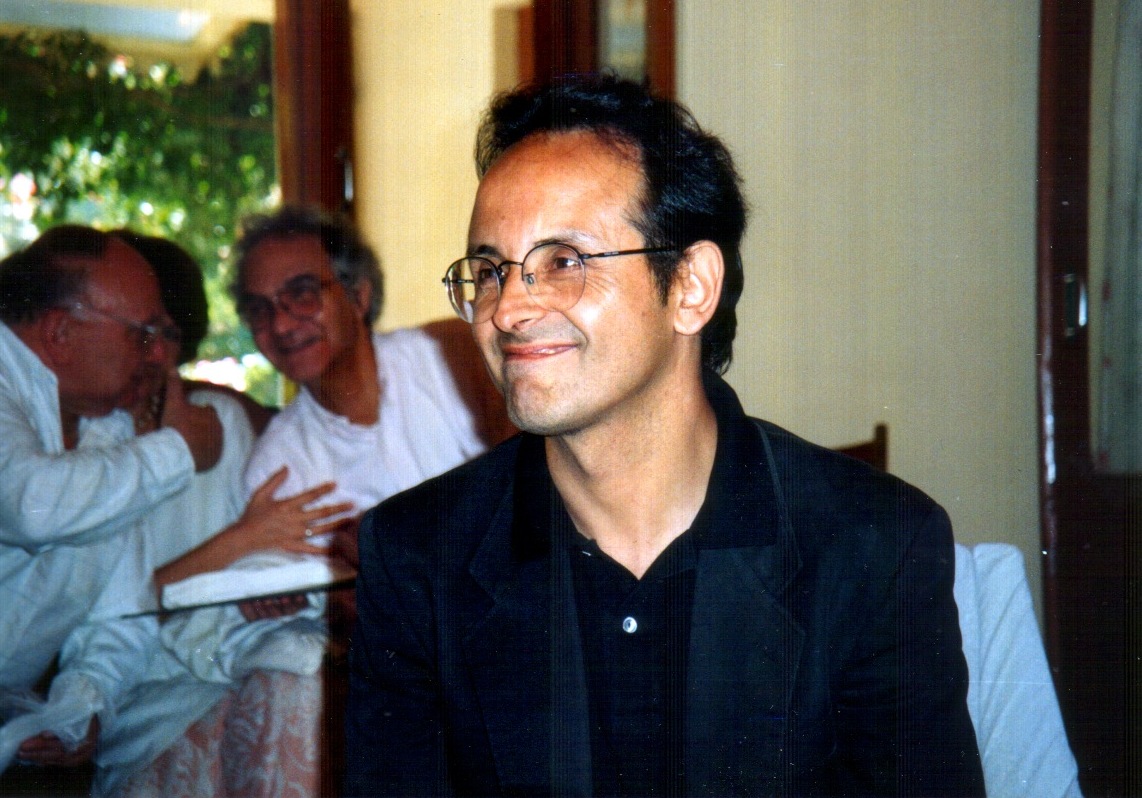
Francisco Varela
Dates: 1946–2001 Domain: Neuroscience, Cognitive Science, Biology
Biography
Francisco Varela was born in Santiago, Chile, in 1946, studied biology at the University of Chile under Humberto Maturana, earned his PhD at Harvard, and spent the most productive years of his career in Paris at the Centre National de la Recherche Scientifique (CNRS). He died of hepatitis C in 2001, at fifty-four, having produced one of the most consequential reconceptions of what cognition is in the twentieth century.
With Maturana, Varela developed the concept of autopoiesis ("self-making"): the claim that living systems are self-producing networks whose organization is maintained through circular processes of component production. An autopoietic system produces the components that produce the system. This circularity, which Maturana and Varela distinguished from the input-output model of engineering, is what makes a living system living. A machine receives inputs and produces outputs. An organism produces itself.
The move from autopoiesis to enactivism came in The Embodied Mind (1991), written with Evan Thompson and Eleanor Rosch. The book argued that mainstream cognitive science had inherited a fundamental error from Descartes: the assumption that cognition is the manipulation of mental representations of a pre-given external world. Varela, Thompson, and Rosch proposed an alternative: cognition is the enaction of a world through the structural coupling of organism and environment. The organism does not represent the world. It brings forth a world through its own sensorimotor activity. Perception is not passive reception of signals. It is an active process of sense-making that depends on the body the organism has, the history of interactions it has undergone, and the environment it is coupled with.
Varela was a serious practitioner of Tibetan Buddhism. He co-founded the Mind and Life Institute with the Dalai Lama and the businessman Adam Engle in 1987, creating the institutional framework for the ongoing dialogue between contemplative traditions and neuroscience. His Buddhism was not decorative. It informed his science directly: the phenomenological method he called "neurophenomenology" (first-person reports of experience integrated with third-person neuroscientific data) drew on both Husserlian phenomenology and Buddhist mindfulness practice as sources of rigorous first-person data about consciousness.
Key Ideas
- Autopoiesis: Living systems are self-producing organizations. The boundary between the system and its environment is not imposed from outside but generated by the system itself. This makes life a category irreducible to mechanism.
- Enactivism: Cognition is not the representation of a pre-given world but the enaction of a world through embodied sensorimotor engagement. Mind is not in the head. It is the ongoing process of structural coupling between organism and environment.
- Structural coupling: The history of reciprocal perturbations between an organism and its environment that shapes both. The organism and its world co-evolve through mutual specification. This is the biological vocabulary for participation (CON-0004).
- Neurophenomenology: A research program integrating first-person phenomenological reports with third-person neuroscientific measurements. The claim that consciousness research requires both: leaving out the first-person data is leaving out the phenomenon you're studying.
Role in the Project
Varela's enactivism is the scientific ground for somatic knowledge (CON-0084) and, more broadly, for the claim that initiatory transformation is irreducibly embodied. If cognition is representation (the mainstream model), then a sufficiently powerful computer can replicate it; information processing is substrate-independent. If cognition is enaction (Varela's model), then it is constitutively embodied, tied to the specific body, specific history, specific sensorimotor capacities of the organism doing the knowing. A machine that processes all the texts about the Eleusinian Mysteries does not thereby undergo what the initiates underwent, because undergoing requires a body.
The connection to Buddhism is equally important. Varela demonstrated that the Buddhist claim about the constructed nature of the self, and the contemplative practices that reveal this construction, are not pre-scientific intuitions but rigorous observations about the nature of cognition. The Mind and Life Institute he co-founded represents the most sustained institutional attempt to integrate contemplative and scientific approaches to consciousness, and it is the direct ancestor of the contemporary mindfulness-and-neuroscience research program.
Primary Sources
- Francisco Varela, Evan Thompson, and Eleanor Rosch, The Embodied Mind (1991): The foundational statement of enactivism.
- Humberto Maturana and Francisco Varela, The Tree of Knowledge (1987): Autopoiesis made accessible.
- Francisco Varela, Ethical Know-How (1999): Enactivism applied to ethics: the claim that moral action arises from embodied readiness-to-hand, not from deliberation about rules.