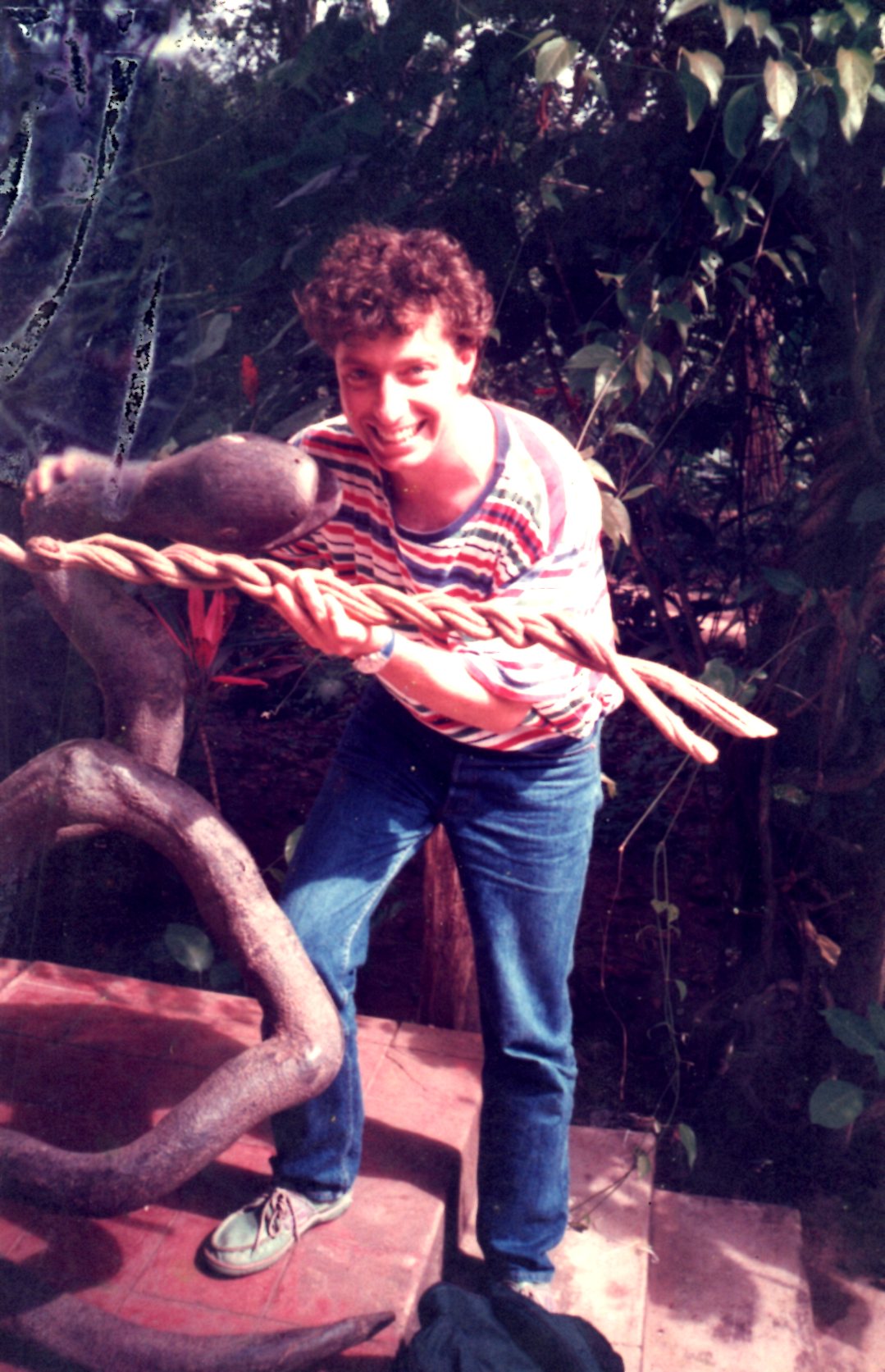
Jeremy Narby
Dates: b. 1959 Domain: Anthropology, Ethnobotany, Consciousness Studies
Biography
Jeremy Narby was born in Montreal in 1959, grew up in Canada and Switzerland, and trained in anthropology at Stanford. His doctoral fieldwork among the Asháninka people of the Peruvian Amazon in the 1980s produced the observation that would define his subsequent career: the shamans he worked with claimed that their botanical knowledge, an extraordinarily precise pharmacopoeia involving thousands of plant species, came not from trial-and-error experimentation but from the plants themselves, communicated during ayahuasca visions.
The Cosmic Serpent: DNA and the Origins of Knowledge (1998) follows this claim into unexpected territory. Narby noticed that the Asháninka described the source of their knowledge as intertwined serpents, a motif he then traced across dozens of Amazonian traditions — and then across global mythology, from the caduceus of Hermes to the Kundalini serpent of yogic tradition to the Rainbow Serpent of Aboriginal Australian cosmology. He then observed that the double-helix structure of DNA, discovered by Watson and Crick in 1953, is visually identical to what the shamans were describing. The hypothesis: that ayahuasca, through a mechanism Narby does not claim to fully understand, gives the human nervous system access to information encoded at the molecular level. That the shamans are, in some sense, reading the biological code.
The hypothesis is speculative. Narby knows this and says so. Its value is not as a confirmed scientific finding but as the most precise contemporary statement of the claim that indigenous knowledge systems may operate through a mode of cognition that Western science does not yet have a vocabulary for. The dismissal of this possibility is itself a product of the epistemological narrowing the consciousness-evolution theorists diagnose.
Intelligence in Nature (2005) extends the investigation to non-human cognition: slime molds that solve mazes, bees that dance directions, trees that communicate through fungal networks. Narby's question: if intelligence is defined by behavior (solving problems, communicating information, adapting to environments), then it is not confined to the human brain.
Role in the Project
Narby belongs to the Living Traditions track. His work connects the Amazonian ayahuasca complex (the most thoroughly documented surviving shamanic system organized around plant-based consciousness alteration) to the broader argument about modes of knowing that initiation cultivates. The serpent-imagery convergence across traditions is one of the strongest cross-cultural observations in the KB. Whether Narby's specific DNA hypothesis holds or not, serpent imagery clusters around visionary and initiatory experience across unconnected traditions. That convergence requires an explanation.
Primary Sources
- Jeremy Narby, The Cosmic Serpent (1998): The serpent hypothesis.
- Jeremy Narby, Intelligence in Nature (2005): Non-human cognition and the limits of anthropocentrism.