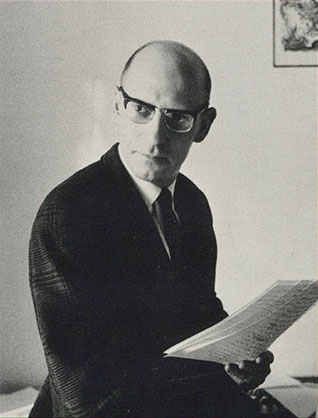
Michel Foucault
Dates: 1926–1984 Domain: Philosophy, History of Ideas
Biography
Michel Foucault held the Chair of the History of Systems of Thought at the Collège de France from 1970 until his death in 1984. His career moved through several phases: the archaeology of knowledge (how discourses constitute what counts as truth), the genealogy of power (how institutions discipline bodies and regulate populations), and the late turn to ethics and self-fashioning (how individuals constitute themselves as subjects through practices of the self).
The late lectures — The Hermeneutics of the Subject (1981–82) and The Courage of Truth (1983–84) — are the most relevant to the project. Here Foucault returned to the ancient Greek and Roman philosophical schools, reading Stoic, Epicurean, and Neoplatonic practices as "technologies of the self": systematic exercises through which individuals transformed their own relationship to truth, pleasure, and power. His engagement with this material was directly stimulated by Pierre Hadot's work on philosophy as a way of life (FIG-0014).
Hadot's public response to Foucault's reading was respectful but pointed: Foucault had rediscovered the ancient spiritual exercises but had misunderstood their orientation. The ancients, Hadot argued, did not practice the care of the self in order to construct a beautiful self. They practiced it to transcend the self — to achieve identification with the universal logos (in Stoicism) or union with the One (in Neoplatonism). Foucault's reading, Hadot charged, was an aestheticization that stripped the exercises of their cosmic and transcendent dimension.
Role in the Project
Foucault represents the philosophical position the Ape of God series names "katabasis without return" — the descent into dissolution that does not produce reintegration. His genealogical method disassembles institutions, discourses, and subjects with extraordinary precision. What it does not do is reassemble them. The care of the self as Foucault reads it produces a self that is aware of its own construction but remains within the horizon of construction. There is no anodos, no return transformed.
The Foucault-Hadot debate is one of the project's most productive tensions: both are right about what the ancient practices were, and they disagree about what the practices were for.
Primary Sources
- Michel Foucault, The Hermeneutics of the Subject (lectures 1981–82): The ancient care of the self.
- Michel Foucault, The Courage of Truth (lectures 1983–84): Parrhesia and the relationship between truth and life.
- Pierre Hadot, "Reflections on the Idea of the 'Cultivation of the Self'" (in Philosophy as a Way of Life): Hadot's response to Foucault.