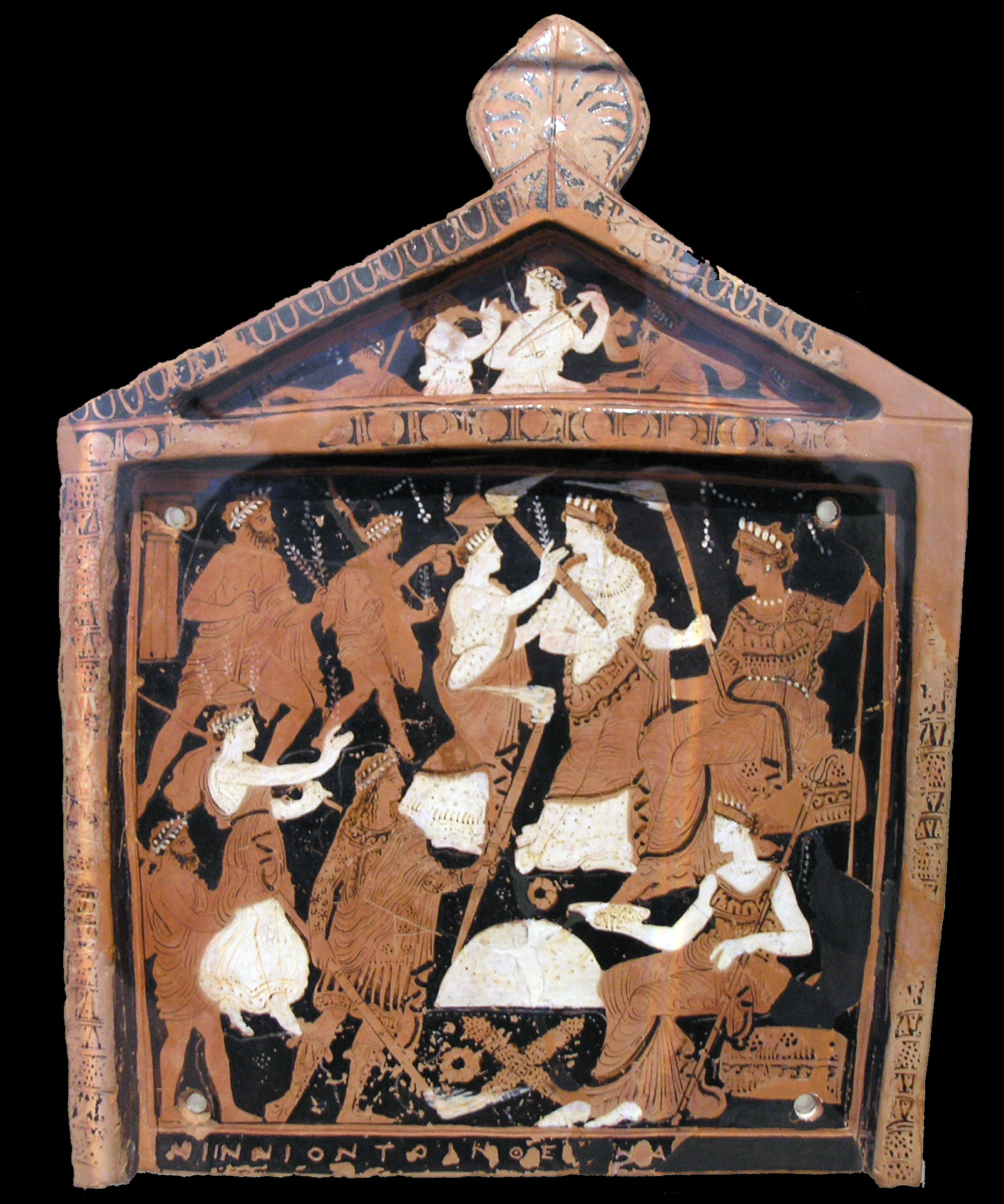
Greater and Lesser Mysteries
The Two-Stage Structure
The Eleusinian initiation was not a single event. It was a process unfolding over at least eighteen months, structured in two distinct ceremonial phases held at different locations and different seasons.
The Lesser Mysteries (ta mikra mysteria) were held in early spring, during the Athenian month of Anthesterion (roughly February-March), at a sanctuary in Agrae, a suburb on the south bank of the Ilissos River in Athens, not at Eleusis itself. According to myth, the Lesser Mysteries were invented to purify Heracles, who needed to be cleansed of the miasma (ritual pollution) from his killings before he could be admitted to the Greater rites.
The Greater Mysteries (ta megala mysteria) were held in autumn, during the month of Boedromion (roughly September-October), at the sanctuary of Eleusis. Only those who had completed the Lesser Mysteries were eligible.
The minimum interval between Lesser and Greater was approximately six months. Many initiates waited longer. The two stages were not simply a warm-up and a main event; they represented qualitatively different operations on the candidate.
The Lesser Mysteries: Purification and Preparation
The rites at Agrae are less well documented than the Greater Mysteries, partly because they were considered preparatory rather than culminating. What the sources indicate:
Purification: The candidates bathed in the Ilissos River. Water purification is one of the oldest ritual technologies in the Mediterranean world, a physical washing that carried ontological significance. The candidate entered the water in one state and emerged in another.
Instruction: The term myesis ("closing" or "initiation") is associated with this stage. The candidates were taught the mythological framework of the rites (the story of Demeter and Persephone) and the basic theological premises of the cult. This was discursive instruction: mathein, learning through teaching.
Sacrifice: Animal sacrifice, likely a pig (the animal sacred to Demeter), was performed as part of the purificatory rite.
The Lesser Mysteries established the candidate as a mystes, an initiate of the preliminary grade, someone who had been "closed" (sealed into the community of those preparing for deeper experience) and purified for what was to come.
The Greater Mysteries: Transformation
The Greater Mysteries were the culmination: a nine-day festival (CON-0094) involving public procession, fasting, the consumption of the kykeon (CON-0095), and the climactic night inside the Telesterion (CON-0092) where the dromena (things enacted), deiknumena (things shown), and legomena (things spoken) were performed.
The initiate who completed the Greater Mysteries was called telesthe, "one who has been completed" or "one who has been perfected" (from teleo, to complete, to bring to an end, to initiate). The verb carries the double meaning of finishing and of being brought to full development. Initiation is completion, not addition.
Epopteia: The Third Grade
Within the Greater Mysteries, a further distinction existed. First-time initiates at the Greater Mysteries underwent myesis (the primary initiation). Those who returned a second year (at minimum one full year after their first Greater Mysteries) could undergo epopteia (CON-0003), the supreme visionary grade. The epoptes ("one who has beheld") saw what the mystes had not yet seen.
The scholarly literature has long debated the exact relationship between these grades. The traditional account (Meursius, 1619) identified the Lesser Mysteries with myesis and the Greater with epopteia, but this is now considered too neat. Kevin Clinton and others have shown that the actual terminology was less systematic: myesis could refer to any stage of initiatory "closing," and the boundary between the main initiation and the epopteia was a boundary within the Greater Mysteries, not between the Lesser and Greater.
What is clear: the structure was graduated. Not everyone who walked the Sacred Way reached the highest grade. The progression (purification, instruction, experience, vision) followed a logic the ancients considered non-negotiable. You could not see until you had been prepared to see.
Why Two Stages?
The graduated structure implies a specific theory of consciousness: that the human being must be prepared, bodily and psychologically, to receive what the rites confer. The Lesser Mysteries worked on the candidate's condition: removing ritual impurity, establishing mythological context, integrating the candidate into the community of initiates. The Greater Mysteries then delivered the experiential content that the prepared candidate could receive.
Burkert's Institutional Analysis
Burkert's Ancient Mystery Cults provides the most rigorous modern analysis of the two-stage Eleusinian structure. The Lesser Mysteries at Agrae in the spring (Myesis) served as preliminary purification and instruction; the Greater Mysteries at Eleusis in the autumn (Telete) contained the full initiatory sequence culminating in the night in the Telesterion. Burkert emphasizes that the distinction between Lesser and Greater was not merely sequential but qualitative: the Lesser Mysteries prepared the candidate's body and social status (fasting, bathing at Phaleron, sacrifice of the piglet), while the Greater Mysteries addressed the soul's relationship to death and the divine. Burkert resists speculative reconstruction of the rites' specific content, insisting on what the evidence actually supports: that the Greater Mysteries involved dromena (things enacted), deiknumena (things shown), and legomena (things said), that the experience occurred at night in the darkened Telesterion, and that the unanimous ancient testimony attributes to it a transformation of the initiate's relationship to death.
Primary Sources
- Kevin Clinton, "Stages of Initiation in the Eleusinian and Samothracian Mysteries" (2003): The most careful recent scholarly analysis of the grade structure.
- Walter Burkert, Ancient Mystery Cults: Treats the grades comparatively across multiple mystery cults.
- Mylonas, Eleusis and the Eleusinian Mysteries: Full archaeological and historical context for both ceremonial phases.