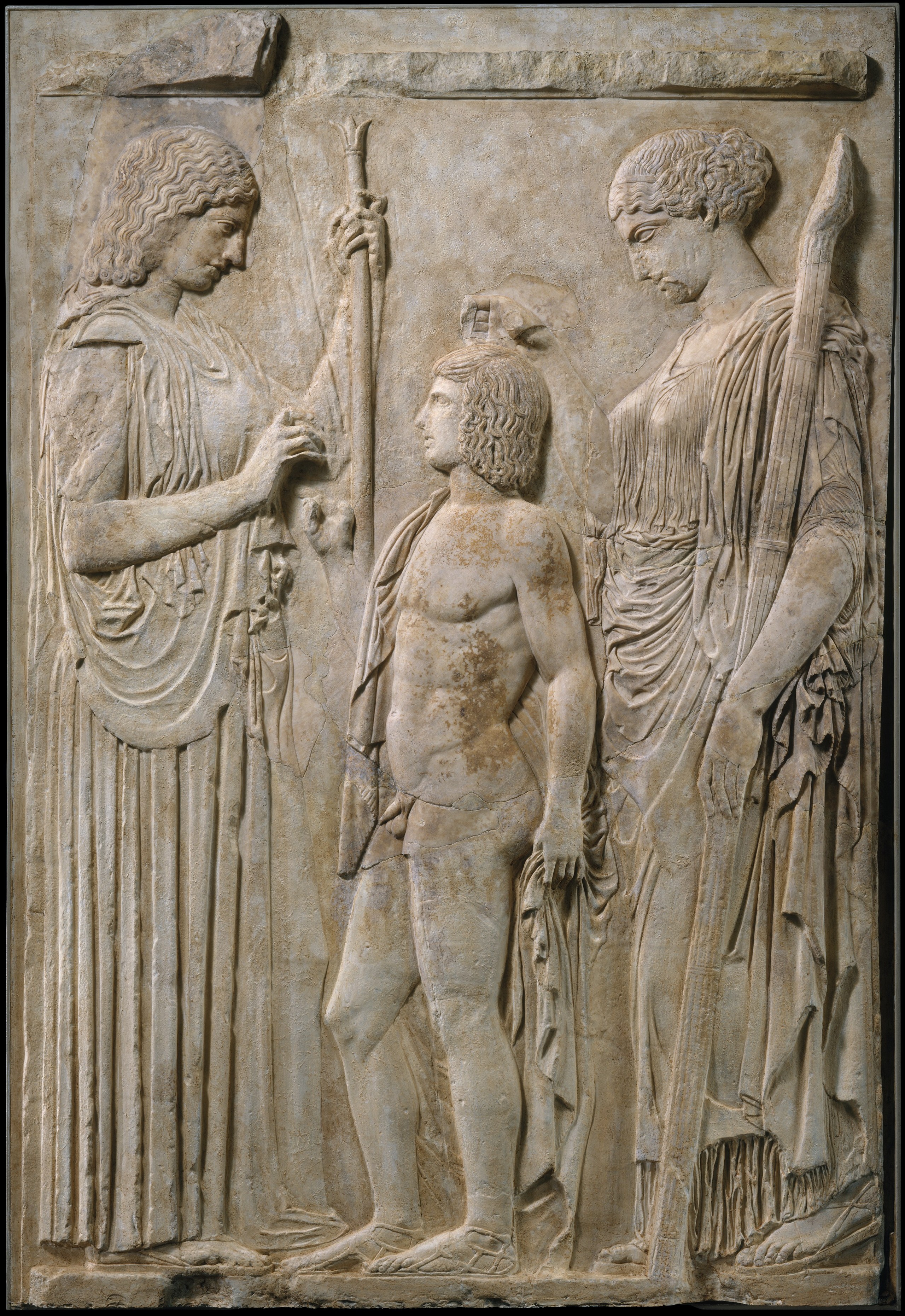
Eleusinian Mysteries
The Institution
The Eleusinian Mysteries were annual rites of initiation held at the sanctuary of Demeter and Kore (Persephone) at Eleusis, a small city fourteen miles northwest of Athens on the Saronic Gulf. The sanctuary occupied a rocky hillside overlooking the Rarian plain, where, according to myth, Demeter taught humanity to cultivate grain.
The oldest archaeological evidence for cult activity at the site dates to the Mycenaean period (c. 1500 BCE). The institution as a formal civic-religious event with documented participation is securely attested from the seventh century BCE. The rites were held annually without interruption until 396 CE, when Alaric I and his Visigoths destroyed the sanctuary. That span, roughly two thousand years of continuous operation, makes the Eleusinian Mysteries the longest-running religious institution in Western history.
Who Could Attend
Participation was open to anyone who met three conditions: they spoke Greek, they had not committed murder (the stain of miasma, ritual pollution, disqualified), and they had undergone the preliminary purification of the Lesser Mysteries (CON-0091). Within these bounds, the Mysteries were inclusive by ancient standards. Citizens and foreigners, men and women, free persons and slaves could all be initiated. The emperor Hadrian was initiated. So was the philosopher Plutarch. So were thousands of ordinary Athenians whose names are lost.
The one category of exclusion that mattered most was linguistic: the rites required Greek because the ritual actions, the spoken formulas (legomena), and the mythological framework all operated in that language. The requirement was functional, not ethnic. A Phoenician merchant who spoke Greek could be initiated. A Greek who had committed murder could not.
The Sanctuary
The sanctuary at Eleusis was not a single temple but a complex that grew over centuries. Its core elements:
The Sacred Way (Iera Hodos): The processional road from Athens to Eleusis, approximately 19 kilometers (12 miles), running northwest from the Sacred Gate in the Kerameikos (the Athenian cemetery). The road passed through the Rheitoi salt lakes, crossed bridges where ritual insults (gephyrismoi) were exchanged, and arrived at the sanctuary precinct by nightfall. See CON-0093.
The Telesterion: The Hall of Initiation, the largest and most unusual building in the complex. An approximately 51-meter-square hypostyle hall with tiered rock-cut seating on all four interior walls, surrounding a central space. Not a theater: no stage, no single sightline. Designed for thousands of initiates to witness a central revelation from every direction simultaneously. See CON-0092.
The Anaktoron: A small stone structure at the center of the Telesterion, accessible only to the Hierophant. The sacred objects (hiera) were kept here and revealed during the climactic moment of the rite.
The Plutonion: A cave or grotto at the base of the acropolis rock, associated with the entrance to the underworld. Persephone's descent was mythologically located here.
The Kallichoron Well: The well where Demeter sat in mourning, according to the Homeric Hymn. The initiates danced around it during the festival.
The Propylaea: The monumental gateway, rebuilt multiple times, most impressively under the Roman emperors Marcus Aurelius and later Hadrian.
Administration
The Mysteries were administered by two hereditary priestly families, both Eleusinian:
-
The Eumolpidae: Held the office of Hierophant (the chief priest, "one who reveals sacred things") and controlled the esoteric content of the rites. The Hierophant's personal name was suppressed during his tenure; he was the office, not the individual. He served for life.
-
The Kerykes: Held the office of Dadouchos (the torchbearer) and other supporting priestly roles.
The Athenian state oversaw the public and civic dimensions of the festival (the proclamation, the procession, the calendar) but did not control the content of the rites themselves. This dual structure (state administration, priestly content) persisted across political regimes: Athenian democracy, Macedonian rule, Roman governance. The rites were too important to abolish, and too secret to fully control.
Political and Cultural Significance
The Mysteries were not marginal. They were central to Athenian civic identity and to the broader Greek cultural world. The sacred truce (spondai) declared before the festival, 55 days of ceasefire across the Greek world, is evidence of their pan-Hellenic prestige. Violating the Mysteries was a capital offense; the trials of Alcibiades and Diagoras of Melos demonstrate the gravity of profanation charges.
Cicero, writing in the first century BCE, declared that Athens had given humanity nothing greater than the Mysteries. Pindar: "Blessed is he who has seen these things before he goes beneath the earth; for he understands the end of mortal life, and the beginning given of God." Sophocles: "Thrice blessed are those mortals who see these rites before departing for Hades; for them alone is there life there; for the rest, all there is evil."
These are not testimonials from the credulous. They are assessments by some of the most rigorous minds of the ancient world, none of whom broke the oath of silence to explain what, specifically, warranted such claims.
Destruction
The emperor Theodosius I banned pagan rites in 392 CE. The sanctuary at Eleusis was destroyed by Alaric's Visigoths in 396 CE. The site was abandoned and eventually buried. Archaeological excavation began in the nineteenth century under the Greek Archaeological Society and continues under the auspices of the Archaeological Society at Athens.
What survives: the architectural foundations, the rock-cut seating of the Telesterion, votive offerings, inscriptions, and the external testimony of ancient writers. What does not survive: the content of the rites themselves. The silence held.
Primary Sources
- Walter Burkert, Ancient Mystery Cults (1987): The authoritative scholarly treatment. Treats the Mysteries as one of several ancient mystery cults, emphasizing social and psychological functions.
- George E. Mylonas, Eleusis and the Eleusinian Mysteries (1961): The most complete archaeological and historical study of the site and the institution.
- Kevin Clinton, The Sacred Officials of the Eleusinian Mysteries (1974): Detailed study of the priestly families and administrative structure.
- Homeric Hymn to Demeter: The mythological charter of the rites. See CON-0096.
Burkert's Institutional Analysis (LIB-0343)
Burkert's Ancient Mystery Cults provides the most methodologically disciplined modern treatment of the Eleusinian Mysteries, insisting on the distinction between what the evidence supports and what scholars have speculatively reconstructed. His key contributions: the Mysteries were not secret doctrines but secret experiences: what was protected by the vow of echemythia was not a body of teaching but the experiential content of the ritual night in the Telesterion. The initiation was open to all Greek-speakers who had not committed murder (and later, to Romans as well), making it the most inclusive of the ancient mystery cults. The Mysteries persisted for nearly two millennia (c. 1500 BCE to 392 CE), a longevity that itself constitutes evidence: whatever the rites accomplished, it was compelling enough to sustain participation across radical changes in Greek political, intellectual, and religious life.
Eliade's Comparative Placement (LIB-0293)
Eliade's Rites and Symbols situates the Eleusinian Mysteries within his comparative morphology of initiation as a "mystery religion," a voluntary, individual initiation (unlike tribal puberty rites, which are compulsory and collective) that promises the initiate a transformed relationship to death. His contribution is to reveal the Eleusinian structure as one instance of a universal pattern while acknowledging its distinctive features: the agricultural myth of Demeter and Persephone as the narrative frame, the mass character of the initiation (thousands participated simultaneously), and the graduated structure (Lesser Mysteries, Greater Mysteries, epopteia) that distinguished levels of initiatory depth. Eliade's limitation, from the project's perspective, is his tendency to abstract the Eleusinian experience into a universal morphology that obscures its historical and ritual specificity.
Agent Research Notes
{placeholder}