Homeric Hymn to Demeter
The Story
Persephone, daughter of Demeter and Zeus, was gathering flowers in a meadow (the narcissus, which Gaia caused to bloom as a lure) when the earth opened and Hades, lord of the underworld, seized her and carried her below. Not metaphorically. The earth opened. She went down.
Demeter heard her daughter's cry and searched the earth for nine days, fasting, carrying torches through the night, asking every god and mortal she met. None would tell her what had happened. On the tenth day, Helios (the sun, who sees everything) told her the truth: Zeus had given Persephone to Hades as a bride. Demeter's grief became rage, and her rage became cosmic: she withdrew from Olympus, disguised herself as an old woman, and wandered the mortal world. While she grieved, the crops failed. The earth stopped producing. Humanity faced starvation.
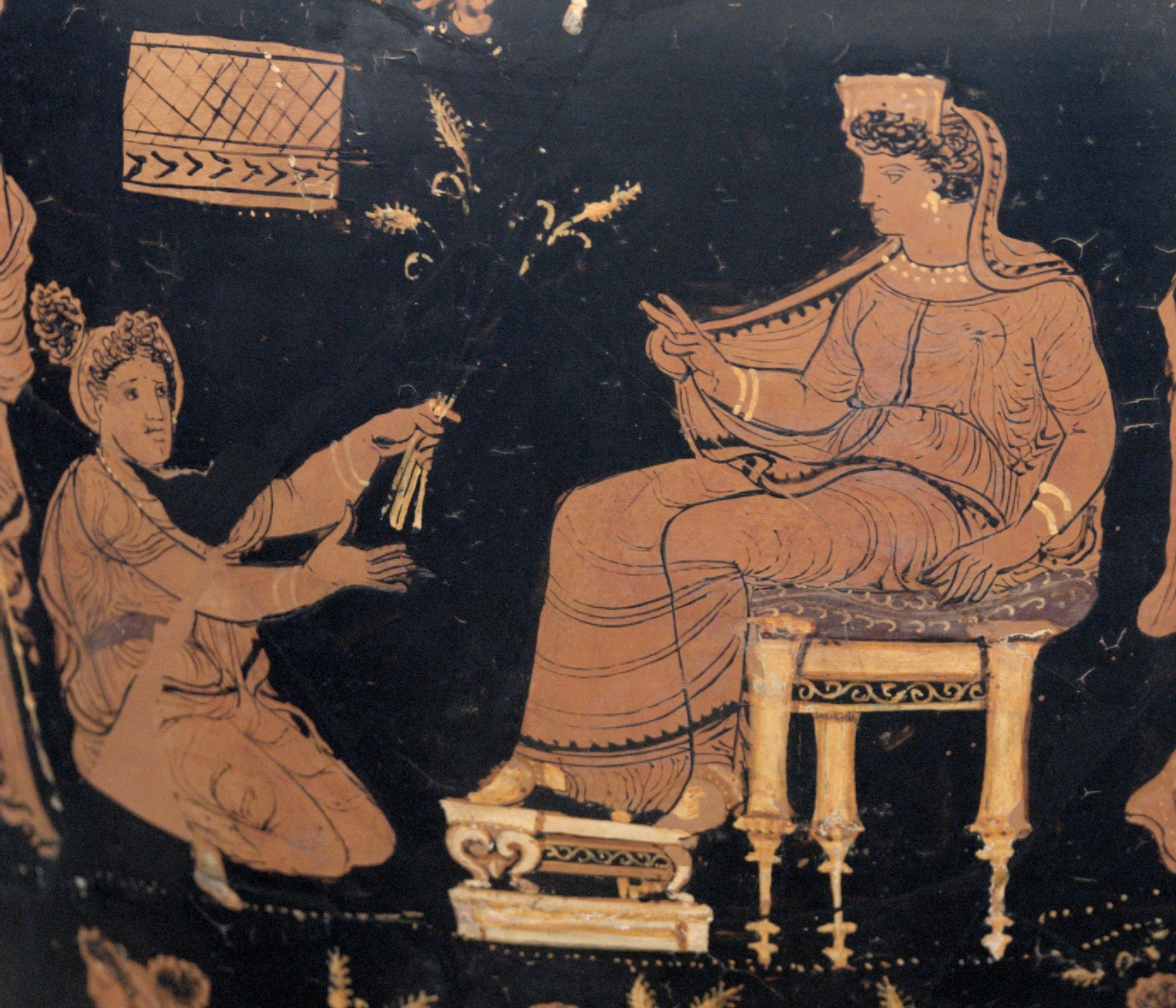
Demeter arrived at Eleusis, at the well called Kallichoron ("of the beautiful dances"), and was taken in by the family of King Celeus and Queen Metanira. She sat in mourning and refused all food and drink until an old woman named Iambe made her laugh with bawdy jests. Then Demeter accepted a drink: barley, water, and pennyroyal — the kykeon (CON-0095). At Eleusis, the goddess attempted to immortalize the infant Demophon by placing him in fire each night. Metanira found her child in the flames and screamed. The process broke. Demeter revealed her true identity and commanded the Eleusinians to build her a temple.
The crops died. Humanity starved. Without humans, the gods received no sacrifice. Zeus relented and sent Hermes to the underworld to bring Persephone back. Hades released her. But first he gave her pomegranate seeds to eat, binding her to the underworld for part of each year. The compromise: Persephone would spend one-third of the year below with Hades and two-thirds above with her mother. Her annual return is why crops grow. Her annual descent is why they stop.
Before departing Eleusis, Demeter taught the rites to the rulers of the city (Triptolemus, Diocles, Eumolpus, and Celeus) and showed them the performance of the Mysteries. The Hymn ends with a beatitude: "Blessed is he among men upon earth who has seen these things."
Why This Myth
The Hymn is not a freestanding literary work. It is a hieros logos: a sacred narrative that provides the mythological charter for a ritual institution. Every element of the nine-day festival (CON-0094) corresponds to an event in the Hymn:
| Hymn Event | Ritual Enactment |
|---|---|
| Persephone's abduction | The katabasis — descent into darkness |
| Demeter's nine-day search | The festival's nine-day duration |
| Demeter's fasting | The initiates' fast |
| Demeter's torchlit wandering | The torchlit procession and vigil |
| Iambe's jests | The gephyrismoi (ritual insults at the bridges) |
| Demeter drinks the kykeon | The initiates drink the kykeon |
| Demeter at the well at Eleusis | Dancing at the Kallichoron Well |
| Persephone's return | The epopteia — the revelation of light after darkness |
The initiates did not watch a dramatization of this story. They enacted it. Their fasting was Demeter's fasting. Their walking was her searching. Their descent into the dark Telesterion was Persephone's descent. The myth was not a frame around the experience. It was the experience's operating system.
The Grain
The most theologically dense image in the Hymn is also its most concrete: grain. Demeter is the goddess of grain. Persephone descends into the earth and returns, which is what a seed does. The kykeon is made of barley. The sacred object revealed by the Hierophant at the climax of the rite was, according to the hostile testimony of the Christian writer Hippolytus, an ear of grain cut in silence.
Grain goes into the earth. It appears to die. Something comes back that was not there before. The Hymn places this agricultural fact at the center of a cosmic narrative about death and return, and the Mysteries enacted that narrative in the bodies of the initiates. The theology is not allegorical. It is participatory. The initiate does not symbolize the grain. The initiate and the grain participate in the same process: descent, apparent death, return in a transformed state.
The Feminine Core
The Hymn is a story about mothers and daughters, grief and rage, loss and partial recovery. The two central divine figures are female. The human who receives the goddess is a queen (Metanira). The old woman who breaks Demeter's grief is female (Iambe). The rites at Eleusis were open to women and men equally, but the mythological framework is matrilineal. The most prestigious initiatory institution in the ancient world was grounded in a myth about feminine experience — the grief of a mother whose daughter has been taken by force, the rage of a goddess who withholds fertility until her demand is met, the joy of reunion that is always partial (Persephone returns, but not entirely — she belongs to two worlds forever after).
Primary Sources
- Helene P. Foley, ed., The Homeric Hymn to Demeter (1993): Critical edition with commentary and interpretive essays. The standard scholarly apparatus.
- N.J. Richardson, The Homeric Hymn to Demeter (1974): The authoritative philological commentary.
- Apostolos Athanassakis, trans., The Homeric Hymns (2004): Readable modern translation with notes.