Telesterion
The Building
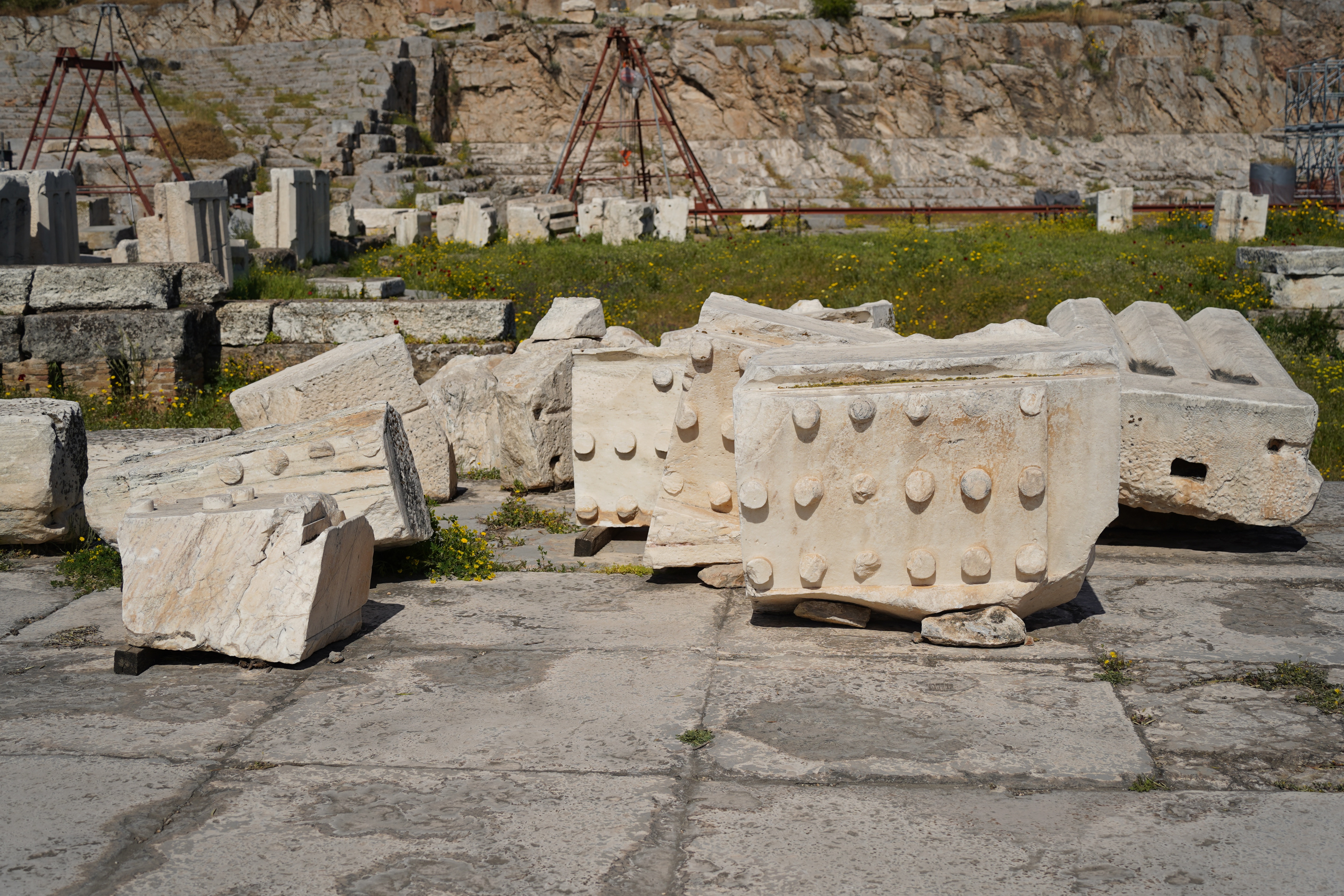
The Telesterion (from teleo, "to complete," "to initiate") was the largest and most architecturally unusual structure in the Eleusinian sanctuary. It was not a temple in the ordinary Greek sense. It did not house a cult statue for public worship. It was a hall designed for a specific operation: the initiation of thousands of people simultaneously into an experience that could not be described afterward.
The building that stood at the time of the Mysteries' greatest prestige (the Periclean reconstruction, mid-fifth century BCE, designed by the architect Iktinos, who also designed the Parthenon) measured approximately 51.5 meters per side. The interior was a vast square hall with the roof supported by 42 columns arranged in six rows of seven. Rock-cut tiered seating, eight steps deep, lined all four interior walls, interrupted only by doorways (two on each lateral side, two along the front). A later addition, the Stoa of Philon (fourth century BCE), added a columned portico along the eastern facade.
The building underwent at least five major construction phases across a millennium:
| Phase | Date | Architect/Patron | Approximate Size |
|---|---|---|---|
| Mycenaean megaron | c. 1500 BCE | Unknown | Small cult building |
| Solonian expansion | c. 600 BCE | Under Solon's reforms | Enlarged, still modest |
| Peisistratean Telesterion | c. 540 BCE | Under the Peisistratid tyrants | 25 × 27 m, columned porch |
| Periclean/Iktinian | c. 440 BCE | Iktinos (Pericles' architect) | ~51 × 51 m, 42 columns |
| Roman restoration | 170s CE | Under Marcus Aurelius | Repair and embellishment |
Architecture as Argument
The Telesterion's design eliminates the spectator's position. In a Greek theater (theatron, "a place for seeing"), the audience is arranged on one side of a curved hillside, all facing a single performance area. What the audience sees, they see from roughly the same angle. The experience is collective but observational.
The Telesterion inverts this. Seating on all four walls means the initiates surrounded whatever happened at the center. There was no single correct angle of vision. The experience was collective and immersive; you were inside it, not watching it. The closest modern analogy might be theater-in-the-round, but the Telesterion held up to 3,000 people (some estimates run higher), and what happened at the center was not a scripted performance but a revelation.
The center of the roof featured an elevated lantern or clerestory, a raised section with openings that admitted light and ventilation into the otherwise enclosed interior. This architectural feature may have served the ritual sequence directly: the contrast between darkness (the hall with the lantern closed or covered) and sudden light (the lantern opened) would have been physically dramatic in a space packed with thousands of fasting, sleep-deprived initiates who had walked fourteen miles that day.
The Anaktoron
At the center of the Telesterion stood a small stone structure called the Anaktoron (from anax, "lord": the "lord's chamber" or "holy of holies"). Only the Hierophant (CON-0010) could enter it. The sacred objects (hiera) were stored here and revealed from here during the climactic moment of the rite.
The Anaktoron's exact form is debated. Mylonas interpreted the archaeological evidence as a small rectangular chamber. Others have proposed a more open structure. What is clear: it was the focal point of the entire building, and access to it was the Hierophant's exclusive prerogative. The restriction physically embodied the graded access to esoteric knowledge.
What the Architecture Tells Us
The building cannot tell us what the initiates saw. But it can tell us what kind of seeing was intended:
- Not spectatorial: No stage, no proscenium, no single direction of vision.
- Not didactic: Not a lecture hall. The seating surrounds; it does not face.
- Not private: Three thousand people. This was not a personal mystical experience but a collective event.
- Not repeatable at will: The building was used once a year, for one night. The rest of the year it stood empty. The architecture served a temporally specific function.
Aristotle's distinction between mathein (learning through instruction) and pathein (undergoing an experience) maps directly onto the architectural evidence. A lecture hall is built for mathein. The Telesterion is built for pathein.
Burkert on the Telesterion's Function
Burkert describes the Telesterion as architecturally unique in the ancient Greek world, a hall designed not for spectacle but for participation. Unlike the theater, which separated audience from performance, the Telesterion enclosed the initiates within the ritual space. Its forest of columns made sightlines impossible from most positions, which means the "things shown" (deiknumena) could not have been a distant display but must have been experienced in proximity, possibly revealed sequentially as the initiate moved through the space or as objects were carried among the crowd. The anaktoron (inner sanctum) at the center was the Hierophant's domain, and whatever was revealed from within it was the climax of the rite. Burkert argues that the architectural evidence constrains reconstruction: the Telesterion was designed for an experience that was collective (thousands participated simultaneously) but intimate (the architecture prevented the panoramic view that theater provided), immersive rather than spectatorial. This is the architectural form of participatory consciousness: a building designed to produce participation rather than observation.
Primary Sources
- George E. Mylonas, Eleusis and the Eleusinian Mysteries: The definitive archaeological study of the site, including detailed analysis of each construction phase.
- Ferdinand Noack, Eleusis, die baugeschichtliche Entwicklung des Heiligtums (1927): The most detailed architectural history, with plans and reconstructions.
- Kevin Clinton, The Sacred Officials of the Eleusinian Mysteries: For the Anaktoron and the Hierophant's role within the building.