Arcanum 0 — Le Mat (The Fool)
Definition
The Fool bears no number. In the Tarot de Marseille (CON-0098), where every other trump carries a Roman numeral, Le Mat carries none — a fact that locates him outside the sequence he accompanies. He is not the first card or the last. He is the card that refuses to be placed.
This refusal is the Fool's philosophical content. Every system of classification generates, by its own logic, something it cannot classify. The twenty-one numbered Arcana (CON-0097) form a structured meditation on the spiritual life — will, receptivity, generation, authority, transmission, choice, mastery, justice, solitude, fate, and so on through the entire arc. The Fool is the remainder. What no structure can contain. Freedom, in its radical sense, is not one capacity among others but the condition that makes all capacities possible — and that none of them exhaust.
The tradition calls this sainte folie — holy folly. The term distinguishes the Fool's freedom from mere irrationality. He is not stupid. He is unconditioned. He walks without a map because he has internalized every map and found them insufficient. This freedom lies on the far side of knowledge. Not its absence.
Tomberg (LIB-0084) and Mebes (LIB-0053) both recognize the Fool's unique structural position but handle it differently. Tomberg places him as the penultimate Letter, just before the World. Mebes assigns him to zero — the value that precedes counting. Either way, the Fool marks a limit: the point where systematic thought encounters what it cannot systematize. Acknowledge the limit or falsify yourself.
Tomberg's Reading (Letter XXI)
Tomberg treats the Fool as Letter XXI — the penultimate meditation, placed after The Sun and before The World. The positioning is deliberate. The Fool does not introduce the series. He appears only after the reader has worked through twenty Letters of increasingly complex spiritual content — and what Tomberg's reader encounters here, after hundreds of pages of discursive meditation, is a man arriving at the edge of what his own method can accomplish. He is what remains when the system has said everything it can say.
The key move is the distinction between wisdom and holy folly. Wisdom is the culmination of the intellectual and spiritual life — the achievement of the preceding twenty Arcana. Holy folly steps beyond it. Even the most complete wisdom cannot capture the living reality it contemplates. The wise person knows many things. The holy fool knows that knowing, however deep, never closes the gap between knower and known.
Tomberg connects this to the Christian tradition of fools for Christ — figures who abandon social respectability and intellectual coherence to embody a freedom reason alone cannot produce. Not anarchic freedom. The freedom of someone who has passed through discipline and emerged on the other side. The tightrope walker from Letter I reappears in a new key: the Magician's concentration without effort becomes the Fool's freedom without recklessness.
The placement also makes a structural argument. If Tomberg had ended with the World, the twenty-two Letters would form a closed system — a complete map of the spiritual life. By placing the Fool at position twenty-one, he breaks the closure. The system acknowledges its own incompleteness. The map confesses it is not the territory.
Mebes' Reading (Arcanum 0)
Mebes assigns the Fool to zero and reads him as the principle of the Absolute — l'Absolu — that which precedes all differentiation and exceeds all classification. The numbered Arcana organize domains of esoteric knowledge into ternary and quaternary structures. The zero Arcanum names the limitless ground from which those structures emerge.
In Mebes' systematic framework (LIB-0053), this is a logical necessity. A system of classification requires something outside itself to anchor the act of classifying. The Fool, as Arcanum 0, is that external anchor: unmanifest potential that makes manifestation possible but is not itself any particular manifestation. Mebes links this to the Hebrew letter Shin and to ain sof — the limitless, the unconditioned.
Symbolic Elements
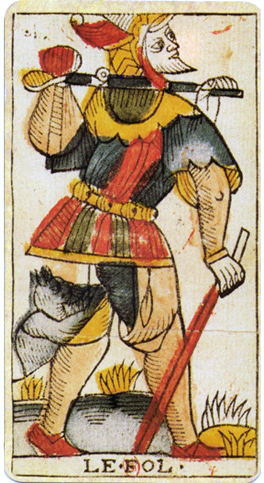
The Marseille Fool is a wanderer. He walks — not seated like the Priestess, the Empress, the Emperor, or the Hierophant, not standing at a workstation like the Magician. A bundle on a stick over one shoulder: the universal emblem of the traveler who owns only what he can carry. His clothing is ragged, torn, particolored — the opposite of the ordered vestments worn by the Pope or the Priestess. No institution. No uniform.
An animal — dog or cat, depending on the deck — tears at his leg or his clothing. Instinct pursuing the spirit, the world pulling at the one who departs, a companion marking the Fool's connection to the animal realm even as he moves beyond human convention — the interpreters disagree. The Fool walks toward a precipice, or at least toward the edge of the card. His gaze is not on the ground before him. He does not see the danger. Or he sees it and walks anyway.
The absence of a number is the most important symbol. Every other trump is fixed in sequence. The Fool is mobile — placeable before the Magician, after the World, or nowhere at all. This structural mobility is the card's meaning. The principle that cannot be pinned down.
Project Role
The Fool functions as a formal acknowledgment of limit. The project constructs frameworks — knowledge graphs, concept taxonomies, interpretive overlays — to make the traditions legible. The Fool reminds the reader (and the project itself) that these frameworks are instruments. Not doctrines.
Every map of the spiritual life is a map. The territory — the actual practice of theoria, gnosis (CON-0009), contemplative discipline — exceeds what any schema can capture. The Fool's presence in the Arcana sequence enacts this structurally: the card the system cannot place, whose unplaceability keeps the system honest.
The implication for AI-assisted knowledge synthesis is specific. A computational system excels at classification — placing entries in sequences, drawing relations between them. The Fool names what such a system cannot do: recognize, from inside, that its own categories are provisional. The anti-algorithm. The principle of freedom no process can generate.
Primary Sources
- Tomberg, Meditations on the Tarot, Letter XXI (LIB-0084)
- Mebes, The Course of the Encyclopaedia of Occultism, Arcanum 0 (LIB-0053)
Agent Research Notes
[AGENT: cursor | DATE: 2026-03-25] Scaffolded as part of Tarot Major Arcana KB expansion. Body population pending via prompt relay to Claude Code.