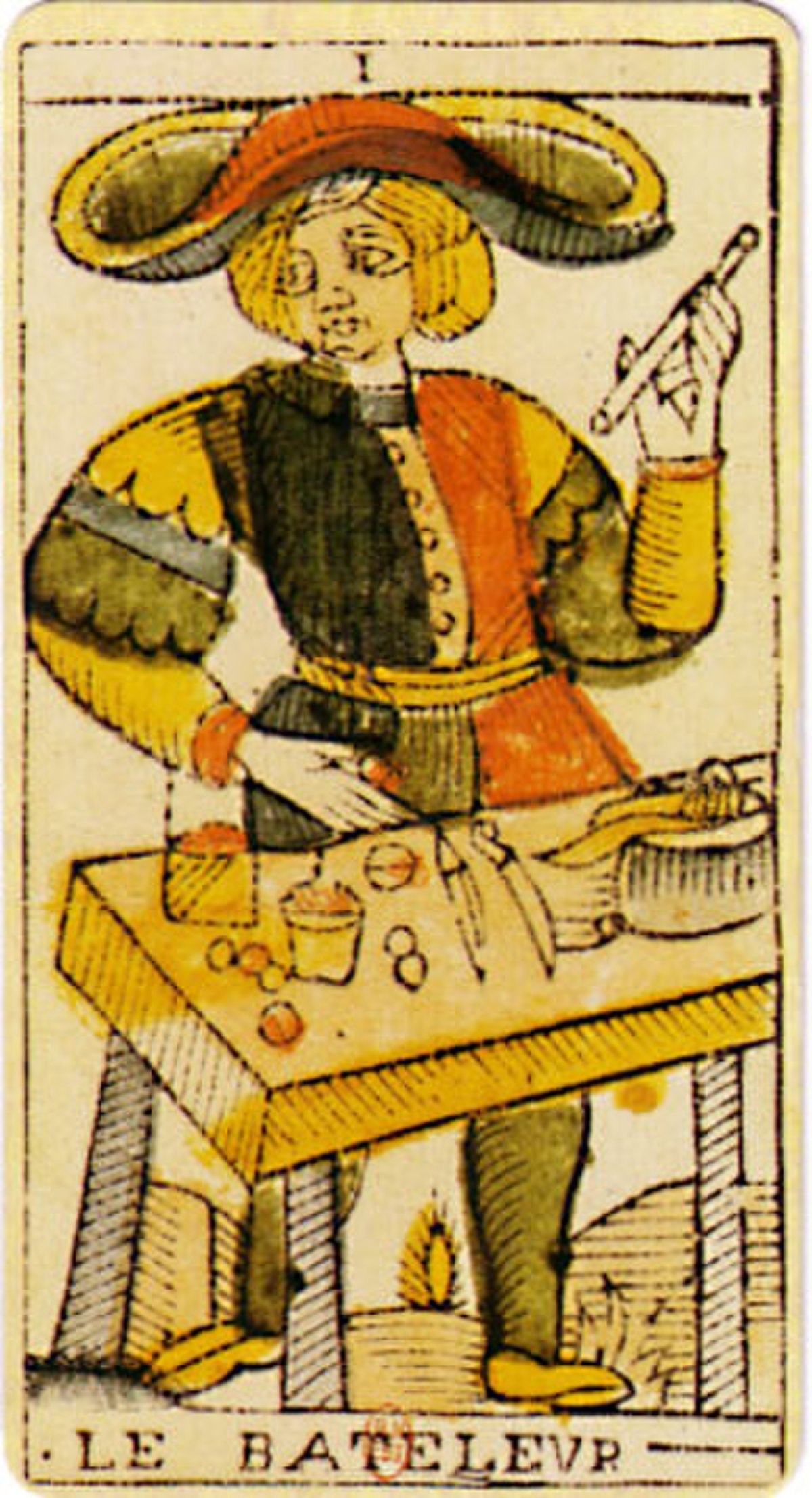
Major Arcana
Definition
The twenty-two Major Arcana — les vingt-deux Arcanes Majeurs du Tarot — constitute the trump sequence of the Tarot deck, numbered I through XXI with one unnumbered card (Le Mat, the Fool). The word arcanum is decisive. Tomberg draws a hard distinction in Letter I of Meditations on the Tarot (LIB-0084): a secret is something hidden by human will, recoverable through disclosure. An arcanum is something else entirely — "that which it is necessary to 'know' in order to be fruitful in a given domain of spiritual life." A ferment. An enzyme. Its presence in consciousness changes what consciousness can do. You cannot be told an arcanum. You activate it through sustained contemplative attention, or it remains inert.
The Major Arcana bear these ferments. They are "authentic symbols" — not allegories, not secrets. Tomberg is precise: they are "magic, mental, psychic and moral operations" that awaken new notions, ideas, sentiments, and aspirations, communicating their content "if the mentality and morality of the recipient is ready." The modern mind has no clean category for this kind of object. A symbolic operation that works on consciousness by being contemplated — the concept sits outside every available taxonomy.
The 22-card sequence forms, in Tomberg's account, "a complete, entire, invaluable school of meditation, study, and spiritual effort — a masterly school in the art of learning." Reading Tomberg, you inhabit this claim — his Letters are discursive, meditative, deliberately slow, a man thinking aloud at a desk, circling each Arcanum until it yields. Mebes (FIG-0126) treats the same sequence with equal seriousness but opposite temperament: schematic, almost diagrammatic, each Arcanum organizing an entire domain of esoteric knowledge — numerology, astrology, alchemy, Kabbalah — in lessons arranged by ternary logic. Pick up his Course and you encounter not contemplation but classification, relentless and architectonic. Together, these two frameworks constitute the richest sustained philosophical engagement with a symbolic system the Western initiatory tradition produced.
Tradition by Tradition
French Occult Tradition (Lévi, Papus)
Eliphas Lévi (1810–1875) initiated the modern philosophical reading of the Tarot in Dogme et Rituel de la Haute Magie (1856), identifying the 22 Major Arcana with the 22 letters of the Hebrew alphabet and the paths of the Kabbalistic Tree of Life. No documentary evidence connects the medieval Tarot to Kabbalah. Lévi invented the link. But the invention proved generative — it gave the Major Arcana a structural armature that elevated them from a card game to a philosophical instrument.
Papus (Gérard Encausse, 1865–1916) systematized Lévi's insights in Le Tarot des Bohémiens (1889), layering on correspondences to astrology, numerology, and the Tetragrammaton. He also transmitted the tradition through the Martinist Order — creating the institutional channel through which Mebes would deliver his Arcane Course lectures in Saint Petersburg two decades later.
Christian Hermetic (Tomberg)
Tomberg (FIG-0031) transformed the tradition he inherited from Lévi and Papus. Each of his twenty-two Letters takes an Arcanum as a point of departure for philosophical-spiritual meditation — but the method is the content. The reader who follows the meditations is doing Christian Hermeticism, not studying it from outside. The letter form ("Dear Unknown Friend") places the reader as fellow pupil. Not student. There are no masters among Christian Hermeticists, Tomberg writes — only one Master, above, and fellow pupils below who recognize each other because they "love one another."
Lévi and Papus built a system of correspondences. Tomberg built a practice of contemplation. The Arcana become occasions for thinking — not repositories of encoded doctrine but starting points from which thought unfolds into insight under conditions of inner silence.
Russian Esoteric (Mebes)
G.O. Mebes (FIG-0126) delivered his Course of the Encyclopaedia of Occultism as a series of lectures in Saint Petersburg around 1911–1912, each structured around one Major Arcanum. Where Tomberg meanders — productively, deliberately — Mebes classifies. Arcanum I covers the active principle and the will. Arcanum II covers the passive principle, binary logic, receptivity. Each lecture maps its Arcanum onto numerology, astrology, alchemy, Kabbalah, with a ternary logic (thesis, antithesis, neutralization) providing the structural skeleton throughout. The effect is closer to a university syllabus than a meditation retreat: systematic, encyclopedic, leaving little to the reader's contemplative initiative.
Mebes inherited from Lévi and Papus through the Martinist current but added a pedagogical rigor that distinguishes his work from both the French divinatory tradition of Etteilla and Tomberg's later contemplative transformation.
Kabbalistic
The correspondence between the 22 Major Arcana and the 22 Hebrew letters — first proposed by Lévi, elaborated by Papus, adopted by both Mebes and Tomberg — draws on the Sefer Yetzirah (Book of Formation), which describes the 22 letters as the instruments through which God created the world. Each letter carries cosmological, elemental, and astrological associations. The mapping is hermeneutic, not historical. It creates a framework within which card imagery and letter symbolism illuminate each other.
The correspondences do not agree across systems. The Golden Dawn assigns one set of letters; the Continental tradition (Lévi, Papus, Mebes) assigns another; Tomberg departs from both. The disagreement is itself informative — proof that the Kabbalistic mapping is an interpretive lens, not a decoded cipher.
Project Role
The Major Arcana are the organizational spine of the project's engagement with the Western esoteric tradition, read through two primary texts: Tomberg's Meditations on the Tarot (LIB-0084) and Mebes' Arcane Course (LIB-0053, LIB-0054). Each card opens into a constellation of concepts, figures, practices, and cross-traditional parallels. The 22-card sequence links Christian Hermeticism to Kabbalah, alchemy, and the broader initiatory tradition — not by collapsing them into a single perennial teaching but by providing a common symbolic language through which their relationships become visible.
The project treats the Arcana the way Tomberg treats them: as ferments activated through contemplative attention. Philosophical operations, not illustrations.
Distinctions
The Major Arcana in this project are not a divination system. Tomberg has no interest in fortune-telling. Mebes treats divination as a derivative, minor application of principles that are primarily philosophical. The popular association of Tarot with fortune-telling is an artifact of the 18th-century divinatory tradition (Etteilla, Court de Gébelin) — a tradition that predates and has largely obscured the philosophical one this project engages.
The Arcana are not Theosophy either. The project does not claim that the 22 cards encode a single perennial wisdom underlying all traditions. They encode a specifically Western Hermetic-Christian-Kabbalistic symbolic system. Cross-traditional resonances exist — with the I Ching, with Hindu tattvas, with Buddhist stages of meditation — and they are genuine. But the Arcana belong to a particular lineage and are read within that lineage's methods.
Nor are they New Age spirituality. The philosophical Tarot tradition demands the same intellectual rigor as any serious philosophical engagement. Tomberg's Letters are as dense as Heidegger, as carefully constructed as Aquinas. Mebes' Course runs with the systematic ambition of a university curriculum. Casual browsing yields nothing.
Primary Sources
- Tomberg, Meditations on the Tarot (LIB-0084): The 22 letters, each a meditation on one Arcanum
- Mebes, The Course of the Encyclopaedia of Occultism (LIB-0053): The systematic treatment of each Arcanum as encyclopedic key
- Mebes, Tarot Majors (LIB-0054): Dedicated treatment of the Major Arcana
Agent Research Notes
[AGENT: cursor | DATE: 2026-03-25] Scaffolded as parent entry for 22 individual Major Arcana concept entries. Body population pending via prompt relay to Claude Code.