Tarot de Marseille
Definition
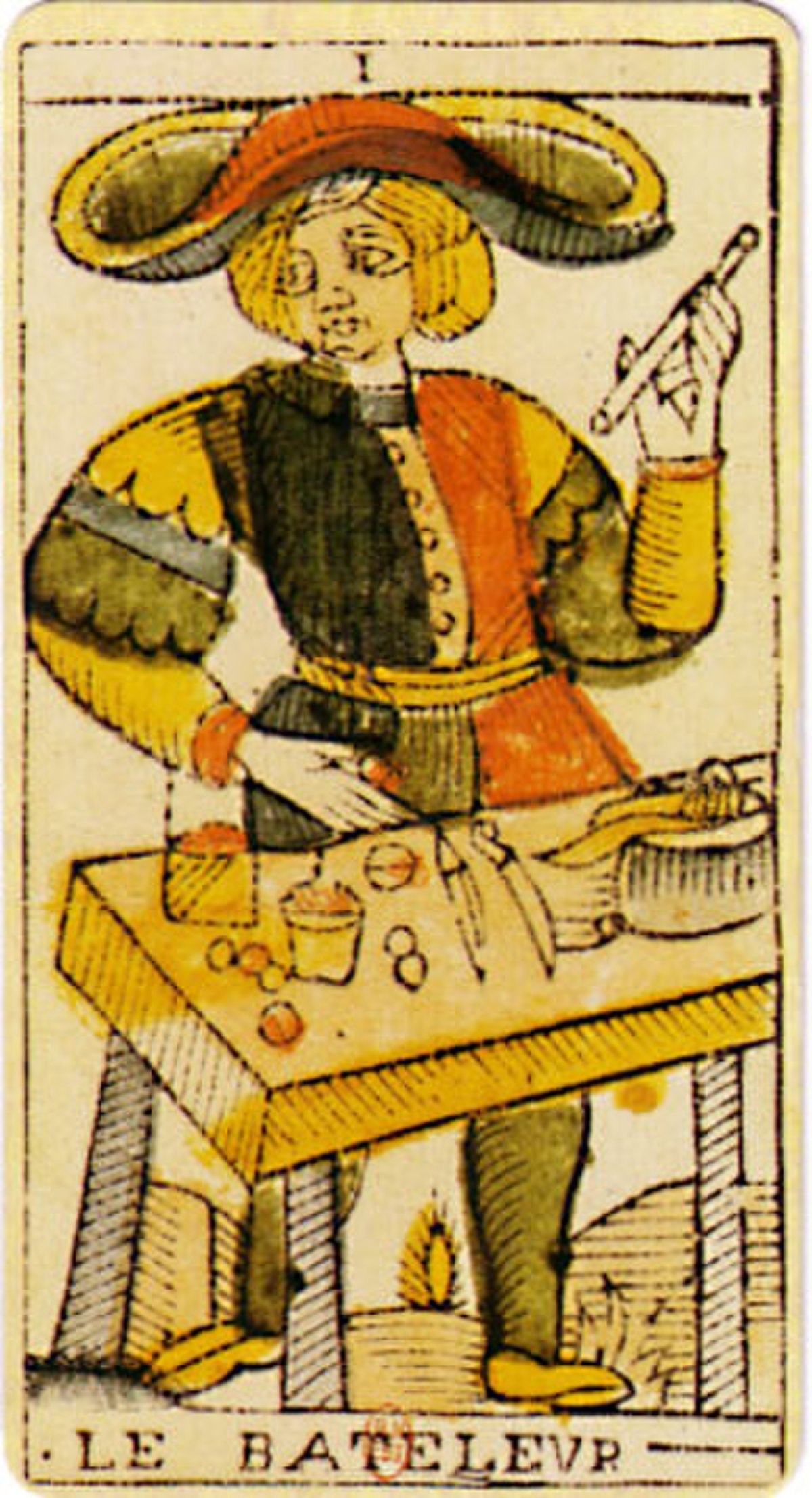
The Tarot de Marseille is not a single deck but a family of decks sharing a common pattern — a stable iconographic tradition that emerged from the Italian tarocchi of the 15th century and crystallized in the French card-making guilds of Lyon, Paris, and Marseille by the mid-17th century. Twenty-two Major Arcana (trumps), fifty-six Minor Arcana (four suits of pip and court cards). Woodcut-printed, stencil-colored, in a distinctive palette: red, blue, yellow, flesh tones on a white ground.
Key exemplars mark the tradition's development. The Jean Noblet deck (Paris, c. 1650) is the earliest surviving complete Marseille pattern. The Jean Dodal (Lyon, c. 1701–1715) represents the pattern in its mature form. The Nicolas Conver (Marseille, 1760) became the standard reference for the 19th-century occult revival. Over two centuries, little variation — an unusual stability that speaks to both the coherence of the imagery and the conservatism of the guild tradition transmitting it.
The Marseille pattern matters because it is the visual substrate of the entire philosophical Tarot tradition. When Lévi, Papus, Mebes (FIG-0126), and Tomberg (FIG-0031) read the cards, they read these images — not the later Rider-Waite-Smith or Thoth designs. The Magician's lemniscate hat, the High Priestess's open book, the Hermit's hooded lamp: these specific details of the Marseille woodcuts are the raw material from which every philosophical interpretation is constructed.
Tradition by Tradition
French Card-Making Tradition
The card-makers (cartiers) of Lyon, Paris, and Marseille organized in guilds that regulated production, ensuring consistency across generations. Woodblock printing, then hand-coloring through stencils — a process that enforced iconographic stability while permitting minor variations in color and line quality between workshops. Card-makers copied each other's designs. The guild system transmitted the template with the conservatism of a craft tradition, not the innovation of an artistic one.
By the mid-18th century, the Marseille pattern dominated the French-speaking world. The persistence was practical — guilds had no incentive to innovate — but the result was a set of images refined over generations into a stable, internally coherent symbolic language.
Hermetic / Occult Revival
Lévi's Dogme et Rituel de la Haute Magie (1856) reframed the Marseille deck from gaming tool to philosophical instrument by identifying the 22 trumps with the 22 Hebrew letters. An interpretive act, not a historical discovery — but it gave the Marseille imagery a new depth. Suddenly the details mattered philosophically. The Magician's table objects, the Papesse's book, the four creatures around the World dancer: all became carriers of Kabbalistic and Hermetic significance.
Papus extended this reframing in Le Tarot des Bohémiens (1889), layering on systematic correspondences and transmitting the framework through the Martinist Order. The Marseille deck was never designed to encode these correspondences. That the imagery proved rich enough to sustain them anyway speaks to the depth of the woodcut tradition's symbolic language.
Christian Hermetic (Tomberg)
Tomberg works from the Marseille iconography throughout Meditations on the Tarot (LIB-0084), and his close visual readings are among the Letters' most striking passages — patient, almost phenomenological attention to detail: the Magician's hat forming a lemniscate, the particular arrangement of objects on his table, the direction of his gaze. He chose the Marseille pattern over the Rider-Waite-Smith deck (available to him) because the Marseille imagery is pre-interpretive. It does not impose the explicit Golden Dawn symbolism Waite and Pamela Colman Smith built into their 1909 redesign. The Marseille cards show what they show. The philosophical reading must be earned through contemplation, not read off the surface.
Project Role
The project uses the Jean Dodal deck (Lyon, c. 1701–1715) as its reference instantiation. The Dodal predates the 19th-century occult overlay, preserving older iconography in its mature form. High-quality reproductions exist in the public domain. All 22 Major Arcana from the Dodal deck have been cataloged as project imagery (IMG-0510, IMG-0593 through IMG-0613).
Why Dodal rather than the more common Conver? The Dodal represents the Marseille pattern before Conver's minor regularizations, preserving ambiguities that reward close attention. The project reads the Dodal cards the way Tomberg reads them — as images to contemplate, not decode.
Distinctions
Marseille vs. Rider-Waite-Smith (1909): Waite and Pamela Colman Smith imposed explicit Golden Dawn symbolism onto the card imagery. The Magician's table gained specific elemental tools (wand, cup, sword, pentacle). The High Priestess gained the pillars of Boaz and Jachin. The Minor Arcana gained narrative scenes. The RWS deck tells you what to think. The Marseille deck makes you look.
Marseille vs. Thoth (1944): Crowley's Thoth Tarot, painted by Lady Frieda Harris, reflects Thelemic theology and Crowley's personal system of correspondences. Deliberate occult engineering. The Marseille pattern is something else — a craft tradition whose symbolism accrued over generations of transmission, not through a single designer's intention.
The Marseille pattern's strength is its ambiguity. Rich enough to sustain multiple interpretive frameworks, reducible to none. It rewards contemplation rather than prescribing meaning — which is why it remains the deck of choice for the philosophical tradition from Lévi through Tomberg.
Primary Sources
- Tomberg, Meditations on the Tarot (LIB-0084): Works from the Marseille iconography throughout
Agent Research Notes
[AGENT: cursor | DATE: 2026-03-25] Scaffolded as part of Tarot Major Arcana KB expansion. The Jean Dodal deck (all 22 Major Arcana) has been downloaded and cataloged as IMG-0510 and IMG-0593 through IMG-0613.