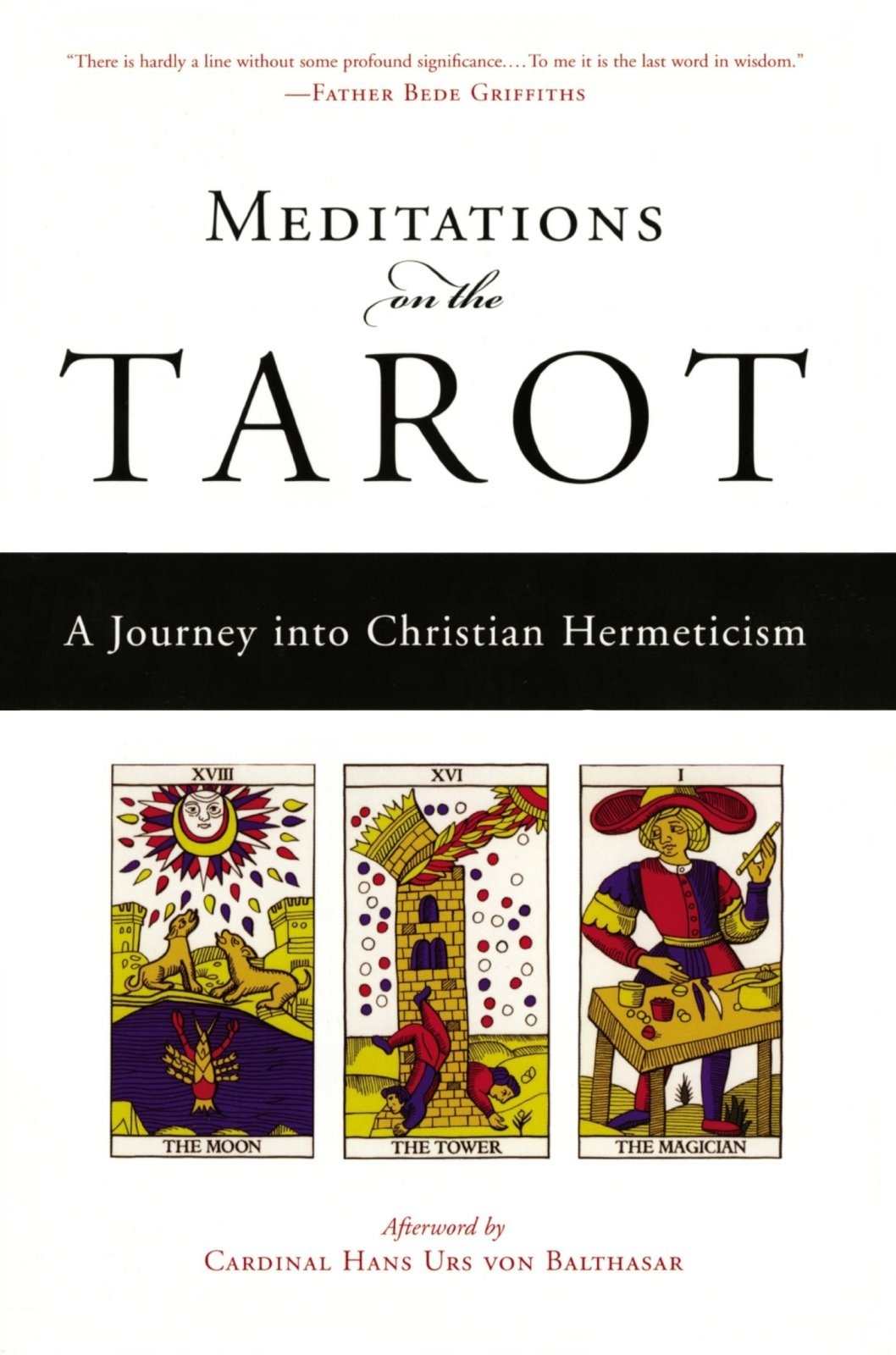
Meditations on the Tarot: A Journey into Christian Hermeticism
Author: Valentin Tomberg (published anonymously) Year: 1980 (French); 1985 (English, trans. Robert Powell) Publisher: Aubier Montaigne (French); Amity House (English); Jeremy P. Tarcher/Penguin (2002 reissue)
Summary
Meditations on the Tarot consists of twenty-two letters addressed to an "Unknown Friend," each organized around one Major Arcanum. Tomberg composed them in French between roughly 1967 and his death in 1973. The book appeared posthumously in Paris in 1980; Robert Powell's English translation followed in 1985. Tomberg's widow disclosed his authorship only after his death. He had published the work anonymously as an initiatic gesture: the ideas carry the authority, not the author's name.
The method is contemplative. Each letter takes an Arcanum as its point of departure and unfolds into an extended meditation drawing on Hermetic philosophy, Catholic mysticism (Eckhart, John of the Cross, Teilhard), Kabbalistic exegesis, Jungian depth psychology (engaged critically), and the French occult tradition of Lévi and Papus. This is not a Tarot commentary in the divinatory sense. Tomberg treats the Major Arcana as a complete symbolic system encoding a Christian Hermeticism that reunites what the modern mind has split apart: faith and gnosis, mysticism and magic, sacrament and intellect.
The arc is wide. The Magician becomes an image of creative freedom as concentration without effort. The Wheel of Fortune becomes the law of cosmic correspondences. The Devil becomes the problem of egregore formation. The World completes the sequence in a vision of cosmic harmony. Hans Urs von Balthasar, among the most important Catholic theologians of the twentieth century, wrote an approving foreword, an endorsement worth weighing for a work steeped in Hermeticism.
Relevance to Project
A touchstone text. The Meditations demonstrates that the Western initiatory tradition did not die with the pagan mystery schools. It went underground and kept producing serious work well into the twentieth century. Tomberg's synthesis of Hermeticism, Catholic mystical theology, and depth psychology is the kind of multi-framework superposition the project's own method (editorial guidance §II) requires: multiple lenses held simultaneously, attention trained on what becomes visible only through their combination.
The anonymous voice models the transmission mode the project aspires to. Tomberg writes as a friend to a friend, not as a teacher to students. The Mystery Schools narrator works the same register: someone who has read deeply, thinking aloud in the presence of the listener. Tomberg got there sixty years ago.
The book also raises a question the project carries without resolving: does the initiatory content require institutional sacramental life (as Tomberg came to believe through his conversion to Catholicism), or can it be transmitted in other forms? This is a live coincidentia oppositorum (CON-0017) for the project, a tension to inhabit rather than a problem to solve.
Key Arguments
- The Tarot as philosophical contemplation: The twenty-two Major Arcana are a complete symbolic system encoding the structures of consciousness, cosmos, and spiritual life. Each Arcanum functions as a "spiritual exercise," a starting point for meditation that unfolds into philosophical insight. Tomberg has no interest in divination.
- Christian Hermeticism as unified tradition: Hermeticism and Christian mysticism illuminate each other. Hermeticism supplies the philosophical architecture that Christian practice needs; Christian sacramental life supplies the transformative power that Hermetic speculation gestures toward but cannot deliver alone.
- Concentration without effort: The first letter (The Magician) establishes the foundational act of all spiritual work: a state of concentration that is simultaneously effortless. Not relaxation. A gathering of the whole person into a point of attention that does not strain. Tomberg treats this paradox as the key to everything that follows.
- Evil as spiritual problem: Tomberg refuses the Augustinian-Thomistic reduction of evil to mere privation of good (privatio boni). Evil is a real force requiring direct confrontation. His treatment of the Devil Arcanum is among the most serious discussions of evil in twentieth-century Christian thought.
- Anonymous transmission: By refusing to sign the work, Tomberg enacts the principle that spiritual knowledge belongs to the tradition, not to the individual transmitter. This engages Guénon's emphasis on initiatic chains (REL-0077) but arrives at a different conclusion about where those chains run.
Key Passages
- Letter I (The Magician), opening pages: The paradox of "concentration without effort" as the foundational act of esoteric practice. The entire book's method is encoded in this opening move.
- Letter I (The Magician), on Hermeticism's nature: A precise negative definition. Hermeticism is neither religion, nor philosophy, nor science, nor magic, but something that holds all four in a synthesis none of them can achieve alone. The book's methodological declaration.
- Letter XV (The Devil), on egregores: Collective psychic entities generated by group thought and emotion. One of the most concrete and unsettling discussions in the book, directly relevant to the project's treatment of counter-initiation (CON-0021).
- Letter IX (The Hermit), on three forms of knowledge: Mysticism (union), gnosis (illumination), and sacred magic (transformation) as three irreducible modes of spiritual knowledge. They must be held together; none reduces to the others.
Agent Research Notes
[AGENT: claude-code | DATE: 2026-03-24] Populated from FIG-0031, CON-0017, REL-0077, OCR sample pages, and editorial guidance. Publication history: French 1980 (Aubier Montaigne), German trans. Spaemann 1983, English trans. Powell 1985 (Amity House), reissued 2002 (Tarcher/Penguin). Von Balthasar foreword in German edition, carried into English editions. Concept coverage expanded: CON-0007, CON-0027, CON-0009, CON-0029, CON-0042, all substantively engaged in the text.