Arcanum XVI — La Maison Dieu (The Tower)
Definition
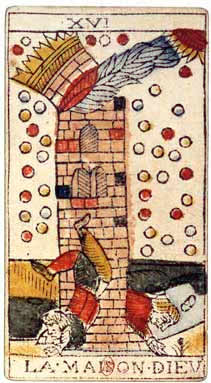
Lightning strikes the tower. The crown flies off. Two figures fall. Colored drops — fire, rain, debris — scatter across the sky. Arcanum XVI depicts catastrophe, but a particular kind: the destruction of something built by human effort on foundations that could not hold.
The tower is not a natural formation. Someone raised it stone by stone, crowned it, inhabited it. The lightning does not strike a mountain or a tree — it strikes an edifice, a human construction that reached too high on insufficient ground. Tomberg (LIB-0084) and Mebes (LIB-0053) both read this Arcanum as the inevitable collapse of structures built from ambition rather than truth, from the desire to systematize rather than the patience to understand.
The French name adds a layer the English title obscures. La Maison Dieu — the House of God. Not a secular building but a would-be temple. Its builders intended it as a dwelling place for the divine. The lightning reveals that the divine cannot be housed in constructions of this kind. What falls needed to fall. What stood in its place prevented what could genuinely be built.
Tomberg's Reading (Letter XVI)
Tomberg's Letter XVI treats the Tower as the danger inherent in all intellectual system-building — including esoteric system-building. The argument is self-reflexive and unflinching. The very project of constructing a comprehensive spiritual framework (which is, after all, what Meditations on the Tarot itself attempts) carries the risk of premature synthesis. Tomberg, the man thinking aloud at his desk, here turns the lens on his own desk.
The key distinction: organic growth versus artificial construction. A tree grows from within, following laws inherent to its nature. A tower is assembled from without, following a plan imposed by its builder. Spiritual understanding that grows through meditation, experience, and gradual deepening can withstand storms. Intellectual constructions that organize spiritual truth according to imported categories — philosophical, scientific, systematic-theological — are towers waiting for lightning.
Tomberg identifies the specific error as confusing map with territory. The system-builder mistakes the elegance of the construction for the truth of what it represents. The categories fit together. The logic holds. The tower rises impressively. But the foundation — living contact with spiritual reality — has been replaced by the satisfaction of structural coherence. The lightning is not punishment. It is correction. What falls reveals what was never grounded, and the rubble becomes raw material for a truer foundation.
This is among Tomberg's most courageous meditations. It implicates his own method. The tower-builder is not only the rationalist or the materialist. It is anyone who systematizes prematurely. Including the esotericist.
Mebes' Reading (Arcanum XVI)
Mebes assigns Arcanum XVI to catastrophe and the liberating force of destruction (LIB-0053). His treatment is structural, almost mechanical — reading Mebes here is like studying a demolition engineer's report. In his ternary logic, the sixteenth Arcanum represents the breaking of forms that have completed their function and now obstruct further development. Not accidental. Lawful. The consequence of forces building since construction began.
Mebes draws particular attention to a principle: false forms attract their own destruction. A tower on false foundations needs no external malice to bring it down. The falsity itself causes the collapse. Lightning, in this reading, is not an arbitrary strike from outside but an internal contradiction reaching its critical point. Every false structure carries within itself the seed of its own demolition.
Symbolic Elements
The Marseille card shows a tall, narrow tower struck at its crown by lightning — or, in some versions, by a sphere of fire descending from above. The crown, a crenellated cap, dislodges and flies to one side. The highest point struck first. Two figures tumble through the air, arms and legs extended, falling away from the tower in opposite directions.
Multicolored drops fill the sky around them. Flames, rain, fragments of the tower itself — the dispersal of concentrated energy. The ground is absent or barely sketched. The card focuses attention on the space between tower and earth. The space of falling.
Tomberg reads the dislodged crown as the loss of the artificial summit — the point of pride that made the tower a target. Mebes reads the falling figures as consciousnesses that identified with the system and now share its fate. Temporarily disoriented. Ultimately liberated.
Project Role
The Tower is the project's standing warning to itself. The temptation to construct a grand unified theory of consciousness from the mystery traditions' testimony is real and persistent. The materials are rich. Gebser's structures, Guénon's metaphysics, Barfield's participation (CON-0004), the initiatory accounts from Eleusis to the Hermetic lodges — they practically invite systematic architecture. A tower could be built.
The Arcanum says: not yet. Not until the foundations are tested. Not until the listening is complete. The task at this stage is gathering testimony, hearing the traditions in their own terms, resisting the premature elegance of synthesis. A framework imposed too early becomes a prison for the material it was meant to organize. Lightning finds artificial constructions with perfect accuracy. What falls — the beautiful system, the satisfying coherence — was never the point. The point was the living contact with reality that the system was meant to serve but ended up replacing.
Primary Sources
- Tomberg, Meditations on the Tarot, Letter XVI (LIB-0084)
- Mebes, The Course of the Encyclopaedia of Occultism, Arcanum XVI (LIB-0053)
Agent Research Notes
[AGENT: cursor | DATE: 2026-03-25] Scaffolded as part of Tarot Major Arcana KB expansion. Body population pending via prompt relay to Claude Code.