Arcanum I — Le Bateleur (The Magician)
Definition
The Magician is the first numbered Arcanum. Tomberg calls him the Arcanum of the Arcana — the card that teaches what all the other cards presuppose. His subject is concentration. Not the grinding, effortful kind that produces headaches and diminishing returns, but the state Tomberg names concentration without effort. The foundational act of the spiritual life. Without it, nothing else in the sequence of twenty-two Arcana can begin.
The distinction cuts against the common assumption that spiritual practice is essentially exertion — more discipline, more willpower, more hours on the cushion. The Magician proposes something different. He stands behind his table of instruments with perfect ease. Gaze elsewhere. He holds a rod in one hand and a ball in the other but does not grip them. Relaxed readiness — the state an athlete enters when technique has been so thoroughly internalized that it operates without deliberation.
Tomberg (LIB-0084) and Mebes (LIB-0053) both treat the Magician as the starting point, but they read that starting point differently. For Tomberg, the Magician introduces a method — the practice of attention that makes all subsequent meditations possible. For Mebes, a metaphysical principle — the active will that initiates the ternary logic structuring all twenty-two Arcana. One reading is phenomenological: what happens when a person attends? The other is structural: what role does the active principle play in a system of esoteric classification?
Together they establish the Magician as the card of beginnings in a double sense. First card encountered. First act taught: concentrated attention, without which encountering anything at all is impossible.
Tomberg's Reading (Letter I)
Letter I of Meditations on the Tarot (LIB-0084) opens the entire work, and Tomberg uses it to lay out the method governing everything that follows. The Magician is not the first topic. He is the instruction manual.
Tomberg's central argument: concentration without effort is the master practice. He distinguishes it from two lesser forms. Interested concentration is attention driven by desire or curiosity — the focus of a gambler watching the roulette wheel. Disinterested concentration is attention maintained by willpower alone — a student forcing herself through a textbook. Neither produces the Magician's state. Concentration without effort arises when attention is sustained not by desire or will but by the intrinsic reality of the object contemplated. The object holds the attention because it is worth attending to. The practitioner has become quiet enough to let it.
Tomberg introduces the analogy of the tightrope walker. A novice on the wire concentrates fiercely, muscles rigid, mind clamped on the task. A master walks the wire with ease, her body making micro-adjustments below the threshold of deliberate thought. The transition from effortful to effortless concentration is not the abandonment of discipline but its perfection. Discipline does not disappear; it becomes rhythm.
This leads to Tomberg's reading of the lemniscate — the figure-eight shape of the Magician's hat. The lemniscate is rhythm's symbol: a continuous figure with no beginning and no end. Tomberg argues that the Magician's consciousness has transposed from the cerebral system, where thinking is sequential and labored, to the rhythmic system, where it flows. The formula: learn concentration without effort, transform work into play, make every yoke easy and every burden light. The echo of Matthew 11:30 is deliberate.
Letter I also introduces the method of analogy, drawn from the Emerald Tablet: as above, so below; as below, so above. Not a vague mystical gesture. A precise cognitive instrument. Analogy is the means by which the Hermeticist moves between levels of reality — physical, psychic, spiritual — without collapsing them into identity or severing them into unrelated domains. The Magician, standing between heaven (his raised rod) and earth (his table of instruments), enacts this analogical movement in his posture.
Then comes the question that reverberates through the entire work: "Have you ever drunk silence?" Not rhetorical. It identifies the experiential precondition for everything the Letters will discuss. Silence is not the absence of noise but the presence of receptive attention. The Magician's concentration without effort is, in practice, the drinking of silence.
Mebes' Reading (Arcanum I)
Mebes (LIB-0053) assigns Arcanum I to the domain of the active principle — the first term of the ternary that structures his entire system. Where Tomberg reads the Magician phenomenologically, as a practice to be enacted, Mebes reads him architectonically, as a structural position in a metaphysical scheme.
The active principle is will, initiative, the creative impulse that begins any process. Mebes associates it with the Hebrew letter Aleph and with the element of spirit as the initiating force. In his ternary logic — thesis, antithesis, neutralization — the Magician is always the thesis, the first assertion from which the dialectical process unfolds. Arcanum II (the Priestess) will supply the antithesis, Arcanum III (the Empress) the neutralization.
This structural reading has the virtue of clarity. It makes visible the logical skeleton of the Arcana sequence: every group of three cards enacts a movement from active to passive to generative. The cost is that the experiential dimension — Tomberg's silence, the tightrope walker's ease — recedes from view. Mebes' Magician is a principle, not a practice.
Symbolic Elements
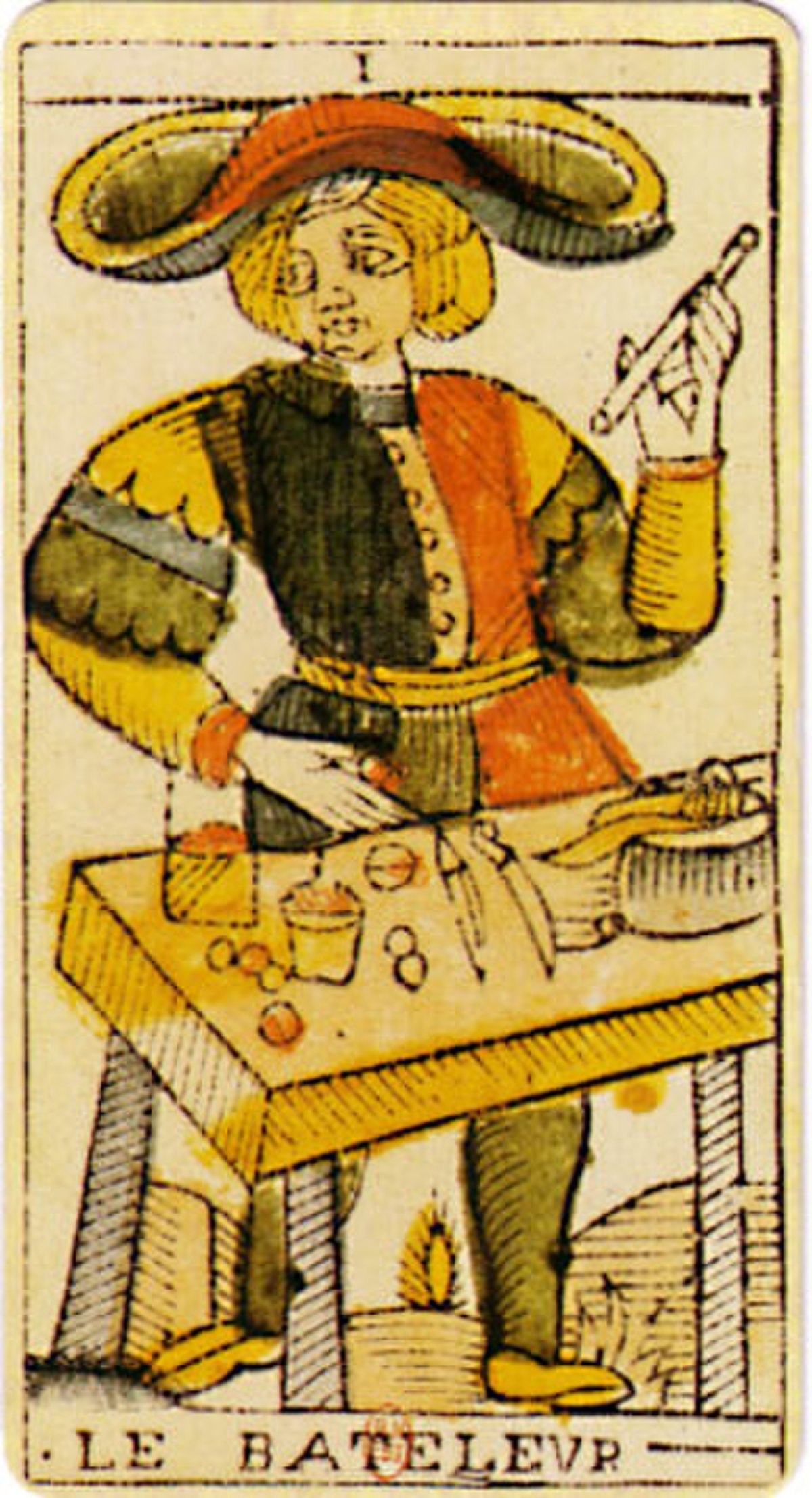
The Marseille Bateleur stands behind a low table. On it: discs, dice, a knife, a cup, a small bag. Not the four suit symbols of the Minor Arcana (though interpreters have mapped them onto wands, cups, swords, and pentacles). They are the tools of a street performer — a bateleur is a juggler, a mountebank, a prestidigitator. The card's title carries a note of disreputability. The Magician is not a priest or a king. He is a performer. His art looks, to the uninitiated, like a trick.
His right hand holds a rod — raised, pointing upward. His left hand holds a golden ball or disc — lowered, pointing toward the earth. The posture mirrors the Hermetic axiom: as above, so below. He is the living enactment of the analogical method.
The lemniscate hat is the card's most distinctive feature. The broad-brimmed hat forms a figure eight on its side — the mathematical symbol for infinity, but also, as Tomberg reads it, the symbol of rhythm. The lemniscate has no endpoint. It flows continuously from one loop to the other, modeling the state of consciousness that the Magician embodies: attention that circulates rather than grips.
His gaze does not rest on his instruments. He looks elsewhere — to the side, or into the middle distance. This detail is critical. A craftsman who stares at his tools has not yet mastered them. The Magician's attention is free because his technique is complete.
Project Role
The Magician defines the boundary that matters most to this project: the line between computation and attention. A machine processes information — holds every object simultaneously, with perfect recall. But it does not attend to any of them. Attention is not storage. It is the act of a consciousness gathering itself in the presence of something real. That gathering cannot be automated.
This is not an argument against computational tools. The project depends on them. The argument concerns what the tools cannot replace. The Magician's concentration without effort names the human contribution no database, no language model, no knowledge graph can supply: the silence in which understanding happens.
The Magician also establishes the project's method. Analogical thinking — as above, so below — is the cognitive instrument the project uses to move between historical periods, between traditions, between the ancient Mysteries and their modern echoes. Analogy is not identity. It is the disciplined perception of structural correspondence across difference. The Magician standing between heaven and earth, instruments laid before him, is this method in action.
Primary Sources
- Tomberg, Meditations on the Tarot, Letter I (LIB-0084)
- Mebes, The Course of the Encyclopaedia of Occultism, Arcanum I (LIB-0053)
Agent Research Notes
[AGENT: cursor | DATE: 2026-03-25] Scaffolded as part of Tarot Major Arcana KB expansion. Body population pending via prompt relay to Claude Code.