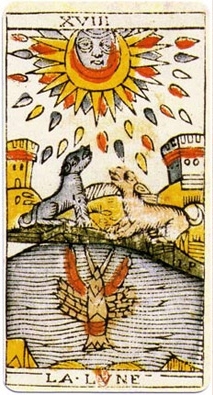
Arcanum XVIII — La Lune (The Moon)
Definition
The Moon does not generate light. It reflects it. What it shows is real — the landscape exists, the path is there, the creatures are present — but everything appears under conditions of distortion. Shadows lengthen. Colors drain. Distances deceive. Arcanum XVIII maps the territory of reflected knowledge: genuine content reaching consciousness through a medium that alters it in transit.
Tomberg (LIB-0084) and Mebes (LIB-0053) both treat this Arcanum as a sustained warning about the intermediate realm between direct spiritual perception and ordinary sensory experience — the realm the Islamic philosophers named mundus imaginalis (CON-0012), the Western tradition calls the astral world. Real. Not arbitrary invention. But it presents truth in images rather than concepts, in symbols rather than statements, and the translation from image to meaning is where error enters. The Moon illuminates. It also deceives. Learning to distinguish what the moonlight shows from what it distorts is the Arcanum's central demand.
The card follows the Star's open receptivity with a necessary correction: not everything received from above arrives undistorted. Between stars and earth lies the Moon, and the Moon's light is borrowed. The traditions that describe direct illumination also describe the zone of phantasms, projections, and half-truths the seeker must traverse to reach it.
Tomberg's Reading (Letter XVIII)
Tomberg's Letter XVIII is a sustained meditation on the epistemology of reflected knowledge (LIB-0084). Reading him here, the discursive voice turns cautious — a man who knows the territory he describes and respects its dangers. His central argument: the Moon represents the entire domain of consciousness where genuine spiritual content arrives in distorted form. Through dreams. Through the collective unconscious. Through astral impressions that accumulate around objects, places, traditions. The content is real. The distortion is also real. Discernment means learning to separate one from the other.
Tomberg develops this through imagination's relationship to reality. Imagination, he argues, is a genuine organ of perception — it perceives realities the senses cannot reach. But it perceives them in its own medium: images, symbols, emotional impressions. Not arbitrary. They correspond to something. But they correspond the way a reflection corresponds to what it reflects — reversed, flattened, subject to the disturbances of the reflecting surface. A troubled mind produces troubled reflections. A biased observer sees what confirms the bias.
The danger is specific: mistaking reflected knowledge for direct knowledge. The person who receives spiritual impressions through dreams, visions, or meditative images and takes them as unmediated truth has confused moonlight with sunlight. The mundus imaginalis (CON-0012) is a genuine ontological domain, but navigating it demands discrimination — recognizing that its images are symbolic, not literal. They point to realities rather than presenting realities directly.
Tomberg connects this to the collective unconscious (in Jung's sense): a vast pool of reflected spiritual content, accumulated over millennia, available to anyone who descends deep enough in meditation or dream. The content is priceless. The risk equally great. Without discrimination, the seeker drowns in images rather than learning to read them.
Mebes' Reading (Arcanum XVIII)
Mebes assigns Arcanum XVIII to the astral world, the imagination in its deceptive aspect, and the necessity of discernment (LIB-0053). His treatment, characteristically schematic, systematizes the principle with almost mathematical precision: every form of mediated knowledge carries distortion proportional to the number of mediating layers. Direct perception (the Sun) — undistorted. One mediating layer (the Moon) — one order of distortion. Multiple layers — tradition, commentary, translation, interpretation — distortions multiply.
The practical danger for the esoteric student is specific. The astral light, which carries images and impressions between planes of existence, does not distinguish between what the practitioner projects into it and what exists independently. Enter the astral realm without discipline and you encounter a mixture of genuine perception and self-generated phantasm. No built-in mechanism for telling them apart. The Moon card, in Mebes' reading, maps this specific danger: the territory where the path exists but illusions flank it on both sides.
Symbolic Elements
The Marseille card presents a nocturnal landscape of extraordinary density. The Moon hangs in the upper center, face in profile, drops or rays falling earthward. Below, two towers stand at the card's edges, flanking a narrow path that leads between them into dark distance. Two canines — a dog and a wolf, the domesticated and the wild — face the Moon, baying. At the bottom, a crayfish emerges from a pool, crawling toward the path.
The twin towers echo the pillars that appear throughout the Major Arcana (CON-0097) — the threshold between known and unknown, conscious and unconscious. The path between them is visible but uncertain. It leads into darkness; the traveler cannot see where it ends. The two canines represent the dual nature of the instinctual realm: the domesticated dog (trained emotion, habitual response) and the wild wolf (raw instinct, ungoverned impulse). Both activated by reflected light.
The crayfish is the most ancient element. A creature from the depths of unconsciousness, armored and primitive, drawn upward by the Moon's pull. Tomberg reads this as deep unconscious content rising into awareness under the influence of reflected spiritual light — powerful, archaic, not yet integrated. The entire composition maps the landscape the seeker traverses between the Tower's dissolution and the Sun's direct illumination: real but treacherous, populated by forces that require navigation rather than trust.
Project Role
The Moon names the project's structural limitation. The project works with reflected knowledge. The traditions' testimony reaches it through texts, translations, commentaries, scholarly interpretations — layers of mediation, each introducing its own distortions. AI processing adds another reflecting surface. What arrives at the listener's ear has passed through the original experience, the tradition's encoding, the written record, the scholarly apparatus, the project's synthesis, the production process. Each step is a Moon. Real content, real distortion.
The project's honesty depends on acknowledging this. It cannot present reflected knowledge as direct experience. When Tomberg describes the Hanged Man's reversal, the project can transmit his description — but the description is moonlight, not sunlight. The direct experience of inversion belongs to whoever has undergone it. The project's task under the Moon: navigate reflected knowledge with maximum discrimination. Distinguish what sources actually say from what commentary claims they say. What the traditions describe from what the project projects onto them. What the listener can receive from what the medium distorts.
Primary Sources
- Tomberg, Meditations on the Tarot, Letter XVIII (LIB-0084)
- Mebes, The Course of the Encyclopaedia of Occultism, Arcanum XVIII (LIB-0053)
Agent Research Notes
[AGENT: cursor | DATE: 2026-03-25] Scaffolded as part of Tarot Major Arcana KB expansion. Body population pending via prompt relay to Claude Code.