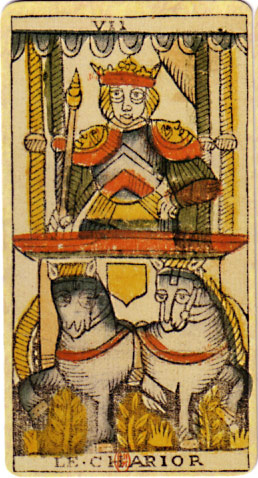
Arcanum VII — Le Chariot (The Chariot)
Definition
The seventh Arcanum of the Major Arcana (CON-0097) presents mastery — not as domination but as the capacity to hold opposing forces in productive tension. A crowned figure rides a chariot drawn by two horses pulling in different directions. The chariot moves forward anyway. That forward motion, achieved without suppressing either force, is the whole teaching.
Mastery here is closer to musicianship than to conquest. A musician does not silence the instrument; she draws coherent form from the tension of vibrating strings. The charioteer draws coherent direction from the tension of opposing pulls. The coincidentia oppositorum (CON-0017) translated from metaphysical principle into lived practice — not the theoretical unity of opposites but the actual, moment-to-moment work of holding contraries together. Without collapsing into either.
Both Tomberg (LIB-0084) and Mebes (LIB-0053) treat this Arcanum as a turning point. The first six Arcana establish polarities — activity and receptivity, authority and freedom, choice and commitment. The seventh integrates them. The Chariot does not transcend the opposites. It rides them.
Tomberg's Reading (Letter VII)
Tomberg's seventh Letter — discursive as always, thinking slowly through the image in his meditative, almost liturgical prose — reads the Chariot as mastery through equilibrium. The charioteer holds two horses: one pulling left, one right; one constructive, one destructive. He maintains forward motion not by favoring either but by balancing both. The horses never stop pulling apart. That tension is the source of the Chariot's power.
This is Tomberg's most sustained treatment of the coincidentia oppositorum (CON-0017) as practice rather than theory. Nicholas of Cusa formulated the coincidence of opposites as a property of the divine intellect — lofty, abstract, safely theological. Tomberg brings it down into psychology. The charioteer is anyone who holds two legitimate but incompatible truths in mind simultaneously without forcing premature resolution. The result is not paralysis but movement. A third thing that neither polarity alone could produce.
Tomberg distinguishes the Chariot's mastery from the Emperor's authority (CON-0103). The Emperor establishes order by decree; the charioteer maintains order through continuous, living balance. The Emperor can rest on his throne. The charioteer cannot. The moment he stops balancing, the chariot veers. Mastery here is not a state achieved but an activity sustained.
The crowned figure points to something else: the charioteer has already been through the initiatory sequence of the first six Arcana. The crown is earned, not assumed. Mastery follows discernment (CON-0105), which follows authority, which follows knowledge. The sequence matters. You cannot balance what you have not first encountered, chosen, and understood.
Mebes' Reading (Arcanum VII)
Mebes assigns Arcanum VII to victory and the mastery of elemental forces. Reading Mebes on this card is like reading a circuit diagram — every element labeled, every relationship specified, the whole arranged with the systematic precision of an occultist who learned his method from nineteenth-century science. The septenary principle governs: seven as completion within a cycle, the day of rest containing the six days of work. The charioteer has passed through the six preceding stages and now demonstrates mastery over the forces those stages introduced.
Where Tomberg attends to the felt experience of balancing opposites, Mebes maps structure. The two horses: active and passive, positive and negative, spirit and matter — the binary oppositions running through the entire Arcane system. The charioteer: the ternary principle, the neutralizing force holding the binary in productive relation. Victory, for Mebes, is not the defeat of one force by another but the integration of both under a third, higher principle.
Symbolic Elements
The Marseille card shows a crowned figure standing in a chariot drawn by two horses — often colored red and blue, or light and dark, marking them as polar opposites. The charioteer holds no reins. Easy to miss, this detail. Hard to overstate. No mechanical control. The charioteer guides by presence, by the orientation of his being, not by physical force.
The chariot itself is cubic, box-shaped — stability, the four elements, a grounded vehicle moving through the material world. The crown indicates sovereignty, but it sits on a head that must remain attentive. The absence of reins links the Chariot to the Magician (CON-0100): both operate through directed attention rather than physical manipulation. The Magician concentrates without effort at the table. The charioteer masters without force on the road.
The two horses, pulling apart, generate the dynamic that makes the image legible. Without their opposition, there is no tension. Without tension, there is no mastery to demonstrate. The card insists that mastery requires something to master — not the absence of conflict but its integration.
Project Role
The Chariot maps onto the project's intellectual method. The Mystery Schools project holds multiple interpretive frameworks in tension: Gebser's structures of consciousness, Barfield's evolution of consciousness, Guenon's traditionalist critique, Steiner's spiritual science. These pull in genuinely different directions. Gebser sees emergence; Guenon sees decline. Barfield historicizes consciousness; Steiner spiritualizes history.
The project does not resolve these tensions by choosing one framework and discarding the others. It does not produce a meta-synthesis that claims to contain all positions. It rides them — maintaining forward motion through the productive tension of holding incompatible interpretations simultaneously, attending to what each reveals that the others cannot.
The coincidentia oppositorum (CON-0017) enacted as intellectual practice. The charioteer holds no reins because the method is not mechanical — it cannot be proceduralized. It requires continuous, living attention from a mind willing to tolerate unresolved contradiction. The payoff: a richer view than any single framework affords. The cost: the discomfort never ends.
Primary Sources
- Tomberg, Meditations on the Tarot, Letter VII (LIB-0084)
- Mebes, The Course of the Encyclopaedia of Occultism, Arcanum VII (LIB-0053)
Agent Research Notes
[AGENT: cursor | DATE: 2026-03-25] Scaffolded as part of Tarot Major Arcana KB expansion. Body population pending via prompt relay to Claude Code.