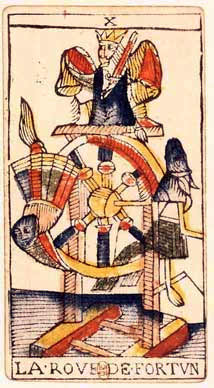
Arcanum X — La Roue de Fortune (Wheel of Fortune)
Definition
The tenth Arcanum of the Major Arcana (CON-0097) poses the question that haunts every philosophy of history: is the wheel going somewhere, or is it just going around? Figures rise and fall on its rim — ascending on one side, enthroned briefly at the top, descending on the other. The wheel turns. Whether it also advances is the question the card refuses to answer.
This refusal is the Arcanum's philosophical content. The Wheel of Fortune does not depict a cycle the way a clock depicts time — as a settled fact about the structure of reality. It depicts the problem of the cycle: the way repetition and novelty, determinism and freedom, fate and will, appear inextricable from one another. The figures on the rim are carried by the wheel. But the card also implies — through the figure at the top and the axis at the center — that there may be a position from which the turning is witnessed rather than merely suffered.
Tomberg (LIB-0084) reads this as the question of destiny and fortune. Mebes (LIB-0053) reads it as the completion of the first denary cycle — ten as the return to unity. Both recognize that the Arcanum marks a threshold: the end of one sequence and the beginning of the question of whether the next sequence will merely repeat or genuinely develop.
Tomberg's Reading (Letter X)
Tomberg's tenth Letter — characteristically meditative, circling the image before approaching it, as if the Wheel demanded circumambulation before interpretation — addresses the problem of determinism and freedom. The oldest question in philosophy, reframed through image. His central argument: the figures on the rim are determined. They rise, peak, fall, carried by rotation. But consciousness need not remain on the rim. The possibility exists — the card points to it without guaranteeing it — of occupying the axis rather than the periphery. The still center rather than the turning circumference.
Not escapism. Tomberg does not suggest the wise person steps off the wheel. The axis is not outside the wheel; it is the wheel's own center. To occupy the axis means to participate in the cycle without being determined by it — to experience rise and fall without mistaking either for a permanent condition. The contemplative tradition's distinction between identification and witness-consciousness operates here: the difference between being the emotion and observing the emotion, between being the historical moment and understanding it.
The Wheel poses the question of whether the cosmic cycles are genuinely cyclical — the Stoic ekpyrosis, the eternal return — or whether they are spiral, each rotation returning to a similar position but at a different level. Tomberg does not resolve this question, and his refusal to resolve it is as significant as anything he asserts. The Letter acknowledges that the evidence supports both readings. Some things repeat. Some things develop. The difficulty is telling which is which, and the Wheel is the image of that difficulty.
Tomberg connects the Wheel to the problem of fortune — the role of the apparently random in human life. Fortune is not Providence, which operates through wisdom, nor is it chaos, which operates through nothing. Fortune is the zone between the two: the domain where pattern and contingency interweave so densely that distinguishing them requires the kind of attention the Hermit (CON-0108) cultivates.
Mebes' Reading (Arcanum X)
Mebes reads Arcanum X as the completion of the first denary cycle — ten as return to unity after the nine individual Arcana have unfolded. Reading Mebes on the Wheel is like reading a technical specification: the denary principle governs, the full cycle has been expressed, what follows operates at a new level of integration. No atmosphere, no meditation — just the architecture of the system laid bare in his characteristic diagrammatic prose (LIB-0053).
In his system, the Wheel represents the relationship between fortune and will — the causal nexus in its cyclical aspect. Karma appears here not as the moral law of individual consequence (that belongs to Justice, CON-0107) but as the larger pattern of cyclical causation carrying individuals, civilizations, and epochs through their appointed rounds. Whether the initiate can step free — can move from rim to axis — is the question motivating the entire initiatory program.
The three figures on the wheel correspond to Mebes' ternary principle applied to time: the past that has fallen, the present at the summit, the future rising to replace it. His structural eye sees not drama but mechanics. The lawful rotation of conditions through their phases.
Symbolic Elements
The Marseille card shows a wheel turned by a crank — a significant detail. Someone or something turns the wheel; it does not turn itself. The crank implies a mover, but the mover is not depicted. This absence generates the card's central ambiguity: is the turning willed (by Providence, by a cosmic intelligence) or mechanical (by the impersonal operation of natural law)?
Three figures occupy the wheel's rim. One ascends on the left, often depicted with animal features — the creature on its way up, not yet fully formed. One sits at the top, crowned or sphinx-like — the figure at the peak of the cycle, momentarily stable. One descends on the right, falling — the figure whose turn has passed. The three together compose a single temporal gesture: becoming, being, ceasing.
The wheel itself has spokes connecting rim to axis. These spokes are the structural links between the periphery of experience (where things happen to you) and the center of experience (where you witness what happens). The entire symbolic program of the card can be read as an invitation: move inward, from rim to axis, from being turned to witnessing the turning.
Project Role
The Wheel of Fortune maps onto the project's central open question (CON-0005): what is the trajectory of consciousness? The project navigates between thinkers who see consciousness evolving — Gebser's structures unfolding from archaic through integral, Barfield's evolution from original participation through withdrawal to final participation — and thinkers who see consciousness declining. Guenon's traditionalist thesis: modernity as fall from a primordial metaphysical knowledge that cannot be recovered through human effort.
These are not trivially different perspectives. They generate incompatible predictions about the future of consciousness, incompatible assessments of the present, and incompatible valuations of the past. If Gebser is right, the traditions the project studies are early stages of something still unfolding. If Guenon is right, they are remnants of something already lost. The difference matters.
The Wheel holds this tension without resolving it — and the project follows the Wheel's example. Rather than choosing between evolution and decline, spiral and circle, the project attends to the evidence for both, tracks where they converge and where they diverge, and resists the premature closure that would make the inquiry tidier at the cost of making it false. The crank turns. The question of who or what turns it remains open.
Primary Sources
- Tomberg, Meditations on the Tarot, Letter X (LIB-0084)
- Mebes, The Course of the Encyclopaedia of Occultism, Arcanum X (LIB-0053)
Agent Research Notes
[AGENT: cursor | DATE: 2026-03-25] Scaffolded as part of Tarot Major Arcana KB expansion. Body population pending via prompt relay to Claude Code.