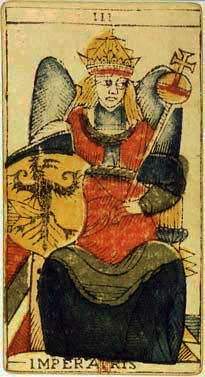
Arcanum III — L'Impératrice (The Empress)
Definition
The Empress is the third Arcanum, and in the logic of the Tarot's opening sequence she resolves the polarity established by the first two. The Magician (CON-0100) acts. The High Priestess (CON-0101) receives. The Empress generates. She is what happens when active will and receptive contemplation meet — something new comes into being. Tomberg names this principle sacred magic. Not the manipulation of hidden forces. The art of cooperating with the creative powers of the spiritual world.
The word magic requires precision. Common usage suggests either stage illusion or the occultist's claim to control supernatural forces. Tomberg means neither. Sacred magic is the creative act that occurs when human effort aligns with spiritual grace. The Empress does not force the world to yield. She tends it, and it bears fruit. Not a sculptor imposing form on resistant stone — a gardener creating conditions for growth and then waiting.
This makes the Empress the Arcanum of creative imagination — imaginatio vera, the "true imagination" of the Hermetic tradition. True imagination is not fantasy. Fantasy constructs images from personal desire. True imagination receives images from the spiritual world and gives them form in the material one. The Empress, seated in her generative abundance, is the principle through which the invisible becomes visible, the potential actual, the unmanifest takes shape.
Tomberg (LIB-0084) and Mebes (LIB-0053) both place the Empress third, completing the first ternary. The position is not arbitrary. The ternary — active, passive, generative — is the fundamental structural unit of Hermetic thought. The Empress completes it. She demonstrates that the polarity of will and receptivity is not a stalemate but a creative tension producing a third term richer than either parent.
Tomberg's Reading (Letter III)
Tomberg's Letter III (LIB-0084) develops sacred magic as the synthesis of the preceding two Letters. The Magician's concentration without effort and the Priestess's contemplative receptivity combine to produce the Empress's creative generation. Tomberg does not treat this as metaphor. He argues that the union of directed attention and receptive silence actually produces effects in the world — the interior act has exterior consequences.
The key move: the distinction between magic and mysticism. Mysticism seeks union with the divine. Magic seeks to bring the divine into manifestation. The mystic ascends; the magician descends — or rather, serves as the channel through which the higher descends into the lower. The Empress enacts this descent. She does not leave the world to seek the spirit. She draws the spirit into the world.
Tomberg distinguishes sacred magic from its degenerate forms with care. Sorcery manipulates. Sacred magic cooperates. The sorcerer imposes his will on spiritual forces. The sacred magician aligns her will with spiritual purposes and becomes the instrument through which those purposes realize themselves. The Empress's posture — seated, not straining — indicates alignment. She does not fight the current. She flows with it. The flow produces abundance.
The implications extend to creative work broadly. Any genuine act of creation — artistic, intellectual, spiritual — participates in the Empress's principle. A writer who forces a text produces something dead. A writer who attends to what the material wants to become, who serves the work rather than commanding it, participates in sacred magic. The Empress is the patron of all such making.
Mebes' Reading (Arcanum III)
Mebes (LIB-0053) assigns Arcanum III to the neutralizing principle — the third term completing the first ternary. Active principle meets passive principle; their interaction produces the generative. The Empress is the synthesis. The child of the first pair.
Mebes associates this Arcanum with creative imagination and the Hebrew letter Gimel. The three-fold structure — thesis, antithesis, neutralization — becomes the template for every subsequent ternary. Each group of three cards recapitulates the pattern the first three establish: action, reception, generation. The Empress, as the first neutralizing term, teaches the reader to recognize this architecture throughout the remaining Arcana. Mebes' treatment is characteristically schematic — he maps the position, names the correspondences, and moves on. The experiential dimension that Tomberg labors to evoke barely appears.
Symbolic Elements
L'Impératrice sits on a throne, holding a scepter in one hand and a shield bearing an eagle in the other. The scepter channels rather than commands — a conduit, not a weapon. The eagle on the shield: the spirit's capacity to soar, vision from above, the perspective that sees wholes rather than parts.
Wings are visible on many versions of the card. The Empress is winged but seated — she possesses the power of flight and chooses to remain grounded. This tension between the capacity for transcendence and the commitment to embodiment defines her. Spirit that has chosen to create within the material world rather than retreat from it.
Her crown signals sovereignty. But her sovereignty is generative, not administrative. She rules by producing abundance, not by issuing decrees. The overall impression is fecundity — not sterile order but overflowing richness.
Project Role
The Empress names the creative principle the project depends on. The project does not merely catalog the Mystery traditions (that would be the Priestess reading the book) or assert claims about them (that would be the Magician wielding his rod). It synthesizes — brings together sources, traditions, and interpretive frameworks to generate something that did not exist before: a coherent account of the Western esoteric tradition as a living intellectual inheritance.
This synthesis is the Empress's act. It requires the Magician's directed attention and the Priestess's receptive silence but is reducible to neither. The generative moment — when disparate sources click into a pattern, when a connection appears that none of the individual sources stated — is sacred magic as Tomberg defines it. The project's method of imaginative synthesis is an Empress-mode operation.
The Empress also marks a limit on automation. A computational system retrieves, correlates, classifies. It cannot generate genuine synthesis — the perception of a whole exceeding the sum of its parts. That perception requires the creative imagination the Empress embodies. Seeing what is not yet visible. Giving it form.
Primary Sources
- Tomberg, Meditations on the Tarot, Letter III (LIB-0084)
- Mebes, The Course of the Encyclopaedia of Occultism, Arcanum III (LIB-0053)
Agent Research Notes
[AGENT: cursor | DATE: 2026-03-25] Scaffolded as part of Tarot Major Arcana KB expansion. Body population pending via prompt relay to Claude Code.