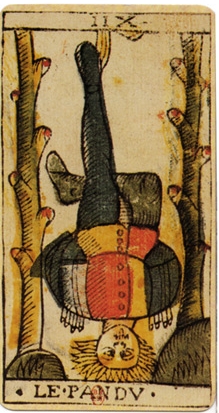
Arcanum XII — Le Pendu (The Hanged Man)
Definition
Arcanum XII presents the most disorienting image in the Major Arcana: a man suspended upside down by one foot. Entirely at ease. The card's philosophical content is inversion itself — the reversal of perspective that occurs when consciousness shifts its center of gravity from the sensory world to the spiritual. What hangs is not the body but a way of seeing. The world perceived from below (material success, social power, self-assertion) looks entirely different when viewed from above (spiritual reality, inner freedom, self-offering).
Both Tomberg (LIB-0084) and Mebes (LIB-0053) treat this Arcanum as the turning point of the sequence. It follows the Wheel of Fortune (CON-0109) and Strength (CON-0110), which together establish the dynamic of fate and the mastery of inner forces. The Hanged Man introduces a third move: the voluntary surrender of that mastery. Not passivity — the figure chose this position. Not defeat — his face is serene. The card depicts what the mystery traditions call katabasis (CON-0002): the descent that is also an ascent, because the one who goes down willingly discovers a freedom unavailable to those who cling to the surface.
The principle at work is paradox held steady. Constraint accepted freely becomes liberation. Loss embraced as offering becomes gain. The Hanged Man does not resolve these paradoxes into a comfortable synthesis; he inhabits them.
Tomberg's Reading (Letter XII)
Tomberg's Letter XII — meditative as always, the prose deliberately slow, each claim turned over and examined before the next arrives — develops the Hanged Man as the Arcanum of practical reversal. His argument proceeds through layers: first the image (a man who reversed his orientation voluntarily), then the moral principle (what the world calls success looks like failure from the standpoint of spirit, and vice versa), then the mystical practice (the soul must learn to "stand on its head" before it can perceive realities invisible to ordinary consciousness).
The key move is Tomberg's insistence that this reversal is not metaphorical. He treats the Hanged Man as depicting an actual reorientation of the cognitive apparatus — a shift in which above and below, gain and loss, activity and passivity trade places. The connection to katabasis (CON-0002) is direct: the initiatory descent into the underworld that every mystery school describes as prerequisite to genuine knowledge. The Hanged Man does not travel downward geographically. He inverts his relation to gravity itself.
Tomberg also develops voluntary constraint. The Hanged Man's hands are bound or hidden — he has surrendered the capacity to grasp, manipulate, build. What remains: the capacity to see and to receive. The precondition for contemplation. One must stop doing before one can begin perceiving. The practical implication for meditation practice is explicit: the meditant who insists on producing results, accumulating experiences, constructing systems has not yet entered the space the Hanged Man occupies.
Mebes' Reading (Arcanum XII)
Mebes assigns Arcanum XII to sacrifice and the reversal of worldly values. Reading Mebes on this card (LIB-0053) is like reading a course syllabus — the principle stated, the correspondences listed, the structural position of each element specified with his characteristic diagrammatic efficiency. Esoteric development requires the practitioner to invert the priorities of ordinary life. Not as ascetic punishment — as cognitive reorientation. What the uninitiated mind treats as real (social position, material accumulation, sensory pleasure) the initiated mind treats as derivative. What the uninitiated mind dismisses as abstract (spiritual law, invisible causation, the life of the soul) becomes the ground of the real.
Within his ternary logic, Arcanum XII completes a triad: the active assertion of Arcanum X, the disciplined force of Arcanum XI, and now the willing self-offering of XII. The synthesis that transcends both action and restraint. Mebes reads this not as private spiritual gesture but as cosmological principle: the universe itself operates through sacrifice, through the willingness of higher orders of being to limit themselves for the sake of what lies below them.
Symbolic Elements
The Marseille card shows a man suspended by one foot from a horizontal beam supported by two trees — or posts with cut branches. His free leg crosses behind the bound one, forming a triangle. Arms behind his back. Out of sight. Despite the apparent torment of the position, his face is calm — often depicted with a subtle expression of peace, even illumination. In many versions a halo surrounds his head. This inversion produces not suffering but enlightenment.
The two trees from which the crossbar hangs carry their own symbolic weight. Their branches are cut — they are living wood shaped by human intention, suggesting that the framework supporting this inversion is itself a product of discipline and cultivation. The figure hangs freely in the space between them, belonging to neither side: suspended between the opposites rather than rooted in one.
Tomberg reads the overall composition as an image of the relationship between freedom and necessity. The rope binds; the spirit within the bound figure is free. Mebes emphasizes the geometrical symbolism: the inverted triangle formed by the legs points downward (toward matter), while the figure's head — the seat of consciousness — occupies the lowest physical point but the highest spiritual one.
Project Role
The Hanged Man names the methodological reversal the project performs. The standard modern approach evaluates the mystery traditions from the outside. Are their claims empirically verifiable? Do their practices produce measurable outcomes? Can their teachings translate into contemporary psychology or neuroscience? Legitimate questions — but they assume the modern framework as stable ground from which the traditions are assessed.
The project inverts this orientation. It asks what the modern condition looks like when viewed from the standpoint of the traditions themselves — when the categories of initiation (CON-0001), katabasis (CON-0002), and epopteia (CON-0003) are taken as descriptions of real cognitive events rather than metaphors in need of demythologization. This is not credulity. It is the willingness to suspend one framework long enough to inhabit another, and to see what becomes visible from that inverted vantage point. The Hanged Man's serenity suggests that the reversal, once accomplished, reveals rather than distorts.
Primary Sources
- Tomberg, Meditations on the Tarot, Letter XII (LIB-0084)
- Mebes, The Course of the Encyclopaedia of Occultism, Arcanum XII (LIB-0053)
Agent Research Notes
[AGENT: cursor | DATE: 2026-03-25] Scaffolded as part of Tarot Major Arcana KB expansion. Body population pending via prompt relay to Claude Code.