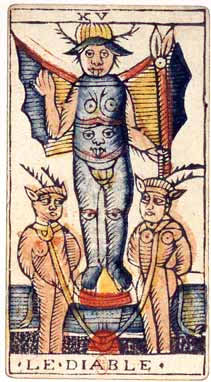
Arcanum XV — Le Diable (The Devil)
Definition
Arcanum XV confronts the question polite esotericism prefers to avoid: evil as a spiritual reality with its own intelligence, its own attraction, its own initiatory power. The Devil is not ignorance. Not the mere absence of good. Not a metaphor for psychological shadow. Tomberg (LIB-0084) and Mebes (LIB-0053) both treat this Arcanum as addressing forces that actively oppose spiritual development — forces that mimic initiation while inverting its direction.
A winged figure presides over two smaller beings chained to its pedestal. The chains are loose. The captives could remove them. This detail carries the Arcanum's philosophical weight: the Devil's power depends on the consent of those it binds. The bondage is voluntary, though the bound may not recognize it as such. Counter-initiation does not force entry. It seduces — offers power, knowledge, belonging, and asks in return only that the bound stop noticing their chains.
The concept extends beyond individual temptation to collective formations. Tomberg's treatment of egregores — psychic entities generated by group thought, emotion, and will — positions the Devil as the Arcanum of collective enchantment. Wherever many minds converge on a single object of fascination without individual discernment, an egregore forms. It takes on a life of its own. Feeds on the attention of its creators. The fifteenth Arcanum maps this territory.
Tomberg's Reading (Letter XV)
Tomberg's Letter XV is among the most original and unsettling in the entire work (LIB-0084). Reading it, you encounter Tomberg at his most unflinching — the meditative, discursive voice suddenly taut, urgent, a man who has watched the twentieth century's collective possessions and refuses to euphemize what he saw. He takes the Devil seriously. Not as a personification of human weakness but as a description of how spiritual evil operates. His central argument: evil generates beings. Persistent thought-patterns, charged with emotion and reinforced by collective will, produce entities that exist independently of their creators. These are egregores — collective phantoms that feed on group psychic energy and acquire quasi-autonomous existence.
The philosophical move is precise. The Devil is not a being comparable to God. The Devil is generated — manufactured when human will, imagination, and desire operate without conscience, without orientation toward truth. What human creativity produces when it serves itself rather than what stands above it. This makes the Devil not less real than a natural being but differently real: a parasite on human freedom, existing only because freedom can be misused.
Tomberg develops counter-initiation at length. Genuine initiation (CON-0001) opens consciousness upward toward spiritual realities. Counter-initiation opens it downward, toward sub-spiritual forces that mimic spiritual authority. The counter-initiate acquires real powers — clairvoyance, influence over others, knowledge of hidden things — but these powers serve the egregore, not the individual. The enchantment: the counter-initiate experiences bondage as liberation.
Tomberg wrote in the aftermath of totalitarianism. His analysis of how egregores capture populations — through the surrender of individual judgment to collective emotion — reads as one of the most trenchant spiritual diagnoses of the twentieth century. Not dated. Not historical. Current.
Mebes' Reading (Arcanum XV)
Mebes assigns Arcanum XV to black magic, the astral light in its deceptive aspect, and the forces of counter-initiation (LIB-0053). His approach is schematic where Tomberg's is meditative — almost diagrammatic, mapping the specific mechanisms by which the practitioner falls from genuine development into its inversion. Every esoteric faculty has its shadow. Clairvoyance becomes psychic manipulation. Knowledge of correspondences becomes sorcery. The will to transform oneself becomes the will to dominate others. Mebes catalogs these inversions with the clinical precision of an occultist who has studied the case histories.
He emphasizes the astral light — the intermediate substance between spirit and matter that carries images, impressions, and forces. In its positive aspect, it mediates between spiritual and physical worlds. In its negative aspect, it becomes a hall of mirrors. The practitioner's own desires reflect back as apparent spiritual realities. The Devil, in Mebes' reading, masters this deceptive reflection: the force that presents illusion as illumination, bondage as freedom.
Symbolic Elements
The Marseille card shows a large winged figure on a pedestal. Bat-like wings — not the feathered wings of Temperance's angel — extend from its back. The figure combines human, animal, and fantastic elements: hooves, horns, a second face on the belly, breasts and male genitalia simultaneously. Visual chaos, and the chaos is itself meaningful. The Devil is a composite, an assemblage, an entity without authentic unity.
Two smaller figures stand chained to the pedestal. The chains hang loose around their necks. They could slip free. This is the essential teaching: the Devil imprisons not by force but by fascination. The bound do not try to escape because they do not experience their condition as captivity. An inverted pentagram sometimes appears above the Devil's head — spirit subordinated to matter, will subordinated to desire. The human being's proper orientation, reversed.
Mebes reads the composite body as the image of the egregore: an artificial entity assembled from disparate human projections, lacking the organic unity of a being created from above. The bat wings parody angelic nature. Spiritual power exercised in darkness rather than light.
Project Role
The Devil raises questions the project cannot avoid. The traditions describe genuine initiatory transformation. They also describe its counterfeit — more common, more accessible, more seductive. Does technique substituting for transformation constitute counter-initiation? Does information substituting for knowledge? Does algorithmic processing substituting for attention?
These are not rhetorical alarms. The questions are precise. Does replacing participatory knowing with data aggregation produce an egregore? Does the collective surrender of individual discernment to algorithmic recommendation constitute voluntary enchainment? The project uses AI tools to investigate traditions that warned against surrendering human faculties to non-human intelligence. The Devil's card sits at the center of this irony. The chains are always loose. The bondage is always voluntary. The first task of discernment is recognizing when one is enchained.
Primary Sources
- Tomberg, Meditations on the Tarot, Letter XV (LIB-0084)
- Mebes, The Course of the Encyclopaedia of Occultism, Arcanum XV (LIB-0053)
Agent Research Notes
[AGENT: cursor | DATE: 2026-03-25] Scaffolded as part of Tarot Major Arcana KB expansion. Body population pending via prompt relay to Claude Code.