Arcanum XXI — Le Monde (The World)
Definition
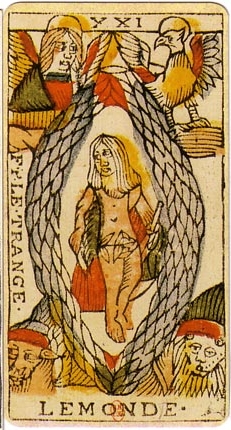
The sequence ends in dance. A figure moves within an oval wreath, surrounded by the four living creatures — angel, eagle, lion, bull — at the card's four corners. The World does not conclude the Major Arcana with a statement, a judgment, or a final truth. It concludes with motion. A body in rhythmic, joyful, perpetual movement within a frame that both contains and celebrates it.
Arcanum XXI addresses cosmic harmony — not as a theoretical proposition but as a lived experience of participation in a living whole. The dancer does not observe the cosmos from outside. The dancer is the cosmos, seen from within, engaged in the activity that holds it together. Tomberg (LIB-0084) and Mebes (LIB-0053) both treat this as the culmination of everything preceding: the death of the old self (CON-0112), the tempering of opposites (CON-0113), the navigation of illusion (CON-0117), the reception of direct light (CON-0118), the resurrection of what was buried (CON-0119). All lead here. The dance that integrates them all.
The World is the Arcanum of final participation (CON-0004) — Barfield's term for consciousness that no longer stands apart from reality as observer but knows itself as participant in reality's ongoing self-expression. Also Gebser's integral structure (CON-0005): all previous structures of consciousness — archaic, magical, mythical, mental — held in transparent co-presence rather than succession. The dance contains all preceding movements. Nothing discarded. Everything transformed.
Tomberg's Reading (Letter XXII)
Tomberg assigns the World to Letter XXII — the final letter of the Meditations (LIB-0084), following the Fool's Letter XXI. Deliberate placement: the Fool is the zero point, the open beginning. The World is the omega point, the fulfilled ending. The entire sequence arcs between them.
Tomberg's central argument: the World dancer holds the same implements as the Magician (CON-0100) — a rod and a spherical object. But the relationship between figure and objects has transformed completely. The Magician stood at a table, concentrating, manipulating instruments with deliberate will. The World dancer moves freely, objects held lightly, almost incidentally, as natural extensions of a body in motion. What began as concentrated play has become cosmic dance. Reading Tomberg here — the final letter, the culmination of a book-length meditation — you sense a writer arriving at something he has been approaching for twenty-one letters. Technique has become grace. The Magician's intention has been absorbed into the dancer's being.
The four living creatures — angel, eagle, lion, bull — operate through multiple symbolic registers. The four evangelists. The four elements. Ezekiel's cherubim. The four fixed signs of the zodiac. Their presence at the corners frames the dance within the full scope of creation. The dance is not a solo performance but a response to a cosmic invitation. The creature dances because the creation calls for dance.
The wreath surrounding the dancer is, in Tomberg's reading, the boundary of a completed transformation. Not a prison. The form a life takes when it achieves its fullest expression — the way a melody has a beginning and ending that define it without confining it. An oval, not a circle. Dynamic rather than static wholeness. An egg rather than a stone.
Tomberg links this to the fermentation pattern (CON-0087) at its final stage. The grain was crushed (Death). The must fermented (Temperance through the Moon). The new substance matured (the Sun, Judgement). Now the wine is poured — not for storage but for celebration. The World dancer is the completed ferment: consciousness transformed through the full alchemical process, expressing its new nature in spontaneous, joyful activity.
Mebes' Reading (Arcanum XXI)
Mebes assigns Arcanum XXI to cosmic synthesis and the completion of the Great Work (LIB-0053). His treatment — schematic to the last, the diagrammatic mind mapping even ecstasy — emphasizes this Arcanum as the summation of the entire system. Every principle introduced in the preceding twenty Arcana finds fulfillment here. The World is not a new teaching. It is the vision of all teachings held simultaneously in living relation.
Mebes reads the four creatures as four fundamental modes of knowledge: intuitive (angel), intellectual (eagle), volitional (lion), practical (bull). The completed adept does not operate through one mode at the expense of the others. All four integrate into a unified activity — the dance that is simultaneously vision, understanding, will, and embodiment. The Great Work's culmination is not the production of a new substance but the realization that the practitioner has become the substance.
In Mebes' ternary logic, the World represents the final synthesis: all prior theses and antitheses united in a living whole that transcends its components without negating them. The dancer contains the Magician's concentration, the High Priestess's receptivity, the Hanged Man's inversion, Death's transformation. All of them. Simultaneously. In motion.
Symbolic Elements
The Marseille card centers on a dancing figure within an oval wreath of laurel or greenery, bound at top and bottom by ribbons. The dancer — female or androgynous, lightly draped or naked — crosses one leg behind the other in a posture of active movement. Each hand holds an object: a rod in one, a small vessel or sphere in the other. The same implements the Magician holds in Arcanum I (CON-0100). Wielded now in a different mode entirely.
At the four corners, outside the wreath, sit the four living creatures: angel (upper left), eagle (upper right), lion (lower right), bull (lower left). Each occupies a stable position, grounded in its corner, while the dancer moves at center. The contrast between the stillness of the four and the motion of the one generates the card's visual rhythm. The cosmos holds steady while the dancer dances within it — or, read differently, the dancer's motion holds the cosmos in place.
The wreath functions as both frame and threshold. It defines the space of the dance without confining it. Tomberg reads the oval as the mandorla — the almond-shaped aureole surrounding Christ in majesty in Romanesque art, signifying the intersection of earthly and divine in a single figure. Mebes reads it as the boundary of the completed Great Work. The circle closes not because the work has been limited but because it has been fulfilled.
Project Role
The World is the horizon toward which the project gestures without pretending to arrive. If the mystery traditions describe a real transformation of consciousness — from the Magician's concentrated intention through death, descent, and resurrection to the dancer's integrated participation — then the World represents what that transformation looks like from the far side. Barfield called it final participation (CON-0004). Gebser called it the integral structure (CON-0005). The project can name it. The project cannot perform it.
It can describe the traditions' testimony that such a state exists. Trace the initiatory sequence they prescribe for reaching it. Identify the dangers along the way — the Devil's enchainment, the Tower's premature construction, the Moon's distortions. But the dance belongs to whoever dances. The World card reminds the project that its ultimate referent is not a concept but an activity. Not something to be understood. Something to be done.
The dancer holds the Magician's implements in transformed hands. This detail matters. The tools are the same — the books, the research, the synthesis, the production. All of these are the rod and the vessel. What changes between Magician and World is not the tools but the relation to them. The project begins as the Magician: concentrating, arranging, making deliberate use of instruments. If it succeeds, it will have moved some distance toward the dancer's freedom. The state in which the tools serve a motion larger than any intention that directed them.
Primary Sources
- Tomberg, Meditations on the Tarot, Letter XXII (LIB-0084)
- Mebes, The Course of the Encyclopaedia of Occultism, Arcanum XXI (LIB-0053)
Agent Research Notes
[AGENT: cursor | DATE: 2026-03-25] Scaffolded as part of Tarot Major Arcana KB expansion. Body population pending via prompt relay to Claude Code.