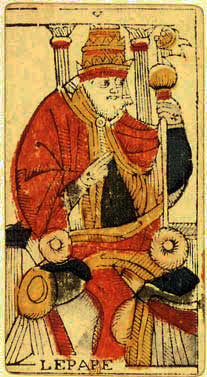
Arcanum V — Le Pape (The Hierophant)
Definition
The Hierophant — Le Pape in the Marseille deck — is the Arcanum of mediation: the vertical transmission of spiritual teaching from one who has received it to those who seek it. The word means, literally, "one who shows the sacred" (from the Greek hierophantes, the chief priest at Eleusis). The Hierophant does not invent what he transmits. He receives from above and passes it below. A channel, not a source.
Vertical transmission differs from horizontal transfer of information. A teacher who conveys facts operates horizontally — knowledge moves from one mind to another at the same level. A hierophant operates vertically — knowledge descends from a higher plane to a lower one, and the mediator makes that descent possible without distortion. Like the Magician, the Hierophant stands between heaven and earth. Unlike the Magician, he works for others. His art: making the vertical operative in the lives of those who kneel before him.
The concept maps onto the project's self-characterization as a hierophantic act (CON-0010). The Mystery Schools podcast does not generate new spiritual content. It mediates existing traditions — receives them through deep reading, transmits them through narration, making what was inaccessible (obscure texts, untranslated sources, traditions fragmented across centuries) available to contemporary listeners.
Tomberg (LIB-0084) and Mebes (LIB-0053) both treat the Hierophant as the fifth Arcanum, completing the second pair (Emperor-Hierophant) and closing the first pentad. Five introduces a new structural principle: the pentagram, the five-pointed star representing, in Hermetic tradition, the human being as mediator between the four elements and the spirit that unifies them.
Tomberg's Reading (Letter V)
Tomberg's Letter V (LIB-0084) develops benediction — the act of blessing — as the Hierophant's essential operation. Not a ritual formality. The act by which the vertical becomes operative: spiritual reality descending through a human mediator to touch those prepared to receive it. The Hierophant blesses, and in blessing, transmits.
Tomberg distinguishes benediction from instruction. A teacher explains. A hierophant blesses. The difference is not that the hierophant withholds information — he adds something information alone cannot carry: the living force of the tradition itself. This is what the Mystery schools understood. Initiation was not the communication of secret doctrines but the transmission of a spiritual reality requiring a living mediator to pass from one generation to the next. The Hierophant is the principle of initiation — not a one-time event but an ongoing act of vertical mediation.
The five senses receive extended treatment. Tomberg reads them as spiritual organs, not merely biological instruments. Sight, hearing, touch, taste, smell — each a mode of contact between the human being and the world, each with a spiritual analogue. The Hierophant, associated with five, activates these spiritual senses, opening the recipient to dimensions of experience that physical senses alone cannot register. Benediction awakens the inner senses.
Tomberg also returns to the question of authority raised in the preceding Letter. The Emperor's authority rests on personal mastery. The Hierophant's rests on something different: fidelity to what he has received. He does not speak for himself. He speaks for the tradition. His authority is the tradition's authority passing through him. This is why the card shows a pope, not a philosopher. The pope's authority is not personal genius but apostolic succession — the chain of transmission connecting the present moment to its source.
Mebes' Reading (Arcanum V)
Mebes (LIB-0053) assigns Arcanum V to the pentagrammatic principle — the domain of religion, law, and teaching. Four material elements (fire, water, air, earth) unified by a fifth: spirit. The Hierophant is the human being who has realized this unification and can therefore mediate between spiritual and material.
Mebes associates the Hierophant with the Hebrew letter He and with law in its spiritual sense — not statutory law but lex divina, the divine law governing the relationship between higher and lower orders of reality. The Hierophant knows this law and teaches it. As always in Mebes, the treatment is architectonic: he maps the position within his system, assigns the correspondences, and proceeds. What Tomberg conveys through pages of slow, circling meditation, Mebes compresses into a structural diagram.
Symbolic Elements
Le Pape sits between two pillars — recalling the Priestess's pillars, but here the symmetry is populated. Two kneeling acolytes face the seated figure, receiving his blessing. The Priestess sat alone with her book. The Hierophant sits with his community. His knowledge is not private. It is transmitted. The act of transmission is the card's subject.
The triple crown — the triregnum — marks authority over three worlds (physical, psychic, spiritual), the same triple sovereignty the Priestess's tiara indicates. In his hand, a triple-barred staff or cross reinforces the three-fold structure. Three recurs within five: the Hierophant's mediation is ternary (above, mediator, below) even as his sequential position is pentadic.
The two acolytes are tonsured, committed to the religious life. They kneel — the posture of reception — faces turned upward. The Hierophant looks down toward them. The vertical axis is visible in the composition itself: flow from the top of the card (crown, source) through the Hierophant's body and hands to the kneeling recipients below.
The act of blessing — one hand raised, fingers extended in benedictio — is the card's central action. Nothing else moves. He does not walk, does not hold a book, does not manipulate instruments. He blesses. The simplicity carries the weight: mediation requires no apparatus. Only a channel clear enough to transmit what it receives.
Project Role
The Hierophant is the project's self-image. CON-0010 develops this at length: the mediation of traditions inaccessible to most contemporary listeners, not because they are secret but because they require contexts — linguistic, historical, philosophical — that few people now possess.
The project acts as Le Pape acts. Receives the traditions through deep reading of primary sources. Transmits them through narrated episodes. Does not invent. Mediates. The authority claimed is not personal but the traditions' own, passing through the project as the Hierophant's blessing passes through his raised hands.
This self-characterization carries an obligation. The Hierophant's fidelity to what he has received is non-negotiable. Distort the transmission — add inventions, soften difficult content, inflate marginal ideas — and the hierophant becomes a propagandist. The project's commitment to source fidelity, accurate citation, and honest representation of positions it disagrees with flows from this identification. The Hierophant blesses; he does not editorialize. Or rather: his editorial choices are themselves acts of mediation, selecting what to transmit and in what order, but never falsifying what the sources actually say.
Primary Sources
- Tomberg, Meditations on the Tarot, Letter V (LIB-0084)
- Mebes, The Course of the Encyclopaedia of Occultism, Arcanum V (LIB-0053)
Agent Research Notes
[AGENT: cursor | DATE: 2026-03-25] Scaffolded as part of Tarot Major Arcana KB expansion. Body population pending via prompt relay to Claude Code.