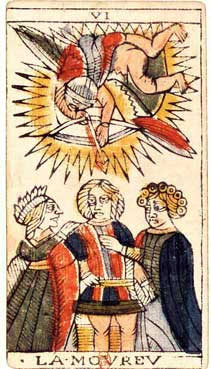
Arcanum VI — L'Amoureux (The Lover)
Definition
The sixth Arcanum of the Major Arcana (CON-0097) is the card of choice — not trivial preference, but the act of discernment that commits the whole person. The Tarot de Marseille (CON-0098) titles it L'Amoureux, the Lover in the singular, not "the Lovers." That grammatical precision matters. This is not a card about romance or partnership. It depicts a single figure at a crossroads, facing a decision that will determine the direction of everything that follows.
The choice the card presents is not between good and evil in any simple moral sense. The two women flanking the young man represent two modes of life, two orientations of attention — one toward the sensible world, one toward the intelligible. Above, a winged figure draws its bow. Something descends to meet the one who chooses rightly. Discernment here is not calculation. It is an act of the whole being, which is why Tomberg (LIB-0084) reads the Arcanum through the lens of the three vows.
Mebes (LIB-0053) approaches the same image from his characteristic structural angle — schematic, almost diagrammatic, each Arcanum slotted into ternary logic like a lesson in an occultist's curriculum. Arcanum VI marks where paths diverge: the initiate tested not by external obstacles but by the requirement to choose between legitimate possibilities. The hexagram — six as the number of intersection — encodes this geometrically. Two triangles meeting. Two directions of force held in a single figure.
Tomberg's Reading (Letter VI)
Tomberg's sixth Letter — written in his characteristic mode of slow, discursive meditation, a man thinking aloud at a desk, turning each idea over before setting it down — takes the three vows of the religious life and strips them of their monastic packaging to reveal their epistemological content. This is his signature move: take a form that appears to belong exclusively to devotional practice and demonstrate that it names a universal condition of consciousness.
Obedience, as Tomberg reads it, is not submission to external authority. It is the alignment of personal will with the structure of spiritual reality — what he calls "listening to the voice from above." The obedient person is not passive. The obedient person is the one whose antenna works. Poverty is not material deprivation but the emptiness that can receive. A consciousness stuffed with its own opinions has no room for anything new to enter. Chastity is the integrity of attention — the refusal to dissipate consciousness across multiple objects of fascination. A chaste consciousness does not flirt. It commits.
The three vows, taken together, describe the conditions under which genuine spiritual knowledge (gnosis, CON-0009) becomes possible. They are not moral prescriptions but epistemic prerequisites. You cannot hear what reality is saying if you are talking over it (poverty). You cannot follow where the inquiry leads if you insist on leading (obedience). You cannot sustain the concentration the work demands if your attention scatters at every distraction (chastity).
The young man between two women is the soul at its moment of decision. The winged figure above — angel or Eros, depending on the reader — signals that the choice is not made in isolation. Something meets the chooser from the other direction. The vertical axis cuts across the horizontal plane of alternatives. Tomberg reads this as grace descending into the field of free choice: human discernment and divine initiative converging in a single act.
Mebes' Reading (Arcanum VI)
Mebes assigns Arcanum VI to choice, discernment, and the testing of the initiate. Where Tomberg reads the image phenomenologically — attending to what the vows do in consciousness — Mebes reads it architectonically. He maps the Arcanum onto the structure of the initiatory path the way an engineer maps load-bearing walls. Reading him is like reading a blueprint: precise, depersonalized, everything in its designated position.
The hexagram governs this Arcanum in his system. Two interlocking triangles — aspiration rising, grace descending — form the structural basis of the choice. The initiate does not merely select between options but stands at the intersection of two forces and must orient correctly within that field. A testing point in the curriculum. The moment where theoretical understanding must become practical commitment.
Symbolic Elements
The Marseille card shows a young man standing between two women. One is often read as virtue, the other as vice, but the image resists that simple moralization — both women appear respectable, even appealing. The choice is not obvious. That is the point.
Above the three figures, a winged being draws a bow, arrow pointed downward. Whether this figure represents Eros, an angel, or the solar principle depends on the interpreter, but its function is consistent across readings: it marks the vertical axis. The choice between the two women occurs on the horizontal plane; the winged figure introduces the dimension of height. The sun appears at the top of the card, reinforcing this vertical orientation.
The card's title — L'Amoureux, singular — identifies the young man, not the group. He is the Lover: the one who must choose what to love, and in choosing, become.
Project Role
The Lover names the decision the project itself has made: to treat the esoteric traditions as reports from a real territory of experience rather than as cultural artifacts to be catalogued and contextualized from a safe distance. Not a neutral methodological preference. A commitment — one that shapes every subsequent inquiry, determines what questions get asked, what evidence counts, what standards of coherence apply.
The three vows, as Tomberg reads them, map onto the project's epistemic stance. Obedience: listening to what the sources actually say rather than ventriloquizing them through contemporary frameworks. Poverty: remaining open to findings that complicate the thesis rather than defending a predetermined position. Chastity: sustaining focused attention on difficult material without dissipating into eclecticism or spectacle.
The project stands, like the young man, between two women: the scholarly tradition that treats esotericism as an object of historical study, and the devotional tradition that treats it as received truth. The winged figure above — the possibility that sustained attention to the material might yield something neither purely historical nor purely devotional — is the wager the project makes.
Primary Sources
- Tomberg, Meditations on the Tarot, Letter VI (LIB-0084)
- Mebes, The Course of the Encyclopaedia of Occultism, Arcanum VI (LIB-0053)
Agent Research Notes
[AGENT: cursor | DATE: 2026-03-25] Scaffolded as part of Tarot Major Arcana KB expansion. Body population pending via prompt relay to Claude Code.