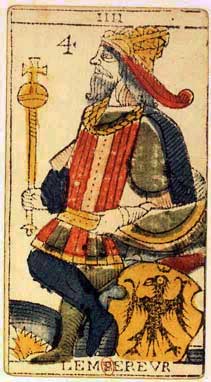
Arcanum IV — L'Empereur (The Emperor)
Definition
The Emperor is the fourth Arcanum. His subject is authority — but not authority as the modern world typically understands it. He does not command through force, institutional position, or inherited status. His authority arises from mastery: the long, patient accumulation of experience that eventually confers the right to speak and the capacity to order. He earned his throne.
The distinction between potestas (power conferred by office) and auctoritas (authority earned through depth) runs through the entire Hermetic tradition and is central to Tomberg's reading. The Emperor does not seize power. He arrives at it. Crossed legs indicate repose, not aggression. He sits because he has finished the journey that conferred his authority. He governs from stillness.
The Emperor also introduces reason as a spiritual instrument. The Magician concentrates. The Priestess reflects. The Empress generates. The Emperor orders. He takes the products of creative imagination and gives them structure — the capacity to think clearly, to distinguish, to arrange. Reason here is not the cold mechanism of formal logic. It is warm, living intelligence that perceives the logos — the rational order within created reality — and cooperates with it.
Tomberg (LIB-0084) and Mebes (LIB-0053) both place the Emperor fourth, beginning a new phase. The first ternary (Magician, Priestess, Empress) is complete. The Emperor opens the second cycle, applying the principles of the first three Arcana to manifest reality — the world of form, structure, and law.
Tomberg's Reading (Letter IV)
Tomberg's Letter IV (LIB-0084) takes up the question of how spiritual authority comes into being. His answer: through the integration of opposites. The Emperor's crossed legs — one folded over the other, forming either a cross or the figure four — are the card's key symbol. They indicate that the Emperor has resolved within himself the tensions the first three Arcana established: action and reception, will and contemplation, initiative and patience. He has not eliminated these polarities. He holds them together. The holding is what confers his authority.
Genuine authority, Tomberg argues, cannot be claimed or conferred. Only recognized. A person who has achieved the integration the Emperor embodies does not need to assert authority — others perceive it. The Emperor's power is not coercive. It operates through the gravitational pull of maturity. People defer to him not because he compels them but because his judgment has been tested and found reliable.
The method of analogy, introduced in Letter I, receives extended treatment here. Tomberg identifies the lex analogiae — the law of analogy from the Emerald Tablet — as the Emperor's rational instrument. Analogy perceives correspondence between levels of reality: the mineral kingdom mirrors the celestial, the human body the cosmos, the soul's structure the structure of society. The Emperor thinks analogically. He sees the same pattern operating at different scales, and this perception is the basis of his ordering intelligence.
Tomberg also sharpens the distinction between authority and authoritarianism. The authoritarian imposes his order on reality from outside. The Emperor perceives the order already present and aligns himself with it. His dominion is stewardship, not domination — the governance of someone who understands the nature of what he governs because he has taken the time to know it.
Mebes' Reading (Arcanum IV)
Mebes (LIB-0053) assigns Arcanum IV to the quaternary principle — the first appearance of four in the sequence. The quaternary introduces stability, manifestation, the material world. The ternary (Arcana I–III) operated in pure principles. The quaternary brings those principles into concrete realization.
Mebes associates the Emperor with the four elements — fire, water, air, earth — and the Hebrew letter Daleth. His authority is the authority of form over matter, structure over chaos. In Mebes' scheme the Emperor marks the transition from metaphysical to physical, principle to manifestation. The treatment is characteristically taxonomic: Mebes names the structural position, maps the correspondences, and advances to the next card.
Symbolic Elements
L'Empereur sits on a throne, body turned slightly in profile. Scepter in one hand, the other resting on a shield. His legs are crossed — the card's most distinctive feature, the detail both Tomberg and Mebes treat as interpretively decisive. The crossed legs form the figure four, visually encoding the card's number into the ruler's body.
The scepter terminates in a sphere or orb: dominion over the material world. Unlike the Magician's wand, which points upward toward the spiritual, the Emperor's scepter is an instrument of earthly governance. The shield bears an eagle — the same eagle on the Empress's shield, linking the two cards, suggesting that authority and fecundity share a spiritual source.
The throne matters. The Emperor does not stand. He is established. Settled, rooted, finished. The chair is functional, not ornate — the seat of one who governs, not one who displays. The overall impression is consolidation: energies that flowed and generated in the Empress have been stabilized, given lasting form.
Project Role
The Emperor represents the kind of authority the project claims for the traditions it examines. These traditions do not derive their weight from institutional endorsement or academic consensus. They derive it from depth of engagement — centuries of practitioners who took the material seriously, tested it against experience, transmitted what survived the test.
Earned authority. Not imposed. The project does not ask listeners to accept the Hermetic tradition on faith. It presents the tradition's claims, identifies their sources, traces their development, and lets the depth of the material generate its own persuasive force. The Emperor governs not by compulsion but by the gravitational pull of substance.
The Emperor also represents the project's commitment to rational structure. Imaginative synthesis (the Empress) must be disciplined by rational order (the Emperor) or it degenerates into speculation. The knowledge graph, the source citations, the careful attribution — Emperor-mode operations. They give form to what creative imagination produces and make it available for scrutiny.
Primary Sources
- Tomberg, Meditations on the Tarot, Letter IV (LIB-0084)
- Mebes, The Course of the Encyclopaedia of Occultism, Arcanum IV (LIB-0053)
Agent Research Notes
[AGENT: cursor | DATE: 2026-03-25] Scaffolded as part of Tarot Major Arcana KB expansion. Body population pending via prompt relay to Claude Code.