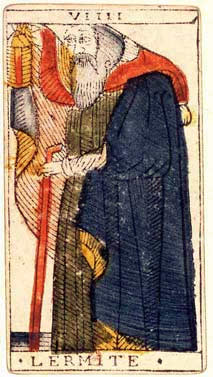
Arcanum IX — L'Hermite (The Hermit)
Definition
The ninth Arcanum of the Major Arcana (CON-0097) is the image of the Hermeticist — the one who walks alone between two darknesses. Not the darkness of ignorance, which lies behind, and not only that. Also the darkness that lies ahead: the ultra-light darkness of knowledge that exceeds the capacity of ordinary consciousness to receive. The Hermit walks between these two darknesses with a lamp that illuminates only the next step and a staff that tests the ground before each footfall.
This Arcanum stands apart from the preceding eight in tone and intimacy. Where the Magician (CON-0100) demonstrates, the High Priestess (CON-0101) guards, and the Chariot (CON-0106) masters, the Hermit walks. His method is not spectacular. Patient, solitary, sustained. The lamp does not flood the landscape with light; it reveals just enough to continue. The staff does not strike; it probes. Here is a consciousness that has accepted the conditions under which genuine knowledge becomes available: slowly, partially, through sustained attention rather than sudden illumination.
Both Tomberg (LIB-0084) and Mebes (LIB-0053) treat this Arcanum as a hinge in the sequence — the point where the outward, structural Arcana of the first cycle yield to something more interior and methodological. The Hermit is not learning a new doctrine. He is practicing a way of knowing.
Tomberg's Reading (Letter IX)
The ninth Letter is the richest and most personal of the early Meditations (LIB-0084) — Tomberg at his most methodologically revealing, his meditative prose slowing even further, circling back on itself, as if the act of writing were itself the Hermit's walk. He identifies the Hermit not as a figure of isolation but as the image of the Hermeticist as such — the practitioner of the Hermetic method, which proceeds by walking between the two darknesses.
The two darknesses are not metaphors. The infra-light darkness: ignorance, confusion, the noise of unexamined assumptions — what has not yet been illuminated. The ultra-light darkness: what exceeds the current capacity of consciousness to hold — the apophatic (CON-0007) dimension of knowledge, where what is known becomes so concentrated it can no longer be expressed in ordinary concepts. The Hermit walks between these two. He is never fully in the light. Always partially in the dark, always working at the edge of what he can see.
Tomberg develops three antinomies — faith and empirical knowledge, the vow system and personal freedom, knowledge and will — and demonstrates that each pair is not a contradiction to be resolved but a polarity to be held in living tension. The coincidentia oppositorum (CON-0017) applied to the practice of knowing itself. The Hermit does not choose between faith and reason. He walks with both. The friction between them generates the light his lamp casts.
The mantle the Hermit wears is what Tomberg calls the "gift of Perfect Night," drawing on the Hermetic text Kore Kosmu from the Stobaeus collection. The mantle is the capacity to endure not-knowing — to keep walking when the darkness on both sides presses in. Not resignation. The specific courage of an intellect that refuses to fabricate certainty where none exists.
The heart, Tomberg argues, is the organ of the Hermit's method. Not the heart of sentiment — the heart as the organ uniting contemplation and action, the organ that "walks, day and night," sustaining inquiry through illumination and darkness alike. The Letter also contains Tomberg's "scientific creed," a precise inversion of the Nicene Creed articulating the faith-structure underlying empirical science, and his reading of the serpent's promise in Genesis (eritis sicut dei, scientes bonum et malum) as genuine prophecy. Fulfilled not through transgression but through the Hermetic path of walking knowledge.
Tomberg closes with an image that has no parallel in the other Letters: when two hermits meet on the road, there is joy. Not the joy of ending solitude — the solitude continues — but the joy of shared responsibility. The Hermit's address to his "Unknown Friend" throughout the book is this meeting on the road.
Mebes' Reading (Arcanum IX)
Mebes assigns Arcanum IX to prudence, initiation, and the Hermetic method — and reading him on this card, one encounters the schematic clarity that defines his entire Course (LIB-0053): each element catalogued, each correspondence labeled, the whole system arranged like a periodic table of occult principles. The ennead governs: nine as the final single digit, the individual cycle completed before the return to unity at ten. The Hermit stands at the threshold of completion. Everything that follows recapitulates the first nine Arcana at a higher level.
The lamp represents individual consciousness — not transmitted teaching, not collective wisdom, but the hard-won illumination of a single mind that has worked through the preceding stages. The staff represents method: the systematic approach keeping the solitary practitioner from wandering into error. Mebes reads the Hermit as the initiate who has internalized the teaching and now carries it forward independently. No longer reliant on the school that formed him.
Symbolic Elements
The Marseille card shows a cloaked figure walking alone. Hooded, holding a lamp in one hand and a staff in the other. The mantle covers nearly everything; only the face, the lamp, and the hand on the staff are visible. This concealment is itself a teaching. The Hermit's knowledge is not displayed. It is carried interiorly, shared only with those who meet him on the road.
The lamp illuminates only the next step. Not the horizon, not the destination, not the landscape — the next step. This constraint is both the Hermit's limitation and his discipline. He does not claim to see farther than he sees. The staff in the other hand serves a different function from the Magician's wand: it does not direct force but tests solidity. It asks: is this ground real? Will it hold weight?
The Hermit walks. He does not sit like Justice (CON-0107), stand like the Magician (CON-0100), or ride like the Charioteer (CON-0106). Walking is the Hermit's mode: steady, rhythmic, forward-moving, never arriving. The destination is not the point. The walking is the point.
Project Role
The Hermit is the project's self-image — or more precisely, the image of its narrator. The narrator thinks alone in the presence of the listener, walking between the darkness of what the traditions once knew and the darkness of what exceeds current frameworks of understanding. The lamp illuminates only the next step. The next source. The next connection. The next careful distinction.
This is not false modesty. The traditions the project investigates claim access to forms of knowledge that contemporary consciousness does not readily reproduce. The project cannot verify these claims from the outside, and it refuses to accept them on authority from the inside. It walks between these two limitations — the infra-light darkness of historical distance and the ultra-light darkness of experiential claims that resist third-person verification — with the lamp of sustained attention and the staff of critical method.
When two hermits meet on the road, there is joy. The project's address to its listener recapitulates Tomberg's address to his Unknown Friend: not a teacher instructing a student, not a performer entertaining an audience, but one walker recognizing another in the shared responsibility of taking the inquiry seriously.
Primary Sources
- Tomberg, Meditations on the Tarot, Letter IX (LIB-0084)
- Mebes, The Course of the Encyclopaedia of Occultism, Arcanum IX (LIB-0053)
Agent Research Notes
[AGENT: cursor | DATE: 2026-03-25] Scaffolded as part of Tarot Major Arcana KB expansion. Body population pending via prompt relay to Claude Code.