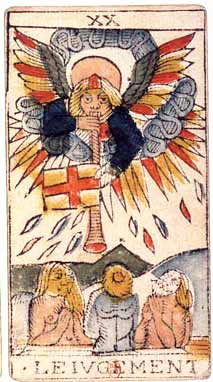
Arcanum XX — Le Jugement (Judgement)
Definition
A trumpet sounds from above. The dead rise. Arcanum XX depicts the moment when a call from a higher order of reality reaches into the depths and awakens what had been asleep, buried, forgotten. Not a future eschatological event alone — a present possibility for consciousness, available whenever the call is heard and answered.
Tomberg (LIB-0084) and Mebes (LIB-0053) both distinguish this card from conventional Last Judgement imagery. No courtroom scene. No judge presides. No verdict rendered. An angel sounds a trumpet, and the dead rise. That is all. The emphasis falls entirely on call and response. Something sounds from above with the power to penetrate sealed tombs and reanimate what lay within. The dead do not rise by their own effort. They are raised by what they hear.
This places Judgement in direct relation to the initiatory sequence. Initiation (CON-0001) begins with a call — the summons the uninitiated hears as appeal and the initiated recognizes as command. Katabasis (CON-0002) is the descent that follows. Epopteia (CON-0003) is the vision that rewards the descent. Judgement adds the final element: the rising that follows death. Consciousness reconstituted at a level it could not have reached without first dying and being called back.
Tomberg's Reading (Letter XX)
Tomberg's Letter XX treats Judgement as the resurrection of consciousness — the awakening of faculties dormant, suppressed, or lost (LIB-0084). Reading Tomberg here, the discursive voice acquires an almost prophetic urgency, rare in his measured prose. His argument is precise: resurrection is not restoration of what existed before death. It is the manifestation of what could not exist until death occurred. The figures rising from the tomb do not return to their former lives. They enter a mode of existence that required the tomb as precondition.
The trumpet does not create what it awakens. It calls forth what was already present in potentia. The dead carried the capacity for resurrection, but that capacity could not actualize itself — it required a call from outside, from above, from a source the dead themselves could not produce. Tomberg reads this as the structure of grace. The human being can prepare, descend, undergo death. But the rising comes from elsewhere.
The argument extends beyond individual resurrection to the resurrection of knowledge. Entire domains of understanding can die — sealed in cultural tombs, inaccessible to the living. The Hermetic tradition, Tomberg suggests, underwent such a burial. Contents not destroyed but entombed: preserved in texts, symbols, practices whose meaning became opaque as the consciousness capable of reading them contracted. The angel's trumpet represents whatever force re-opens these sealed domains. Whatever call reaches into the cultural tomb and raises what had lain dormant.
This is among Tomberg's most forward-looking meditations. He writes about civilizational resurrection — the awakening of capacities modernity declared dead but that persist, entombed, awaiting the call.
Mebes' Reading (Arcanum XX)
Mebes assigns Arcanum XX to resurrection, the call to awakening, and the eschatological dimension of consciousness (LIB-0053). His treatment, characteristically systematic — Mebes maps the Arcanum's position with the precision of an engineer reading a blueprint — emphasizes that resurrection is possible only after the full cycle of descent, death, and transformation has been completed. No shortcut. No self-generation.
Mebes develops a principle: the call from above operates at multiple scales simultaneously. Individual level — the practitioner's accumulated work crystallizes into a new capacity, a faculty prepared in darkness suddenly emerging into light. Collective level — a tradition or civilization that has undergone its nigredo begins showing signs of new life. Mebes reads the three figures in the tomb (man, woman, child) as the full triad of consciousness: active principle, receptive principle, their synthesis. All three raised simultaneously by the single trumpet call.
Symbolic Elements
The Marseille card divides into upper and lower registers. Above, an angel emerges from clouds, sounding a long trumpet from which a banner hangs. The angel's posture orients downward — the call descends. Below, three figures rise from an open coffin set in the ground: a man, a woman, a small figure between them. Hands raised — in prayer, astonishment, reception.
The trumpet is the card's central object. It bridges the registers, connecting the angel's domain (above clouds, beyond the visible world) to the tomb (below surface, within earth). The medium is sound. Not light, not touch, not sight. Hearing. The choice matters. Sound penetrates where light cannot — enters sealed spaces, passes through walls, reaches the deaf as vibration. The call that raises the dead operates through a faculty that does not require open eyes or an active mind. It reaches consciousness below voluntary attention.
The triad of man, woman, and child echoes the ternary structures organizing the entire Arcana system: active, passive, their synthesis. What rises from the tomb is not a single faculty but the full structure of consciousness, reconstituted. The open coffin remains visible. Resurrection does not erase death. It presupposes it.
Project Role
The project carries a wager at its core: something the modern world declared dead is not dead but entombed. The mystery traditions, the participatory modes of consciousness they cultivated, the initiatory knowledge they transmitted — sealed in a cultural tomb by the Enlightenment's reduction of knowledge to what can be measured, tested, publicly verified. The texts survive. The symbols persist. The practices are recorded. But the consciousness that could read, inhabit, and enact them contracted. What remains is a tomb. Preserved contents, inaccessible.
Judgement asks whether a call can reach into this tomb. The project does not claim to be that call — at most, a description of the trumpet's sound, an account of what resurrection would look like if it occurred. But describing the traditions' testimony with seriousness and precision, refusing to dismiss what the modern mind finds implausible, is itself a form of opening the lid. Whether the contents rise depends on something the project cannot control. The listener's capacity to hear what the traditions actually said. To recognize in that hearing not a historical curiosity but a summons.
Primary Sources
- Tomberg, Meditations on the Tarot, Letter XX (LIB-0084)
- Mebes, The Course of the Encyclopaedia of Occultism, Arcanum XX (LIB-0053)
Agent Research Notes
[AGENT: cursor | DATE: 2026-03-25] Scaffolded as part of Tarot Major Arcana KB expansion. Body population pending via prompt relay to Claude Code.