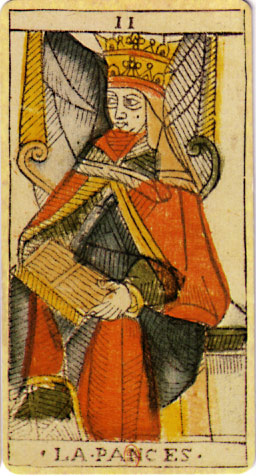
Arcanum II — La Papesse (The High Priestess)
Definition
The High Priestess — La Papesse in the Marseille deck — is the Arcanum of gnosis (CON-0009): knowledge that arrives not through analysis but through reception. She sits where the Magician stands. Holds a book where he holds a rod. Her eyes rest on what is before her; his gaze wanders. Everything about her posture reverses his. The reversal is the point. The Magician enacts the active mode of knowing — concentration directed outward through will. The Priestess enacts the passive mode — attention turned inward through stillness.
Gnosis here does not mean secret information or occult data. It means direct, unmediated knowing — the kind that arises when the mind ceases to construct and begins to reflect. A mirror does not reach out to seize the image. It receives. The Priestess is the mirror. Her knowledge is the knowledge of surfaces that have become perfectly still: what they show is not their own invention but the reality that falls upon them.
This places the High Priestess in the tradition of apophatic knowing (CON-0007) — the via negativa that defines the divine by what it is not, approaching truth by removing obstacles to its reception rather than building frameworks to contain it. She does not argue. Does not demonstrate. She reads — and the book she reads is not a human composition but the Book of Nature itself, legible only to the gaze that has learned to be still.
Tomberg (LIB-0084) and Mebes (LIB-0053) both place her second, immediately after the Magician, establishing the fundamental polarity of the entire Arcana sequence: action and reception, will and contemplation, speech and silence. Every subsequent Arcanum unfolds from this initial pair.
Tomberg's Reading (Letter II)
Tomberg's Letter II (LIB-0084) takes up reflection as a mode of knowing. The Magician concentrated; the Priestess reflects. Tomberg distinguishes reflection from mere thinking. Thinking constructs — assembles concepts, draws inferences, builds arguments. Reflection receives. It allows an impression to form on the still surface of consciousness, the way a landscape forms on the surface of a lake.
The book the Priestess holds is central. Not a book of doctrine, not a textbook of esoteric knowledge — the Book of Nature, the created world read as a text. This reading requires a particular attention: not the analytical attention that dissects but the contemplative attention that perceives wholes. Tomberg argues that nature, rightly read, is a revelation. The physical world speaks to the consciousness that has learned to listen. The Priestess models this listening.
Tomberg connects the Priestess to gnosis (CON-0009), distinguishing it from both faith and empirical knowledge. Faith accepts on authority. Empirical knowledge verifies through experiment. Gnosis knows directly — the way you know that you are awake. Not irrational; it does not contradict reason. But reason does not produce it. It is the fruit of the contemplative silence the Priestess embodies.
The veil between the Priestess's pillars marks the boundary between the manifest and the hidden. Tomberg reads it not as a barrier but as a threshold — a membrane through which influence passes in both directions. The visible world is not sealed off from the invisible. It is separated by a veil thin enough to be transparent to the attentive gaze. The Priestess sits at this threshold. She reads what comes through.
Mebes' Reading (Arcanum II)
Mebes (LIB-0053) assigns Arcanum II to the passive principle — the antithesis to the Magician's thesis. Where Arcanum I introduces will and initiative, Arcanum II introduces receptivity and reflection. The logic is binary: every active principle calls forth a corresponding passive one, and the tension generates the third term. Reading Mebes here, the prose is almost diagrammatic — he is mapping structural positions, not describing interior states.
He associates the Priestess with the Hebrew letter Beth and the principle of duality — the moment the One becomes Two. Not a fall. A precondition for knowledge, which requires a knower and a known, a subject and an object. The Priestess makes the Magician's activity knowable by providing the reflective surface against which it can be perceived.
Symbolic Elements
La Papesse sits between two pillars, a veil stretched between them. The pillars have been read as Solomon's — Jachin and Boaz — marking the threshold of the sacred precinct. The veil is not opaque. It filters rather than blocks.
She wears a papal tiara — the triple crown — signaling authority over three worlds: physical, psychic, spiritual. A blue mantle covers her. Blue: the color of contemplation and depth. She is seated, stable, in repose — the opposite of the Magician's mobile readiness.
The open book on her lap is the card's defining object. Her reading is not the scanning of text but the absorbed attention of someone receiving a communication. The book is open. The knowledge is available. But it requires a reader capable of the stillness necessary to receive it.
Project Role
The High Priestess establishes the second coordinate of the project's method. The Magician supplies active concentration — focused attention brought to bear on sources. The Priestess supplies receptive silence — willingness to let the sources speak rather than forcing them into predetermined frameworks.
This polarity maps onto the apophatic dimension (CON-0007) the project identifies as central to the Mystery tradition. The Mysteries were not information. They were experiences requiring a particular state of receptivity, one the discursive intellect alone could not produce. The Priestess models that state. She does not analyze the book. She reads it. The difference matters: a scholar who dissects a text versus a reader who allows a text to change her.
For AI-assisted work, the Priestess poses a pointed question. A language model can process every text in the library simultaneously. It cannot read any of them in the Priestess's sense — cannot sit in silence before a text and allow it to form an impression on a still surface. The project's human contribution is precisely this Priestess-mode attention: receiving what the sources actually say, not what a pattern-matching system predicts they will say.
Primary Sources
- Tomberg, Meditations on the Tarot, Letter II (LIB-0084)
- Mebes, The Course of the Encyclopaedia of Occultism, Arcanum II (LIB-0053)
Agent Research Notes
[AGENT: cursor | DATE: 2026-03-25] Scaffolded as part of Tarot Major Arcana KB expansion. Body population pending via prompt relay to Claude Code.