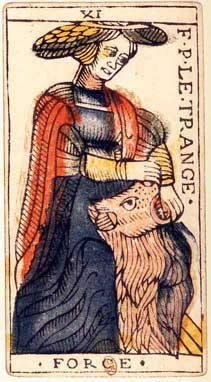
Arcanum XI — La Force (Strength)
Definition
The eleventh Arcanum of the Major Arcana (CON-0097) redefines force. A woman opens the jaws of a lion with her bare hands. No strain. No struggle. No weapon. The lion does not resist — or rather, its resistance dissolves in the presence of a power it cannot comprehend because that power does not oppose it.
This is the Arcanum of spiritual force: the kind of strength that overcomes not by overpowering but by being of a different order entirely. Physical force meets resistance and must exceed it. Spiritual force meets resistance and transmutes it. The distinction is not decorative. It names two fundamentally different relationships between consciousness and the forces it encounters — one based on opposition, the other on integration.
The Tarot de Marseille (CON-0098) titles the card La Force, which means both "strength" and "force" without the English distinction between them. That ambiguity is productive. The card collapses the difference between the capacity (strength) and its exercise (force) because in the domain this Arcanum addresses, they are the same thing. The woman does not store strength and then deploy it; her strength is the act of opening the lion's mouth. It exists only in practice.
Tomberg (LIB-0084) reads this as the culmination of a principle introduced with the Magician (CON-0100): concentration without effort. Mebes (LIB-0053) reads it as the domain of spiritual mastery over the vital forces. Both recognize that the Arcanum inverts the ordinary understanding of power — and that this inversion is not paradox for its own sake but a precise description of how consciousness actually operates when it has reached a certain maturity.
Tomberg's Reading (Letter XI)
Tomberg's eleventh Letter — still in his meditative, unhurried mode, each paragraph a slow circling toward the image's center — develops the principle of "force without effort." The phrase sounds like a contradiction until the Arcanum demonstrates what it means. The woman opens the lion's jaws without strain. She does not wrestle the lion into submission. Does not trick it, drug it, exhaust it. She opens its mouth the way one opens a book: with the confidence that comes from an entirely different relationship to what is being opened.
Tomberg distinguishes two kinds of force. Compulsive force — the force of muscle, machinery, political coercion — operates by exceeding resistance. It requires more power than whatever it pushes against. It breaks, bends, or exhausts. Spiritual force operates differently. It does not exceed resistance; it renders resistance irrelevant by addressing a deeper level of the being that resists. The lion's jaws are powerful. But the woman's hands operate on a plane where jaw-strength does not apply.
This principle connects directly to the Magician's "concentration without effort" (CON-0100). The Magician concentrates — fully, completely — without the muscular tension that ordinarily accompanies effort. The woman of Strength exercises force — fully, completely — without the struggle that ordinarily accompanies power. Both figures demonstrate that the highest form of any capacity operates without the characteristic friction of its lower form. Concentration at its peak is effortless. Force at its peak is gentle.
Tomberg reads the lion as the vital, instinctual forces of the human being — not evil, not fallen, but wild. These forces are not to be killed (ascetic suppression), not to be indulged (libertine surrender), but integrated. The woman does not close the lion's mouth; she opens it. She does not silence the vital forces; she gives them expression under the governance of a consciousness they recognize as sovereign. The lion submits not because it is defeated but because it encounters something it was always oriented toward.
Mebes' Reading (Arcanum XI)
Mebes assigns Arcanum XI to spiritual strength and the mastery of vital forces. The undecimal principle — eleven as the first number beyond the completed denary cycle — signals that this Arcanum operates in new territory. The first ten Arcana have completed their circuit; Strength begins the second pass at a higher level.
His treatment (LIB-0053) is characteristically schematic — a lesson outline more than a meditation, each term defined, each correspondence catalogued with the methodical precision of an occultist who treats the Arcana the way a chemist treats elements. The woman and the lion form a binary that the act of opening resolves into a ternary: spiritual principle (woman), vital principle (lion), integration (the open mouth, the act itself). Thesis-antithesis-neutralization — Mebes' consistent method. The neutralizing term is not a compromise between the two poles but a living act holding both in full intensity.
Mebes connects this Arcanum to the practical domain of working with the body's vital energies — what various traditions call prana, chi, or the etheric forces. The point is not to suppress these energies but to redirect them under the governance of conscious intention, exactly as the woman redirects the lion's force without diminishing it.
Symbolic Elements
The Marseille card shows a woman standing, opening the jaws of a lion with her bare hands. The absence of tools — no sword, no chain, no whip — is the card's most legible symbol. Every other image of human dominion over animal power involves an instrument. Here there is only direct contact: hand to jaw, consciousness to instinct, with nothing mediating.
The woman wears the lemniscate hat — the figure-eight or infinity symbol above her head — connecting her directly to the Magician (CON-0100), who wears the same sign. This visual link across the Major Arcana sequence establishes that the Magician's principle (concentration without effort) and Strength's principle (force without strain) are the same principle operating in different domains. The Magician works at the table of the mind; the woman of Strength works in the arena of the will.
The lion is not diminished. It remains a lion — full-maned, powerful, present. The card does not depict taming in the sense of domestication. The lion has not been made into a house cat. Its wildness remains intact; what changes is its relationship to the figure who opens its mouth. The opened jaws suggest speech as much as submission — as if the woman were giving the lion a voice it could not find on its own.
Project Role
Strength names the project's characteristic mode of engaging its material. The esoteric traditions make claims about consciousness, about the structure of reality, about the possibility of knowledge that exceeds ordinary sense-perception. These claims are the lion: powerful, strange, resistant to domestication by conventional academic frameworks, and dangerous if handled with either too much fear or too much credulity.
The project opens the lion's mouth. It does not suppress the strangeness of its material by reducing it to psychological projection, cultural production, or historical curiosity. Nor does it surrender to the material by accepting esoteric claims as received truth. It holds the lion's jaws open — maintaining the full force of the traditions' strangeness while subjecting that strangeness to rigorous, patient, intellectually honest inquiry.
This requires a specific kind of strength: the willingness to stay with material that does not resolve into the categories available to contemporary thought, without either forcing a resolution or abandoning the attempt. The woman does not close the lion's mouth; she does not reduce the traditions to something manageable. She opens it wider — letting the traditions speak in their own voice while maintaining the sovereignty of critical intelligence. Force without strain. Engagement without surrender.
Primary Sources
- Tomberg, Meditations on the Tarot, Letter XI (LIB-0084)
- Mebes, The Course of the Encyclopaedia of Occultism, Arcanum XI (LIB-0053)
Agent Research Notes
[AGENT: cursor | DATE: 2026-03-25] Scaffolded as part of Tarot Major Arcana KB expansion. Body population pending via prompt relay to Claude Code.