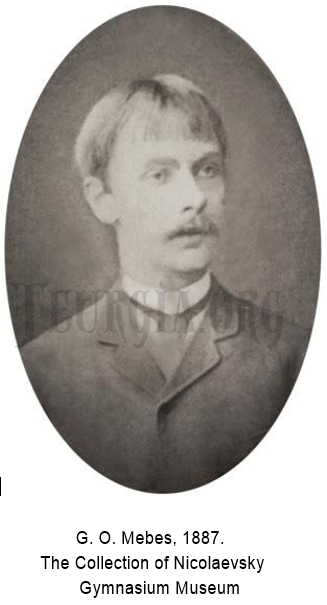
G.O. Mebes
Dates: 1868–1930? Domain: Western Esotericism, Tarot, Occultism
Biography
Grigory Ottonovich Mebes was born in 1868 in Russia, of Baltic German descent. He moved in the pre-revolutionary esoteric circles of Saint Petersburg — a milieu shaped by French occultism (Lévi, Papus) and by the Martinist Order, to which Mebes was affiliated. Around 1911–1912, he delivered his Kurs entsiklopedii okkultizma (Course of the Encyclopaedia of Occultism) as a lecture series in Saint Petersburg. He published under the initials G.O.M. The lectures did something no prior Tarot commentator had attempted at that scale: they used each of the 22 Major Arcana as the organizing principle for an entire domain of esoteric knowledge. Arcanum I governed will and the active principle; Arcanum II governed binary logic, receptivity, and the concept of the arkanum itself; and so on through all twenty-two, constructing a complete encyclopedic edifice from Tarot's symbolic architecture.
Mebes' method was structural. He relied on a ternary logic — thesis, antithesis, neutralization — as the fundamental operation of esoteric reasoning, applying it recursively across numerology, astrology, alchemy, and Kabbalah. This distinguished him sharply from the French divinatory tradition descending from Etteilla, which treated the cards as instruments of fortune-telling. For Mebes, divination was a degradation of the Arcana's philosophical function. The cards were not oracles. They were keys — each one opening a systematic domain of knowledge.
The Russian Revolution destroyed the milieu in which Mebes worked. The Soviet state dismantled esoteric organizations, arrested occultists and Freemasons, and severed an entire tradition of Tarot scholarship and initiatic practice. Mebes was likely arrested in the late 1920s during these persecutions. The exact date and circumstances of his death remain uncertain — the question mark after "1930" reflects the best scholarly estimate that he perished in Soviet camps or was executed around that time. His work survived him, but the living context of Russian esoteric pedagogy in which it was delivered did not.
Key Works (in library)
| Work | Year | Relevance |
|---|---|---|
| The Course of the Encyclopaedia of Occultism (Russian) | c. 1912 | The complete Arcane Course: each Major Arcanum structures a lecture on a domain of occult knowledge |
| Tarot Majors | — | English-language treatment of the 22 Major Arcana |
| Tarot Minors | — | Treatment of the 56 Minor Arcana |
Role in the Project
Mebes and Tomberg form the project's two primary lenses for reading the Major Arcana. Mebes provides the systematic-encyclopedic framework: what each Arcanum governs, how it relates to adjacent Arcana through ternary logic, what domain of esoteric knowledge it organizes. Tomberg provides the contemplative-phenomenological framework: what each Arcanum reveals when held in sustained meditative attention, what it discloses about the relationship between human consciousness and spiritual reality.
The two approaches are not redundant. Mebes maps the architecture; Tomberg inhabits it. The project needs both — the structural grammar that makes the Tarot legible as a coherent system, and the meditative depth that makes individual Arcana productive as starting points for thought. Where the project traces the Tarot's function as an instrument of esoteric pedagogy, Mebes is the primary source. Where it traces the Tarot's function as a vehicle for contemplative practice, Tomberg takes precedence.
Key Ideas
-
The Arcanum as encyclopedic key: Mebes does not treat the Major Arcana as isolated symbols to be interpreted one at a time. Each Arcanum functions as the organizing principle for an entire domain of esoteric knowledge. Arcanum I governs will, the active principle, and the metaphysics of beginnings. Arcanum V governs religion, hierarchy, and the pentagrammatic structure of the human being. The card is not a picture to be decoded — it is a key that opens a systematic field of inquiry. This is what separates Mebes from both the divinatory tradition (which reads cards as messages) and the contemplative tradition (which reads cards as meditation objects). For Mebes, the card is a structural principle.
-
Ternary logic: The fundamental logical operation in Mebes' system is the ternary: thesis, antithesis, neutralization. This is not Hegelian dialectic, though the formal resemblance is obvious. Mebes' neutralization does not produce a higher synthesis that subsumes the prior terms — it produces a third principle that holds the binary in active tension. The ternary governs how Arcana relate to each other (every three cards form a ternary group), how concepts within a single Arcanum interrelate, and how the student is meant to think. Binary logic — either/or — is, in Mebes' framework, the mark of incomplete understanding. The trained esotericist thinks in threes.
-
The Tarot as initiatory curriculum: Mebes treats the sequence of 22 Major Arcana as a complete course of instruction, ordered to guide the student through progressive stages of esoteric knowledge. The sequence matters: earlier Arcana establish principles that later Arcana presuppose. This is a pedagogical architecture, not a symbolic gallery. You do not browse. You proceed. The student who has not grasped the ternary structure of Arcanum I lacks the conceptual equipment for Arcanum IV. This curricular logic is one of Mebes' sharpest points of contrast with Tomberg, who treats each Arcanum as a self-contained starting point for meditation — each containing the whole in miniature, each approachable independently.
Connections
- Influenced by: Eliphas Lévi (French occult tradition), Papus (Gérard Encausse), Louis Claude de Saint-Martin (Martinism)
- Influenced: FIG-0031 Tomberg (who inherited and transformed the Arcana framework), Russian esoteric circles
- In tension with: FIG-0031 Tomberg (methodological, not personal — Mebes' systematic-encyclopedic approach vs. Tomberg's contemplative-phenomenological approach; see REL-0136); the divinatory tradition descending from Etteilla, which Mebes regarded as a degradation of the Arcana's philosophical function to fortune-telling
Agent Research Notes
[AGENT: cursor | DATE: 2026-03-25] Scaffolded as part of Tarot Major Arcana KB expansion. Body population pending via prompt relay to Claude Code. Death date uncertain — Mebes likely perished in Soviet purges c. 1930. Published under initials G.O.M. Three LIB entries in library: LIB-0053 (Russian edition), LIB-0054 (Majors), LIB-0055 (Minors).