← Essays

Source Essay

The Gods Withdraw, the Humans Burn

The four plays in Euripides I — Alcestis, Medea, The Children of Heracles, Hippolytus — document a theological crisis at the heart of fifth-century Athens. The gods are present but no longer reliably aligned with human meaning. The essay reads Euripides as a seismograph of the early Hardening: the moment participatory consciousness begins to crack.


I. The Youngest Tragedian
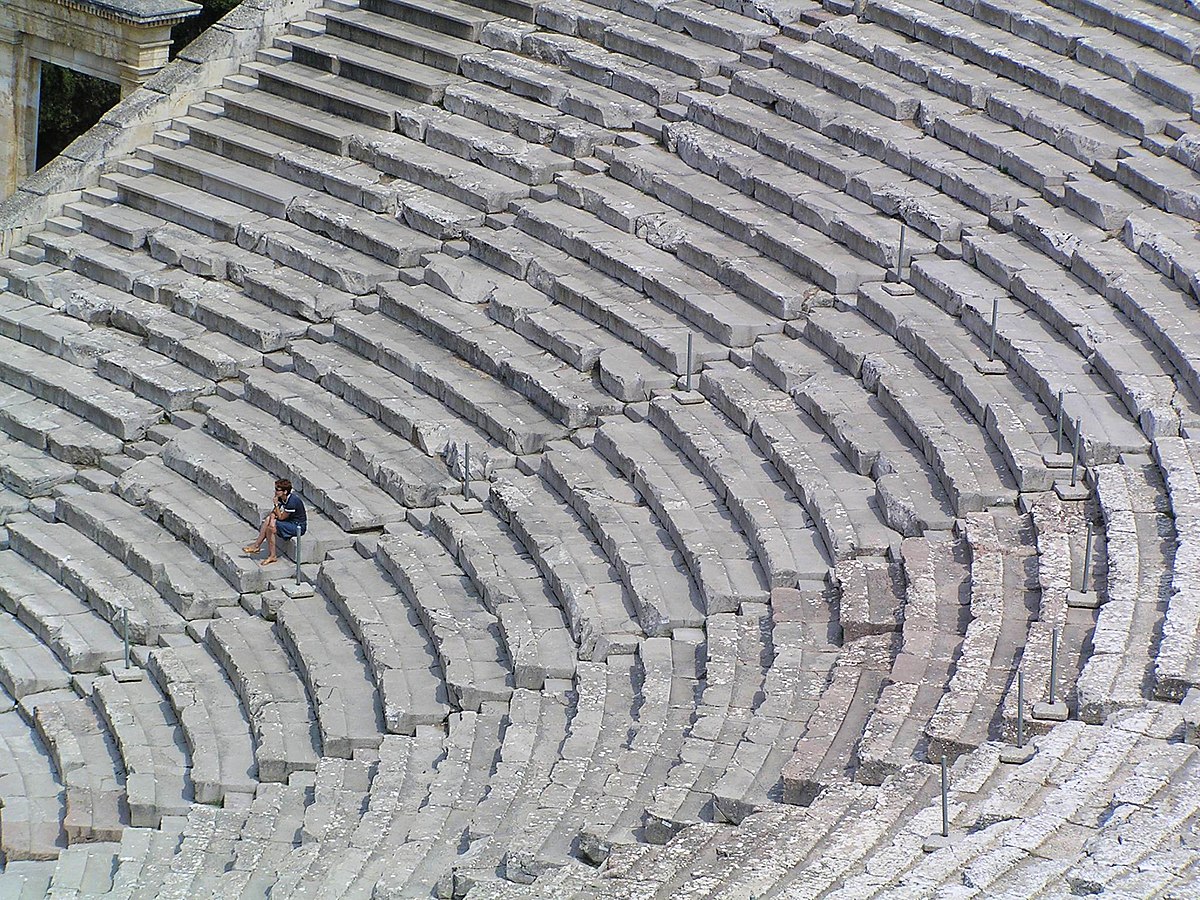
Theater at Epidaurus (Wikimedia) — the best-preserved ancient Greek theater. Epidaurus captures the architectural scale and acoustic precision of the space where Euripides broke the tragic form

Euripides was born around 480 BCE, the year of Salamis, the sea-battle that secured Athens's survival and launched its imperial century. By the time he began producing tragedies in the 450s, the Athenian theater was already a mature institution with fixed conventions: mythic plots sung by choruses and resolved by divine intervention. Aeschylus had established the form. Sophocles had perfected it. Euripides broke it open.

The four plays in this volume (Alcestis, Medea, The Children of Heracles, Hippolytus) span roughly 438 to 428 BCE, the early and middle period of a career that would produce some ninety plays, of which eighteen survive. They are not Euripides's most famous works (the Bacchae holds that distinction for this project), but they are the plays where his distinctive signature first becomes unmistakable: the gods are present but unreliable, the heroes are damaged, the women carry the dramatic weight, and the audience is denied the clean resolution that catharsis (CON-0043) traditionally requires.


II. Alcestis and the Debt That Cannot Be Paid
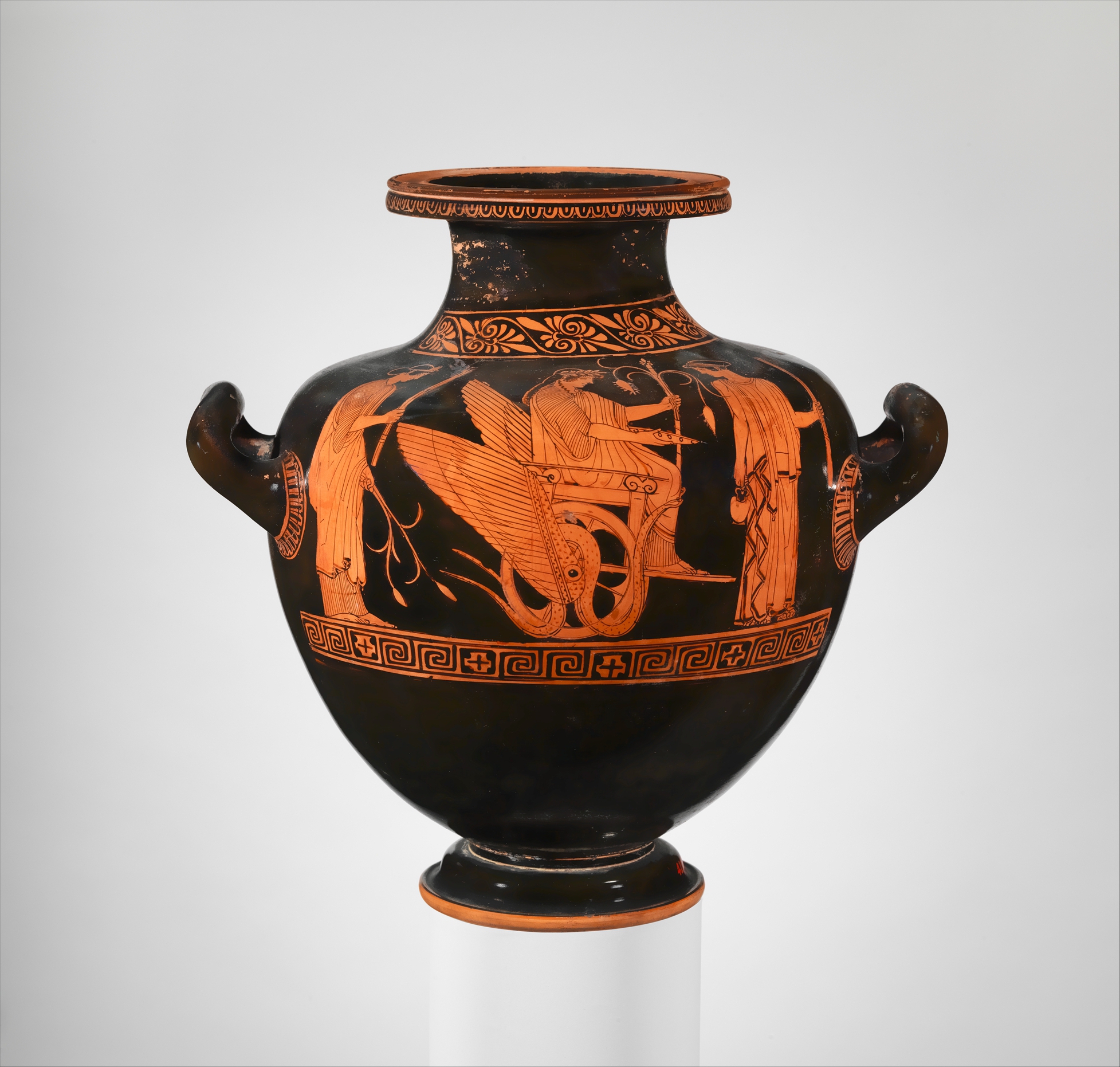
Eleusinian hydria (Met, ca. 460–450 BCE) — a ritual vessel from the same decade as the Alcestis (438 BCE). The Eleusinian mythology of the woman who descends to death and returns is the template Euripides draws on and subverts: Alcestis comes back silent, veiled, changed

Alcestis occupies a strange generic position: the fourth play in its original tetralogy, the slot usually reserved for a satyr play, comedy after tragedy. It is neither. Admetus, king of Pherae, has been granted a privilege by Apollo: when his fated day of death arrives, he may live if someone volunteers to die in his place. Everyone refuses: parents, friends, the whole court. Everyone except Alcestis, his wife.

She dies. The household mourns. Heracles arrives and gets drunk at the funeral feast, oblivious. When he learns the truth, he wrestles Death at the tomb and brings Alcestis back. On the surface, the play resolves. Wife restored, husband preserved, the bonds of guest-friendship honored. But Euripides has planted a question the resolution cannot answer. Admetus, watching his wife die for him, realizes that surviving her death is worse than dying himself. "I see it now," he says. "Too late." He has purchased life at a cost that makes life unbearable.

This is not a moral fable about selfishness. It is a diagnosis of a specific failure of consciousness. Admetus understood death as a problem to be solved, a transaction in which a substitute could be arranged. He treated the sacred boundary between life and death as negotiable. The play reveals that it is not. Alcestis's return does not undo the revelation. She comes back veiled and silent. She will not speak for three days. The woman who returns from the dead is not simply the woman who left. Something has changed that festive resolution cannot repair. Euripides gives his audience the happy ending and then shows them that the happy ending is not enough.


III. Medea and the Failure of Containment
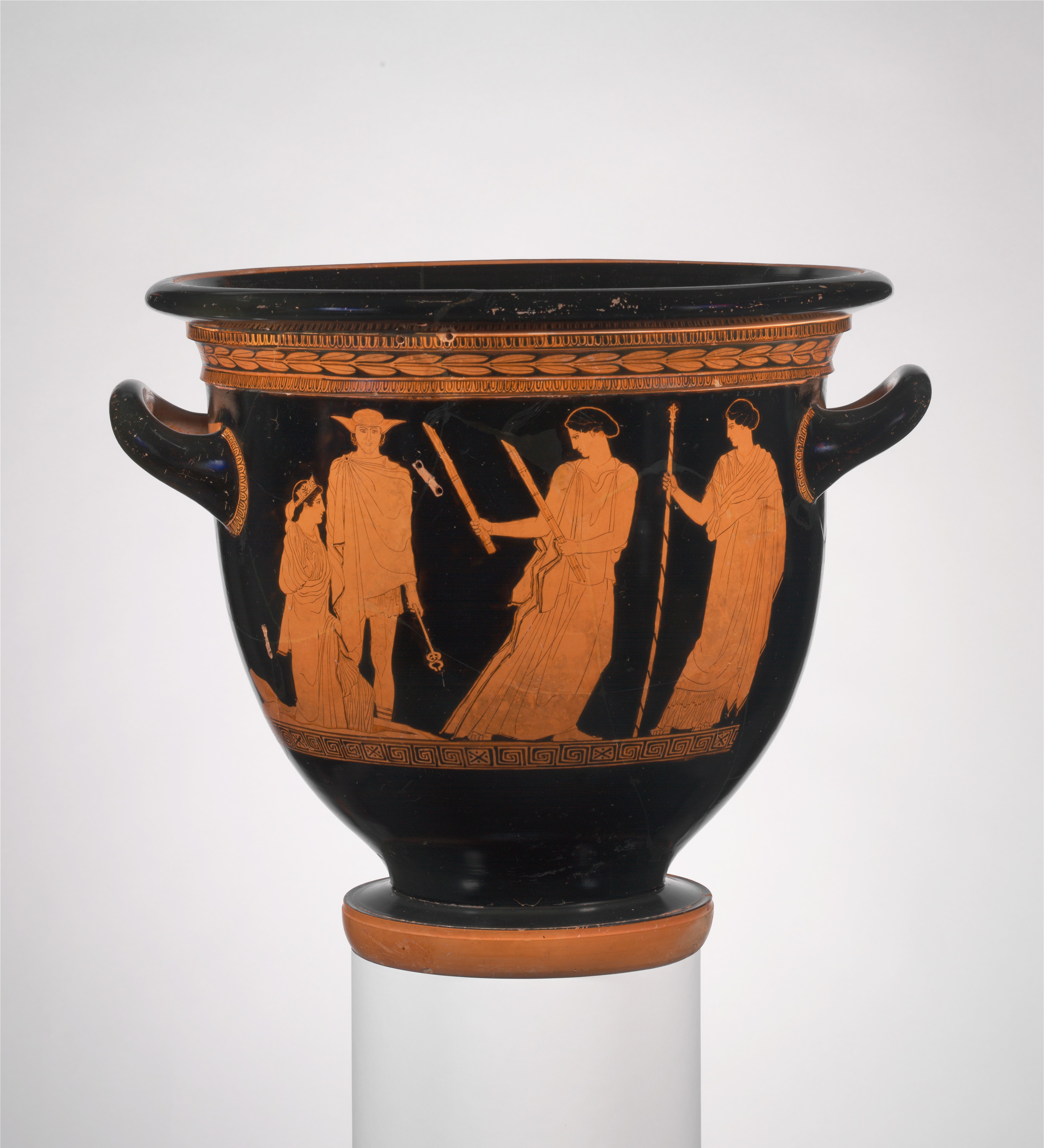
Eleusinian bell-krater (Met, ca. 440 BCE) — from the same decade as the Medea (431 BCE). The ritual vessel represents the initiatory container that should have held Medea's power. Medea is the pharmakon uncontained — initiatory knowledge severed from architecture

Medea is the most disturbing play in the Greek tragic canon. Medea, the foreign sorceress who helped Jason obtain the Golden Fleece, has been abandoned by him in Corinth. He is marrying the king's daughter for political advantage. Medea, barbarian, female, displaced, has no legal standing and no recourse. She kills Jason's new bride, the bride's father, and her own two children. Then she escapes in the chariot of the Sun, her grandfather, ascending above the stage while Jason screams below.

The play's horror is not the violence. Greek tragedy is full of violence. The horror is that Euripides makes Medea's logic intelligible. She is not mad. She calculates. She knows exactly what the murder of her children will cost her. "I understand what evil I am about to do," she says, "but my thymos is stronger than my counsels." Thymos (spirit, passion, the seat of rage and honor) overrides bouleumata, deliberation. The play stages the catastrophe that occurs when a consciousness contains powers it cannot integrate.

For the project's purposes, Medea is a document of what happens when the ritual container fails. Medea is a priestess of Hecate, trained in the pharmaka: drugs, herbs, poisons, the ambiguous substances that heal or kill depending on dosage and context. She is, in the project's terms, an initiate whose initiatory knowledge has been severed from its proper context. Displaced from Colchis and betrayed by the man for whom she used her arts, stripped of every social bond that might contain her power, she becomes the pharmakon uncontained: transformation without direction, power without architecture. The children die because there is no structure left to hold what Medea carries.


IV. Hippolytus and the God Who Destroys What He Demands
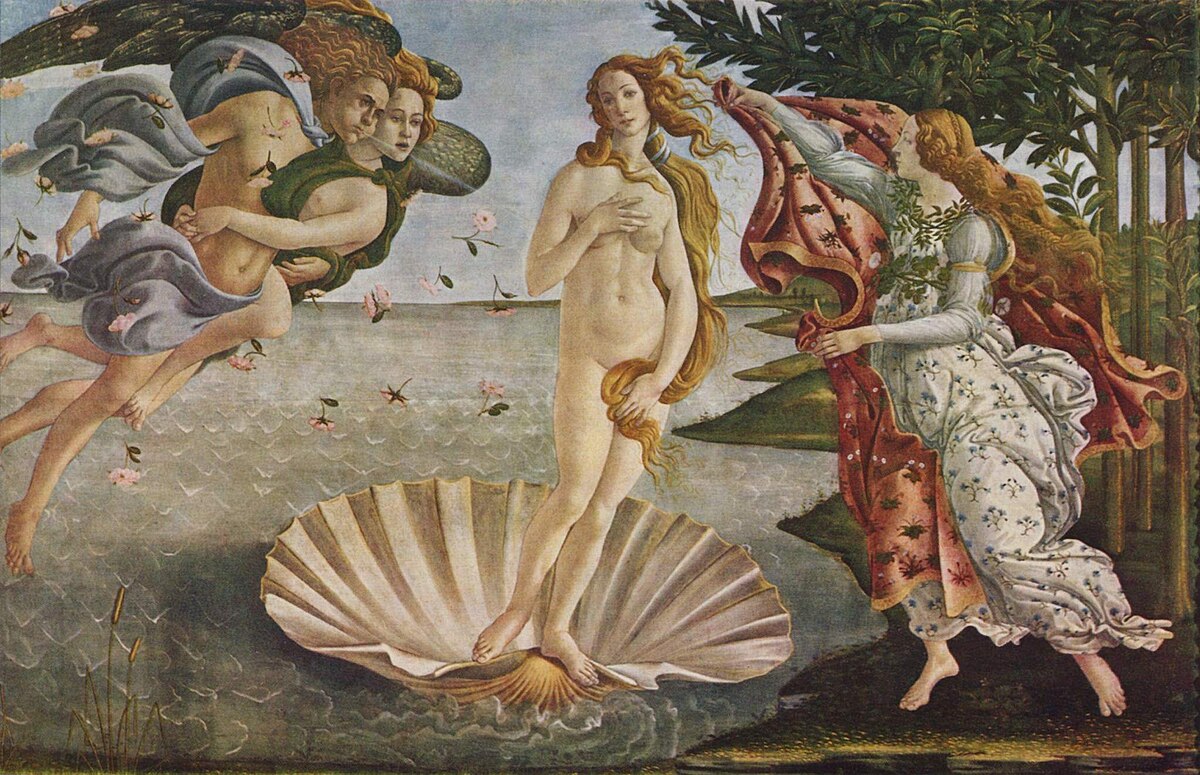
Botticelli, Birth of Venus (Uffizi) — Aphrodite in her full emergence. Hippolytus denied that she existed in him. Showing the goddess in her overwhelming beauty rather than the destruction she causes is a statement about what was refused

Hippolytus is the play in this volume most directly relevant to the mystery traditions. Hippolytus, son of Theseus, has devoted himself entirely to Artemis, goddess of the hunt, of virginity, of the wild. He refuses Aphrodite. Not politely. Contemptuously. He will not acknowledge her power. He will not sacrifice at her altar. He considers erotic desire a contamination.

Aphrodite destroys him for it. She causes his stepmother Phaedra to fall catastrophically in love with him. Phaedra, ashamed, kills herself and leaves a note accusing Hippolytus of rape. Theseus curses his son. Poseidon sends a bull from the sea. Hippolytus is dragged to death by his own horses. Artemis appears at the end to explain what happened, to comfort the dying Hippolytus, and then, in one of the most devastating lines in Greek tragedy, to leave. "It is not lawful for me to look upon the dead," she says. "I see that you are near that moment now. Farewell."

The play's theological structure is precise. Hippolytus's error is not that he chose chastity. It is that he chose one god against another. He elevated Artemis by denigrating Aphrodite. In the Greek religious world, this is not piety but hubris, because the divine powers are real, and refusing to acknowledge a real power does not make it disappear. It makes it destructive. Aphrodite does not punish Hippolytus for failing to love her. She punishes him for denying that she exists in him.

The initiatory reading is direct. The mystery traditions insisted on wholeness: the initiate cannot choose which gods to face. The terrifying and the erotic are as real as the luminous. Hippolytus's exclusive devotion to the virginal, the wild, the uncontaminated is itself a form of contamination: the refusal to integrate what is dark, embodied, and desirous. Catharsis (CON-0043) in its original ritual sense requires confronting the full range of what the soul contains. Hippolytus refuses the confrontation. The play is the consequence.


V. Where the Gods Stand
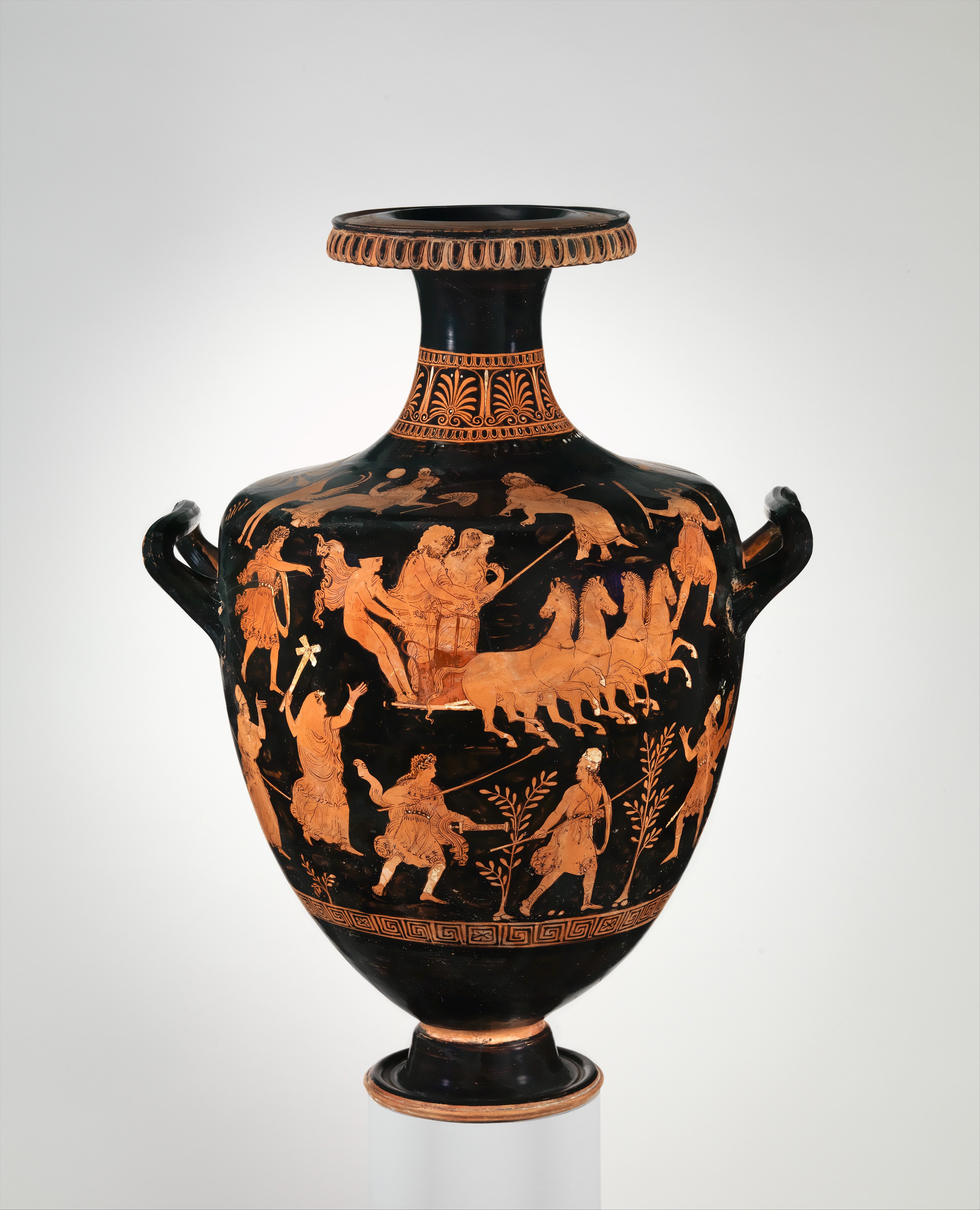
Eleusinian hydria (Met, ca. 340–330 BCE) — a vessel from a century after Euripides, from the world that inherited his theological crisis. The mysteries continued, the gods remained, but the consciousness that could meet them without mediation had begun to crack

What unites these four plays, and what makes Euripides essential for the project, is a theological question more radical than anything in Aeschylus or Sophocles. In Aeschylus, the gods are terrible but just. The Oresteia ends with a new cosmic order. In Sophocles, the gods are inscrutable but their oracles are reliable. Oedipus fulfills his fate precisely because every attempt to avoid it drives him toward it. In Euripides, the gods are present, powerful, and not reliably on the side of human meaning.

Aphrodite destroys Hippolytus and Phaedra to settle a personal slight. Apollo saves Admetus through a bargain that makes Admetus's life unlivable. Hera and Athena do nothing for Medea's children. The divine machinery operates, but it does not produce justice or wisdom. It produces consequences. The gods are forces (real, impersonal in their operations, devastating in their intersection with human lives), and Euripides refuses to soften this into a morally consoling frame.

This is the consciousness shift the project needs to register. Between Aeschylus (born c. 525 BCE) and Euripides (born c. 480 BCE), something has changed in the Greek mind's relationship to the divine. The participatory consciousness that experienced the gods as present and legible has not disappeared, but it has become strained. Euripides still believes in the gods (his plays make no sense without real divine agency), but he no longer trusts that divine agency and human flourishing are aligned. The gods withdraw not by disappearing but by becoming unintelligible.

This is the early tremor of what Barfield calls the loss of participation and what the project calls the Hardening. The gods are still there. The rituals still operate. But the consciousness that could undergo catharsis and feel genuinely restored has begun to crack. Euripides registers the crack. He does not cause it. He does not celebrate it. He stages it, unflinchingly, in plays that deny the audience the resolution tragedy traditionally provides.

For the listener encountering these plays for the first time: read them as seismographs. They record the first vibrations of a centuries-long shift: the gods ceasing to carry intelligibility and becoming, instead, problems to be solved. The mystery traditions existed, in part, to hold this shift at bay, to maintain the participatory encounter with the divine that ordinary consciousness was beginning to lose. Euripides shows us what it looked like when the holding began to fail.

More Essays

What Happened Inside the Mysteries

The founding long-form essay of the Mystery Schools project: an imaginative synthesis of classical archaeology, consciousness evolution, neuroscience, and Western esotericism.

Dear Unknown Friend

A reading essay on Valentin Tomberg's Meditations on the Tarot, moving through concentration without effort, analogy, the Hermit's neutralization of binaries, the scientific creed, and anonymous transmission.

The Cartographer's Blind Spot

Eliade's Rites and Symbols of Initiation gave the modern West its most influential map of initiatory structure. This essay engages both the power and the limitation of his comparative method, asking what the tripartite schema reveals about consciousness transformation and where its universalizing impulse becomes a cage that obscures the very phenomena it describes.

The Sober Witness

Burkert's Ancient Mystery Cults is the foremost empirical account of what the five major mystery traditions actually looked like. This essay engages his insistence on institutional specificity and ritual mechanics, honors his refusal to romanticize, and asks the question his method forbids: not what were the mysteries, but what did they do to consciousness?

The Garment and the Stage

Barfield's Saving the Appearances is the single most important theoretical text for the Mystery Schools project. This essay engages his argument that perception itself has a history, that the ancient world was not a stage but a garment, and that the trajectory from original participation through the hardening points toward a final participation that the mystery traditions may have anticipated.

The Oath and the Roses

The only Latin novel to survive complete from antiquity is also the single most important first-person account of mystery initiation. Apuleius's Golden Ass enacts in narrative form the arc the project traces across all traditions: degradation through unprepared contact with the sacred, descent into embodied helplessness, and restoration through the goddess who moves first.

The Architecture of Descent

Dante's Commedia enacts the full initiatory structure that the project traces across all traditions: descent through death, purification through ordeal, ascent to direct vision. The essay reads the poem not as medieval theology set to verse but as evidence that the katabasis-anabasis pattern survived as a living architecture of spiritual experience long after Eleusis fell.

The Golden Bough and the Weight of History

Virgil's Aeneid contains the most sustained literary katabasis in Latin literature and the direct predecessor to Dante's Commedia. Unlike Odysseus or Orpheus, Aeneas descends not for personal gain but to receive the burden of history. The essay reads Book VI as initiatory architecture and the Gate of Ivory as a warning about the gap between vision and record.

The Rage and the Recognition

The Iliad is not an initiation narrative. It is the poem that establishes what consciousness looks like before initiation: the heroic mode, brilliant and lethal, cracked open by grief into something the heroic code cannot contain. Achilles's recognition of Priam as human father is the metanoia that makes the Odyssey's initiatory journey necessary.

The Dead Who Know the Way Home

The Odyssey is the oldest surviving initiation narrative in Western literature. Its deep structure follows the initiatory pattern centuries before the mystery cults formalized it: separation, ordeal, encounter with death, transformed return. Book XI's nekuia is the first literary katabasis, and the poem's implication is that the initiatory structure was already active in Greek consciousness at the earliest recorded moment.

The God Who Went Down Laughing

Aristophanes's Frogs is the only surviving ancient text that stages a complete katabasis as comedy. Dionysus descends to Hades to fetch a dead tragedian, and the play's laughter is not incidental to the initiatory structure but part of it. The essay reads Frogs as evidence that the Mysteries and the theater were twin Dionysian institutions.

The First Naming of What Is

Hesiod's Theogony is the first systematic cosmogony in the Western tradition — a genealogy of the gods that doubles as a logic of how reality differentiates from primordial openness through grounding and generation. Works and Days preserves the earliest Greek myth of the Five Races, a decline narrative the project reads as testimony about the loss of original participation.

The Invisible Fraternity and Its Visible Historian

Waite's 1924 history is the most thorough English-language account of the Rosicrucian movement, written by a scholar who was also an initiate. The essay reads it as evidence for the egregore phenomenon: the power of an initiatic aspiration to generate real institutions even when no original institution can be documented.

The Book That Unsays Itself

The Tao Te Ching opens with an act of philosophical self-cancellation: the Dao that can be spoken is not the constant Dao. The essay reads the text as the Daoist form of participatory consciousness, where wu wei (action without force) is the Eastern counterpart to what the Western mystery traditions reach through initiation and descent.

The Battlefield and the Chariot

The Gita begins with a warrior's refusal to fight and unfolds into the Indian tradition's most concentrated instruction on action, knowledge, and devotion. The essay reads the three yogas as the explicit form of what the Western mystery traditions perform implicitly, and Krishna's cosmic vision as the Indian epopteia.

The Teaching at the Foot of the Teacher

The Upanishads are the philosophical summit of the Vedic tradition and the Eastern counterpart to the Eleusinian Mysteries: both claim that direct experiential knowledge of ultimate reality transforms the knower. The essay reads the Katha Upanishad's descent to Death as structural katabasis and the Upanishadic epistemology as participatory knowing.

The Analyst in the Telesterion

Von Franz reads Apuleius's Golden Ass as a map of individuation rendered in narrative form before Jung existed to name the process. The donkey is the shadow swallowing the ego whole; Psyche's descent is the anima's own differentiation; Isis is the Self arriving when the ego has been sufficiently dissolved. The project takes this psychological architecture and asks the question von Franz's method cannot: whether the territory the psyche maps is merely internal.

The River Has No Teacher

Hesse's 1922 novel stages the most radical claim a spiritual narrative can make: that the greatest teacher in the story is wrong — not in what he knows, but in the assumption that what he knows can be transmitted through doctrine. Siddhartha walks away from the Buddha and into the world, and the novel follows what happens when a consciousness must descend into lived experience because no teaching can substitute for it.

The Diagnosis That Outlived Its Doctor

René Guénon's 1927 polemic is the Traditionalist diagnosis of modernity as the Kali Yuga, an age that has not lost the hierarchy of knowledge but inverted it. The essay reads the book as the ground on which the counter-initiation concept later stands, weighs its diagnostic power against its anti-historical exclusivism, and follows the dangerous political afterlife of Traditionalism from Evola to Dugin.

The Borrowed Name and the Brilliant Darkness

An anonymous Syrian monk, writing around 500 CE under the stolen name of an apostle's convert, smuggled a body of Neoplatonic mysticism into Christian orthodoxy. The essay reads the Dionysian corpus as the moment mystery-school metaphysics changed clothes, traces its apophatic core — the "brilliant darkness" of unknowing, and follows its underground passage into the Western contemplative tradition from Eriugena to Eckhart.

The Work the Mind Cannot Do

Iamblichus wrote On the Mysteries around 300 CE as a reply to Porphyry's skeptical letter on the value of ritual, signing it with the mask of an Egyptian priest. The essay reads the book as the founding defense of theurgy: the argument that a fully descended soul cannot think its way back to the divine, and that the ascent must be completed by god-work performed in matter, the Mysteries carried forward in philosophical form.

The Flight of the Alone

The Enneads collect Plotinus's treatises on the One, Intellect, and Soul, and on the soul's descent into matter and its return. The essay reads Plotinus as a practitioner rather than a theorist, a philosopher who reported union with the One from experience, and sets his contemplative ascent against Iamblichus's theurgy, while weighing the real convergence between henosis and the Vedantic identity of atman and brahman.

The Faculties That Slumber

How to Know Higher Worlds is Rudolf Steiner's practical manual of modern initiation: a step-by-step discipline of reverence, thought-control, and moral training that he printed openly, for an individual to walk alone. The essay reads it as the operative tradition's modern manual, the clearest account of what initiation had to become to survive into a consciousness with a free, self-aware ego.

The Doctrine Behind the Doctrines

The Secret Doctrine is the most ambitious synthesis in modern esoteric literature: Blavatsky's claim of one lost wisdom-tradition behind all religions, science, and philosophy. The essay reads it as both a real bridge, the route by which Eastern concepts entered Western consciousness, and a cautionary mirror of the project's own synthetic method when ambition outruns rigor, transparency of sources, and the discipline of distinction.

0:00
0:00